Making money from YouTube Shorts really boils down to one thing: getting into the YouTube Partner Program (YPP). Once you're in, you get a piece of the ad revenue that runs in the Shorts feed. The first hurdle is hitting the magic numbers: 1,000 subscribers and 10 million valid Shorts views in the last 90 days.
How YouTube Shorts Monetization Actually Works
So, how does the money actually get from an advertiser to your pocket? It's not as simple as the ads you see on long-form videos. Shorts use a shared revenue model, which is a bit different but absolutely crucial to understand if you want to make a real income.
First, let's talk scale. YouTube Shorts are a juggernaut, pulling in a staggering 90 billion daily views. That's a massive audience, and getting a piece of that action starts with qualifying for the YPP.
The Two Paths to Monetization
The good news is there are a couple of ways to get into the YPP. You only need to qualify through one of these routes.
Here's a quick breakdown to see which path makes the most sense for you:
YouTube Partner Program Eligibility for Shorts Creators
| Requirement | Shorts Creator Path | Traditional Path |
|---|---|---|
| Subscribers | 1,000 | 1,000 |
| Performance Metric | 10 million valid public Shorts views | 4,000 public watch hours on long-form videos |
| Timeframe | Within the last 90 days | Within the last 12 months |
As you can see, if you're all-in on Shorts, the first path is your most direct route. But if you mix in longer videos, you can still qualify the old-fashioned way.
Once you’re approved for the YPP, don't forget the final, critical step: you have to go into your YouTube Studio and accept the "Shorts Monetization Module." If you skip this, your Shorts won't earn a dime, even if you're officially a partner.
The Ad Revenue Sharing Model Explained
Alright, let's follow the money. The process is a four-step journey designed to pay everyone involved, from creators to music publishers.
First, YouTube bundles up all the money made from ads that appear between videos in the Shorts feed. Think of this as one giant pot of cash.
Before creators get paid, YouTube uses some of that money to cover music licensing fees. This is actually a huge plus for us. It means you can use popular, trending songs from YouTube's library without getting hit with copyright claims. What's left over after the music is paid for becomes the Creator Pool.
This flowchart gives you a great visual of how the money moves.
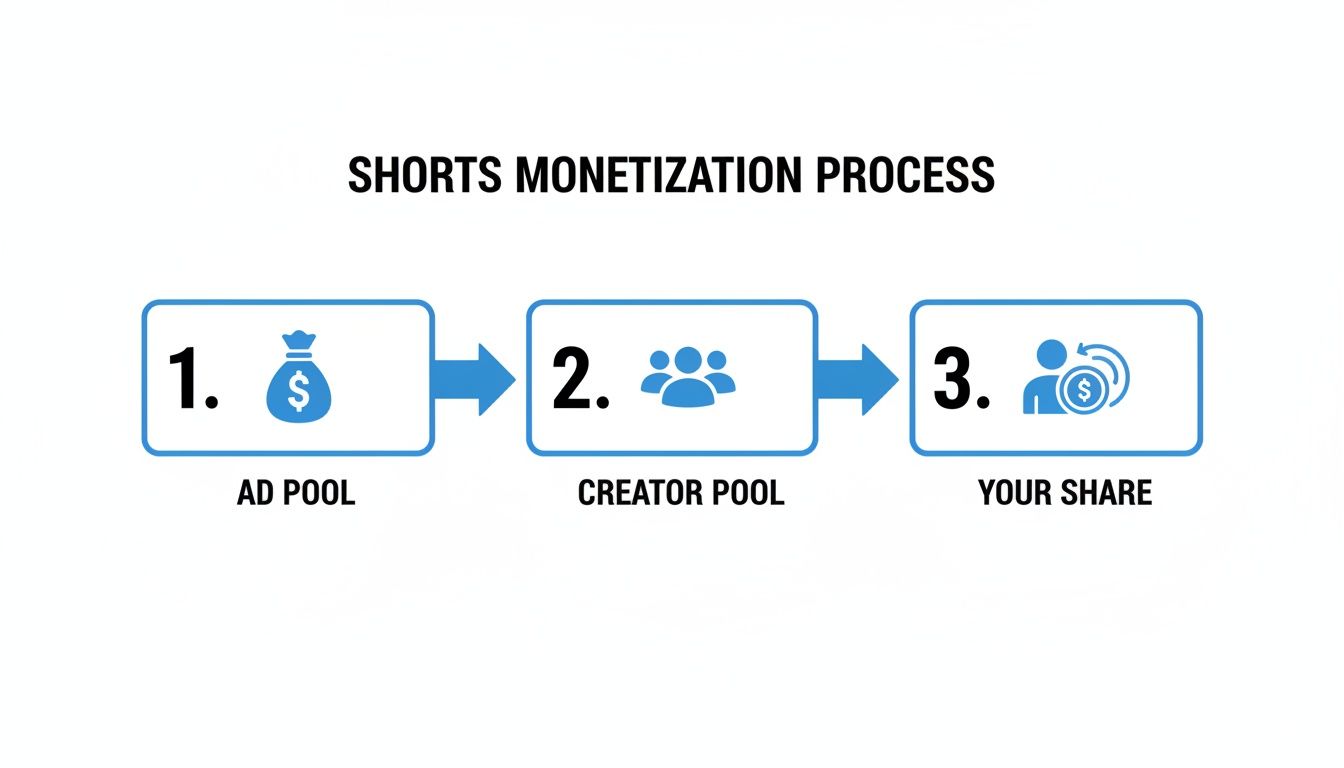
From there, the Creator Pool is divided up among all monetizing creators. Your share is determined by how many views your Shorts got compared to the total views of all monetized Shorts in your country.
Let's say your videos accounted for 1% of all eligible Shorts views this month. You'll get 1% of the money from the Creator Pool. From that allocation, you keep a 45% share, and YouTube takes the rest. For a deeper dive into the mechanics of ad costs, understanding the cost per impression formula is a great place to start.
Key Takeaway: Your earnings aren't tied to a specific ad that ran next to your Short. It’s all about your slice of the total viewership pie.
This system rewards consistency and high performance. The more views you rack up, the bigger your piece of the pie gets. To get a better idea of what those numbers might look like, we've broken down the potential income in our guide on how much YouTube Shorts pay for 1 million views.
Squeezing More Juice From Your Shorts: How to Maximize Your Earnings
Getting into the YouTube Partner Program is a massive win, but let's be real—it's just the starting line. Now the real work begins. You've got to shift your mindset from just chasing views to attracting the right kind of views that actually pad your bank account.
It all comes down to the first two or three seconds. That’s all the time you have to stop someone mid-scroll. If you can’t nail the hook, nothing else you do in the video matters. A strong hook is your number one tool for boosting revenue because it drives up watch time and retention—the very signals that tell YouTube's algorithm, "Hey, show this to more people!"
The Art of the Scroll-Stopping Hook
A killer hook doesn't just grab attention; it plants a question in the viewer's mind that they absolutely have to see answered. Forget the "Hey guys, welcome back" intros. You need to drop them right into the action or hit them with a statement they can't ignore.
Here are a few of my go-to techniques:
- The Problem Hook: Call out a pain point they know all too well. A finance creator could open with, "You're literally burning hundreds of dollars every month and you have no idea."
- The Curiosity Hook: Show the amazing result before you explain how you got there. Think of a cooking Short that opens with a perfect avocado rose and text that reads, "I promise this is way easier than it looks."
- The Contrarian Hook: Go against the grain in your niche. A fitness coach might say, "If you actually want abs, you need to stop doing crunches right now."
These simple shifts get people to stick around, which is crucial for getting their view to count. For a deeper dive, our guide on how to make viral Shorts on YouTube is packed with templates you can steal.
Target High-RPM Niches and Locations
Here’s a hard truth: not all views are worth the same amount of money. The cash you earn per thousand views, your RPM (Revenue Per Mille), can swing wildly based on your topic and who’s watching.
Some niches are simply goldmines because advertisers are tripping over themselves to reach those audiences.
Pro Tip: I've consistently seen the highest RPMs in niches like personal finance, technology, business, and real estate. A single view on a Short about stock trading can be worth 10x more to an advertiser than a view on a funny cat video.
Where your viewers live is just as critical. A view from someone in the United States, the UK, or Canada is generally worth a lot more because companies spend more on ads in those markets. You can't force people to watch from a specific country, but you can definitely make your content more appealing to them.
Keep these things in mind:
- Language: Sticking to English is the easiest way to reach a global, high-RPM audience.
- Culture: Weave in trends, references, and examples that resonate in those top-tier countries.
- Timing: Post your Shorts when people in those time zones are most likely to be scrolling.
Keep It Advertiser-Friendly
This part isn't glamorous, but it's non-negotiable. If you want to get paid, you have to play by YouTube's Advertiser-Friendly Content Guidelines. Break the rules, and you risk getting your videos completely demonetized or hit with "limited ads," which absolutely tanks your income.
It’s not about censoring yourself; it’s about creating content that brands feel safe putting their ads on.
Here’s a quick mental checklist before you post:
- Is it safe? Avoid anything that looks dangerous, hateful, or like harassment.
- Is it clean? Tone down the profanity and steer clear of overly sensitive or inappropriate themes.
- Is it mine? Use music from YouTube's Audio Library or another royalty-free source. A copyright claim can send your hard-earned revenue straight to someone else.
By making content that people love and brands feel good about, you're not just making videos—you're building a reliable media asset. That's the secret to turning this Shorts thing into a long-term, sustainable business.
Looking Beyond Ad Revenue for Real Growth
Getting into the YouTube Partner Program is a huge win, but if you're only relying on Shorts ad revenue, you're leaving a ton of money on the table. Honestly, thinking of ad revenue as your primary income is like building a house with just one support beam—it's risky. The real path to a stable, long-term career as a creator is to build multiple streams of income.
These alternative methods can often dwarf what you make from the Shorts feed, turning your channel from a hobby into a legitimate business. This isn't just about making more money; it's about financial security. Ad revenue can be a rollercoaster, swinging wildly with algorithm tweaks and seasonal ad budgets. Building other income sources protects you from that unpredictability.
Landing Your First Brand Deal
For many creators, brand deals and sponsorships are where the real money is. Marketers are pouring money into short-form content because they know it works. They see the incredible engagement rates Shorts creators pull in—often 2.5 times higher than long-form videos—and they want a piece of that action.
And you don't need a million subscribers to get started. Brands are smarter now; they're actively seeking out micro-influencers with dedicated, niche audiences. What matters is that you can show you have a real connection with your viewers and can influence their decisions.
To get on their radar, you need a media kit. Think of it as your channel's resume. Keep it to a single page and include:
- Who You Are: A quick bio about you and what your channel is all about.
- Who You Reach: Your key audience stats (age, gender, top countries) straight from YouTube Analytics.
- Your Numbers: Subscriber count, average 90-day Shorts views, and your engagement rate.
- What You Offer: A simple menu of your services, like a dedicated Short, a 3-video package, or a bundle with an Instagram Reel.
Start by reaching out to brands that are a natural fit for your content. If you review budget tech, don't pitch a luxury watch company. Authenticity is non-negotiable. Keep your pitch email short, personalize it, and get straight to the point: explain the value you can bring to their audience.
The Power of Affiliate Marketing
Affiliate marketing is a brilliant way to build up some passive income. The concept is dead simple: you promote a product you actually use and love, and you earn a commission whenever someone buys it through your unique link. It’s far less intimidating than pitching a brand deal, and you can start doing it from day one.
The best spots for affiliate links are in your Shorts description and, even better, a pinned comment. Don’t just drop a link and run. Write an engaging comment that adds context. For example, a fitness creator might pin: "This is the exact protein powder I use to hit my goals every day! You can grab some here:" followed by their affiliate link.
Key Insight: The golden rule of affiliate marketing is to only recommend products you genuinely stand behind. Your audience trusts your judgment. Promoting a garbage product for a quick commission will burn that trust to the ground, and you'll never get it back. Always be transparent and disclose that your links are affiliate links.
Selling Your Own Products
This is the level-up moment—when you go from being just a creator to a true entrepreneur. Selling your own stuff, whether it's physical merch or digital products, gives you total control over your brand and your income. It also forges a much deeper bond with your most loyal fans who are eager to support you directly.
You generally have two options here:
- Physical Merchandise: We're talking t-shirts, mugs, hats, or phone cases featuring your logo or an inside joke from your channel. Platforms like Spring (formerly Teespring) or Fourthwall make this super easy, integrating with YouTube so your shop appears right under your videos.
- Digital Products: This is where the margins are incredible because there's virtually no overhead. A travel creator could sell their custom video editing presets. A personal finance channel could offer a downloadable budget template. A gaming creator could sell a detailed guide for a tough level.
The trick is to create something that solves a real problem or provides genuine value to your audience. This cements your authority in your niche and creates a revenue stream that is 100% yours. If you're looking for inspiration, it's worth exploring the different methods of turning video clipping into income, as these ideas can spark great product concepts and even streamline your workflow.
To help you decide where to focus your energy, here’s a quick comparison of how these different monetization streams stack up against each other.
Monetization Methods At a Glance
| Method | Income Potential | Setup Effort | Best For |
|---|---|---|---|
| Brand Deals | High | Medium | Channels with a focused niche & engaged audience. |
| Affiliate Marketing | Medium | Low | Creators who regularly use specific products. |
| Selling Products | Very High | High | Established creators with a loyal community. |
| YouTube Ad Revenue | Low to Medium | Low | All monetized creators as a baseline income. |
By weaving these strategies together, you create a much stronger and more resilient monetization system for your channel. Your ad revenue becomes a nice bonus, not the foundation you're desperately relying on. This is how you transition from making videos for fun into building a sustainable and profitable career.
Using Analytics to Scale Your Content and Income
If you want to turn your YouTube Shorts from a fun hobby into a real income stream, you have to stop guessing. The secret to scaling is making decisions based on data, not just vibes. Your YouTube Analytics dashboard is a treasure trove of information, showing you exactly what’s working, who’s watching, and where you should focus your energy.
A lot of creators obsess over vanity metrics like subscriber counts. While that number feels good, it doesn't directly put money in your pocket. You need to zero in on the metrics that actually drive your revenue and growth.
Key Metrics to Track for Shorts Monetization
When you jump into your analytics, these are the numbers that truly matter for your monetization strategy.
- Views: This is the big one. It's the base metric that determines your slice of the Creator Pool pie. Knowing which videos are getting seen is step one.
- Audience Retention: This shows you the average percentage of a Short people actually watch. High retention is a massive signal to the YouTube algorithm that your content is engaging, which in turn gets you more reach.
- Viewed vs. Swiped Away: Think of this as a real-time A/B test for your hooks. A high "Viewed" percentage means your first few seconds are doing their job and stopping the scroll. A low one means you're losing people before you even get started.
- RPM (Revenue Per Mille): This is your earnings per 1,000 views after YouTube takes its cut. Tracking RPM is crucial because it helps you spot which content topics and styles are the most valuable.
Once you start consistently checking these numbers, patterns will jump out at you. You might find your "how-to" Shorts pull in a way higher RPM than your comedy skits. Or maybe you'll see that Shorts under 30 seconds hold attention way better than those pushing the 60-second limit.
Your best-performing videos aren't flukes; they're your blueprint for success. Break them down—the hook, the topic, the editing, the audio—and figure out how to replicate that magic in your next batch of content.
Identify and Replicate Winning Formulas
Let's make this practical. Open your YouTube Studio, head to Analytics, and pull up your top 10 Shorts by views from the last 90 days. For each one, ask yourself:
- What did I do in the first three seconds to grab attention?
- Did I use a trending sound or a specific style of music?
- What was the core topic? Was it educational, funny, or shocking?
- How did it end? Was there a strong call-to-action or a satisfying loop?
You’ll start seeing the common threads. Maybe all your viral hits started with a bold text overlay or posed a question directly to the viewer. This data is your roadmap for creating more content that resonates and, as a result, earns more.
Thinking beyond just ad revenue, having a solid grasp on how to calculate marketing ROI helps you understand the bigger picture of your content's financial performance.
Scaling Your Production Workflow
Knowing what works is half the battle. The other half is figuring out how to produce more of it without burning out. Scaling is about working smarter, not harder. This is where you need an efficient workflow and the right tools.
A game-changing technique is content batching. Don't try to film one Short every single day. Instead, block off an afternoon and film 10 or 15 of them all at once. This gets you into a creative flow for filming, and then you can switch gears to editing later.
This is also where automation can seriously level up your output. Tools like Aicut are built for exactly this. You can upload a single long-form video—like a podcast episode or a detailed tutorial—and let the AI automatically find the juiciest, most shareable moments. It can turn that one video into a dozen or more Shorts, ready to go.
This approach doesn't just save you hundreds of hours. It ensures your Shorts are built around topics and ideas that you already know your long-form audience loves, giving them a much higher chance of success from the start.
Navigating YouTube Policies to Protect Your Income

Hitting that monetization milestone is a huge win, but the real challenge is keeping the revenue flowing. You have to play by YouTube's rules. One misstep can get you demonetized, shutting off your ad revenue instantly.
Think of these policies not as a list of "don'ts," but as a guide to building a channel with real, lasting value. Following them is just good business. The absolute foundation of this is YouTube's Advertiser-Friendly Content Guidelines. Brands pay to be seen next to safe, positive content, and violating that trust is the quickest way to kill your income.
What Does "Advertiser-Friendly" Actually Mean?
In simple terms, it means avoiding touchy subjects. If your content could make a big brand nervous, it's probably not advertiser-friendly. YouTube’s systems are always on the lookout for red flags, so it's smart to err on the side of caution.
These are the topics that will almost guarantee your Shorts get demonetized or slapped with limited ads:
- Inappropriate Language: Dropping f-bombs constantly or using hateful speech is out.
- Violence and Disturbing Imagery: This covers anything graphic, shocking, or meant to gross people out.
- Adult Content: Sexually suggestive or explicit themes are an immediate flag for the system.
- Harmful or Dangerous Acts: Content showing or encouraging dangerous stunts can jeopardize your entire channel.
Key Takeaway: Ask yourself this: Would a company like Coca-Cola or Nike be okay running an ad on this video? If there's any hesitation, it’s probably best to avoid it.
Walking the Copyright Tightrope with Music and Clips
Copyright is another minefield where so many creators trip up. Using music or clips you don't have the rights to is a fast track to a Content ID claim. When that happens, any ad money your video makes goes directly to the copyright owner, not you.
This is a huge deal for Shorts, where viral sounds and music are everything.
Thankfully, YouTube gives you a safe harbor. The YouTube Audio Library inside the Shorts creator is your best friend. Every track and sound effect in there is pre-cleared for you to use in your monetized content. When you use audio from this library, YouTube has already handled the licensing, so you can still collect your 45% revenue share.
Grabbing unedited clips from movies, TV shows, or other YouTubers is also a massive risk. You can't just re-upload someone else's work and expect to get paid; you're more likely to get a copyright strike.
The goal is always to be original. If you do use third-party material, you need to transform it completely by adding your own commentary, creative edits, and a fresh perspective. Sticking to these rules isn't just about avoiding trouble. It's about building a brand that viewers and advertisers trust, securing your income for the long haul.
Frequently Asked Questions About Monetizing Shorts
Diving into Shorts monetization can feel a bit like navigating a new world. Let's be honest, it brings up a ton of questions. You're not the only one asking, so I've put together some straight-up answers to the things creators wonder about most.
Can I Get Monetized Without 1,000 Subscribers?
Yes! It’s one of the biggest misconceptions out there. While you need 1,000 subscribers for the full ad-revenue deal, YouTube has a fantastic on-ramp for smaller creators.
If you have at least 500 subscribers and hit 3 million Shorts views in the last 90 days (or 3,000 public watch hours on long-form), you can apply for the YouTube Partner Program (YPP). This doesn't unlock the Shorts ad revenue share, but it gives you immediate access to "fan funding" tools.
So, what does that include?
- Super Thanks: Think of it as a tip jar. Viewers can send you a few bucks right on your Short to show some love.
- Channel Memberships: Your die-hard fans can pay a monthly fee for special perks you create, like custom badges or exclusive content.
- Super Chats & Stickers: If you ever go live, your audience can pay to make their comments stand out.
It’s a brilliant way to start earning and build a real community long before you hit those bigger YPP milestones.
How Much Can I Realistically Earn From Shorts?
This is the million-dollar question, and the honest answer is... it depends. A lot. Your niche, where your audience is watching from, and your total views all play a huge role. But the potential is growing, and faster than you might think.
In what was a huge piece of news, it came out that Shorts now pull in more revenue per watch hour than traditional long-form videos in the US. For creators, that typically works out to an RPM (Revenue Per Mille, or earnings per 1,000 views) between $0.03 and $0.10. That figure can climb much higher if you're in a high-value niche like finance or tech. You can read up on the details in these game-changing revenue findings.
So, what does that look like in practice? A Short that gets 1 million views might earn you anywhere from $30 to $100+, all depending on who’s watching and what you’re talking about. One viral hit won't make you rich, but a consistent flow of videos pulling in good numbers can really add up.
Do I Have to Be in the YPP to Monetize?
If you want to earn money directly from YouTube through ads or fan funding, then yes. Being accepted into the YouTube Partner Program is non-negotiable for that.
But—and this is a big but—the YPP is not the only game in town. I know plenty of creators who built a serious income from their channel long before they ever got that YPP acceptance email. They just got creative and looked beyond YouTube's built-in tools.
Here’s how they do it:
- Affiliate Marketing: From day one, you can drop affiliate links in your pinned comments and video descriptions. When someone buys, you get a cut.
- Brand Deals: Don't underestimate the power of a small, dedicated audience. Brands will pay for sponsored Shorts if your community is engaged.
- Selling Your Own Stuff: Use your Shorts to drive people to your own courses, digital downloads, or merchandise.
Thinking about your Shorts as the top of a sales funnel is one of the smartest things you can do. It gives you income streams that don't rise and fall with the algorithm, building a much more stable foundation for your creator business.
Ready to stop the editing grind and actually scale your Shorts production? Aicut uses AI to chop up one long video into dozens of viral-ready Shorts in just a few minutes. It's time to grow your channel, not your editing backlog. Create your first AI-powered Short for free at https://www.aicut.pro.