So, what exactly is an AI ad creative generator?
Think of it as having a super-powered creative assistant on your team. It’s a tool that uses artificial intelligence to whip up ad copy, images, and videos automatically. Instead of the slow, manual grind of design work, you get rapid-fire, data-backed content production. It's like having a creative partner who never gets tired and already knows what will perform best.
What Is an AI Ad Creative Generator?
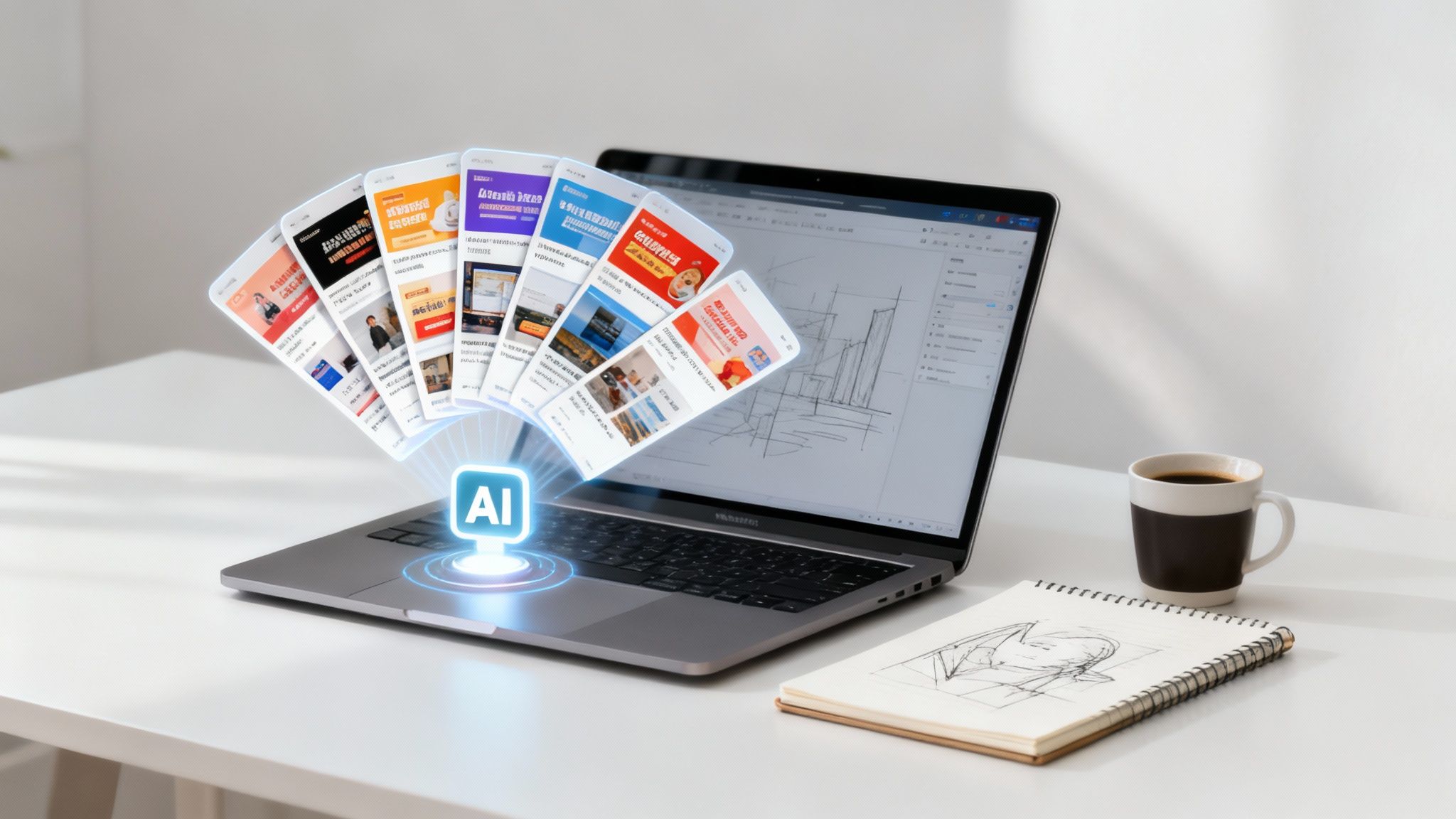
Let's use an analogy. Imagine a chef who can instantly create hundreds of unique dishes just by knowing which ingredients were a hit with diners the day before. That's pretty much how an AI ad creative generator works for marketing. It doesn't just guess; it uses powerful machine learning to figure out what makes an ad a winner.
These platforms sift through mountains of data from successful ads, looking at everything from color palettes and headlines to the pacing of a video clip and the call to action. By recognizing these successful patterns, the AI can generate new, relevant creatives designed specifically for your audience and goals. This directly solves one of the biggest headaches for marketers: constantly needing fresh content to keep ad fatigue at bay.
The Core Function of an Ad Generator
At its heart, an AI ad creative generator is built for two things: scale and speed.
The old way of making a single ad could take days, even weeks, juggling writers, designers, and video editors. AI cuts that down to minutes. But this isn't just about saving time—it’s about unlocking a whole new level of testing and strategy.
With an AI tool, you can create dozens of versions of one core ad concept without breaking a sweat. This lets you A/B test everything from the headline to the background image to see what truly connects with your customers. You stop guessing and start making decisions backed by real data, which means your ad dollars go a lot further.
Here are a few things these tools do exceptionally well:
- Automated Copywriting: They write attention-grabbing headlines and body copy.
- Image and Video Creation: They can produce stunning visuals from just a text prompt or a product URL.
- Brand Alignment: They learn your brand’s specific style, colors, and fonts to keep everything consistent.
- Performance-Based Iteration: They analyze past campaign data to suggest what to create next.
An AI ad creative generator changes the entire workflow. It turns a slow, step-by-step manual process into a fast, automated loop of creating, testing, and improving. It gives even small teams the power to run campaigns like a massive agency.
By taking over the heavy lifting of content creation, these tools let marketers get back to what they do best: thinking about big-picture strategy and analyzing results.
To see what this looks like in the real world, check out these use cases for AI-powered ads and see how they’re driving real growth.
How AI Is Reinventing Ad Production
An AI ad creative generator isn’t just pulling ideas out of thin air. It’s making highly calculated, data-backed decisions. This is a huge shift from the old days of relying purely on human intuition to a process that’s automated and built on real-world performance data.
Think about it. A traditional creative team might come up with a few solid ad concepts based on their experience. An AI, on the other hand, can instantly analyze thousands of top-performing ads in your niche, figure out what makes them tick, and spin up hundreds of new variations in minutes.
The Technology Behind the Magic
So, how does it all work? The "magic" is really just two powerful technologies working in sync.
First, you have generative models. These are complex algorithms that have been trained on enormous libraries of images and videos. They’ve learned the underlying patterns of visual content so well that they can create brand-new, often photorealistic, visuals from just a simple text description.
The second piece of the puzzle is natural language processing (NLP). This is the tech that allows the AI to actually understand your ad copy, product descriptions, and brand messaging. It’s what ensures the visuals and the text come together to tell a cohesive story that sounds like you.
When you combine these two, you get a tool that can translate a simple idea into a polished, campaign-ready ad.
It creates a powerful feedback loop where the AI learns from your brand guidelines, product info, and past campaign results to figure out what resonates with your audience. AI is truly changing the game, allowing for far more efficient and scalable content creation. For example, looking into methods for automating UGC ad creation with N8n gives you a glimpse into just how far this automation can go.
From Manual Work to Data-Driven Automation
This move toward automation is already making waves. AI-generated creatives are on track to become a dominant force, expected to make up 35% of all digital ads by 2025—a massive leap from just 8% in 2022.
This growth is no surprise when you consider that 88% of marketing professionals report using AI tools in their daily work. The global AI marketing industry is exploding, projected to grow from $6.46 billion in 2018 to $47.32 billion by 2025, all thanks to the incredible efficiency AI brings to the table.
What does this all mean for marketers? It means we can move faster and make smarter decisions. Instead of pouring weeks into a single concept, you can now test dozens of different ad variations to find a clear winner before you put serious budget behind it.
Think of an AI ad creative generator as your creative co-pilot. It takes care of the repetitive, time-sucking production tasks, which frees you up to focus on the big picture—strategy, analysis, and refining the creative vision for even better results.
At the end of the day, this technology isn’t just about making ads faster. It's about making them better by optimizing every single creative element for maximum engagement, turning ad creation into as much of a science as it is an art.
Exploring Different AI-Generated Ad Formats
An AI ad creative generator isn’t a one-trick pony. Think of it more like a versatile creative studio, capable of producing a whole range of ad formats, each designed to connect with audiences in a different way. Let's move past the theory and look at the actual, campaign-ready content these tools can produce.
The output you can get from an AI generator is incredibly diverse. We're talking everything from high-energy video ads that stop the scroll to authentic-looking User-Generated Content (UGC). This flexibility means you can perfectly match the ad format to your campaign goal and platform, whether that's a TikTok story or a YouTube pre-roll.
Dynamic Video Ads
Video is king, but producing it has always been slow and expensive. That's a reality that AI ad creative generators are flipping on its head. They are fantastic at creating short, dynamic video clips that grab attention in just a few seconds. A fashion brand, for instance, could use AI to spin up dozens of variations for an Instagram Reel, each showing off a different product against a unique background.
This is where AI is really making waves. In fact, video advertising is being completely reshaped, with nearly 90% of advertisers planning to use generative AI for their video ads in 2025. It's predicted that by 2026, AI-generated video will make up 40% of all digital ads. What used to take a creative team two weeks of hard work can now be done in minutes, which is a game-changer for rapid testing and optimization. You can see just how much AI is changing the game in these insightful performance statistics.
Authentic UGC and Testimonial Styles
Today's customers trust recommendations from real people far more than polished corporate messages. AI ad generators have gotten incredibly good at creating ads that mimic this authentic, user-first style.
- UGC-Style Clips: These ads look and feel like they were made by a real customer. The AI can generate a video of someone unboxing a product or showing how it works, complete with a natural-sounding voiceover and casual editing.
- Selfie-Style Testimonials: In the same vein, AI can produce believable video testimonials. An AI-generated avatar can deliver a script praising your product in a selfie-style format, building social proof and credibility without the hassle of hiring actors.
By replicating the raw, unpolished feel of user content, these AI-generated ads tap into the audience's desire for authenticity. This builds trust and can lead to significantly higher engagement rates, especially on platforms like TikTok and Instagram.
Photorealistic Product Visuals
You absolutely need high-quality product images, but professional photoshoots are expensive. An AI ad creative generator can produce stunning, photorealistic images of your products in any setting you can dream up.
Imagine you sell outdoor gear. Instead of shipping your products to a remote mountain for a photoshoot, you can just tell the AI to place your backpack on a photorealistic hiker looking out over a stunning alpine vista. This opens the door to endless creative exploration without the logistical nightmare. Brands can generate entire catalogs of lifestyle images, saving thousands of dollars and weeks of production time.
AI Ad Format Capabilities and Best Use Cases
So, which format should you use? It all comes down to what you're trying to achieve and where your audience hangs out. Each AI-generated format has its own strengths.
Here’s a quick breakdown to help you match the right creative to your marketing goals:
| Ad Format | Key Features | Best For (Platform/Objective) |
|---|---|---|
| Dynamic Video Ads | Short, fast-paced, visually engaging clips with text overlays and music. | Meta & YouTube: Driving brand awareness and direct response. Great for grabbing attention in crowded feeds. |
| UGC-Style Content | Looks and feels like a real customer review or "how-to" video. Often features a person talking to the camera. | TikTok & Instagram Reels: Building trust and authenticity. Perfect for consideration-phase marketing. |
| Selfie/POV Testimonials | First-person perspective ads where an AI avatar speaks directly to the audience, sharing a "personal" experience. | Social Stories & Short-Form Video: Creating social proof and relatability. Excellent for conversion-focused ads. |
| Photorealistic Clips | High-fidelity, cinematic visuals of products in idealized settings or in use. | Pinterest & Programmatic Display: Showcasing product quality and aspiration. Ideal for top-of-funnel campaigns. |
Ultimately, the power of AI is giving you a full creative toolkit. You can quickly generate different formats, test them against each other, and see what truly connects with your audience without breaking the bank.
This technology makes it so much easier to experiment with different visual styles. For those ready to jump in, exploring a library of AI video ad templates is a great way to see the creative potential for yourself. With the right prompts and a clear vision, you can generate a steady stream of diverse, high-performing ads for any campaign.
Your Step-by-Step Ad Creation Workflow
Turning a great idea into a high-performing ad campaign used to be a tangled mess. But with an AI ad creative generator, the whole process gets a lot clearer. Forget juggling a dozen tools and team members—this is about following a simple, repeatable workflow to get great ads out the door, fast.
Think of it like an assembly line for your marketing. Each step flows right into the next, taking your raw concept and turning it into a finished ad that’s ready to launch. This structured approach cuts out the guesswork and gives you a reliable way to make content that works.
Step 1: Define Your Campaign Goal
Before you even think about writing a prompt, you have to know what you're trying to accomplish. Are you trying to build brand awareness, get people to a landing page, or drive immediate sales? Your goal sets the entire creative direction.
Giving the AI a clear objective is like putting a destination into your GPS. If you just tell it "drive," it's not going anywhere. But tell it "take me to the downtown library," and it maps out the best route.
For instance, a goal like "increase conversions for our new running shoes" will produce completely different ads than one focused on "building brand awareness among fitness enthusiasts." The more specific you are, the better.
Step 2: Write Effective Prompts
The prompt is everything. It's the instruction you give the AI, and the quality of your ad depends entirely on the quality of that instruction. Vague prompts create generic, forgettable ads. Detailed prompts produce sharp, on-brand content that actually connects with people.
A solid prompt for a video ad should feel like a mini creative brief. Here’s what to include:
- Target Audience: Who are you talking to? (e.g., "millennial urban cyclists")
- Product/Service: What's for sale? (e.g., "a new waterproof commuter backpack")
- Key Message: What's the one thing they need to remember? (e.g., "keep your gear dry in any weather")
- Visual Style: What should the ad look and feel like? (e.g., "fast-paced, gritty, POV shots on a rainy city street")
- Call to Action (CTA): What do you want them to do next? (e.g., "Shop Now and Get Free Shipping")
The best prompts give the AI guardrails, not a straitjacket. They provide enough detail to guide the generator but leave just enough room for it to come up with something compelling and unexpected.
Step 3: Supply Your Brand Assets
To make sure your ads look like your ads, you need to give the AI your brand’s visual identity. This is the key to staying consistent and building brand recognition across every single campaign you run.
Most good AI platforms let you upload a brand kit, which usually includes:
- Logos: All your variations, in different formats and colors.
- Color Palette: Your official primary and secondary brand colors.
- Fonts: Your brand's specific typography.
- Product Shots: High-quality images of whatever you’re selling.
When you feed the AI these assets, it ensures every piece of content it creates looks like it came straight from your in-house team. It's the secret to making AI-generated content feel authentic to your brand.
This flow shows how you can start with a core idea and let the AI spin it into different formats, like authentic UGC or powerful testimonials—both crucial for building trust.
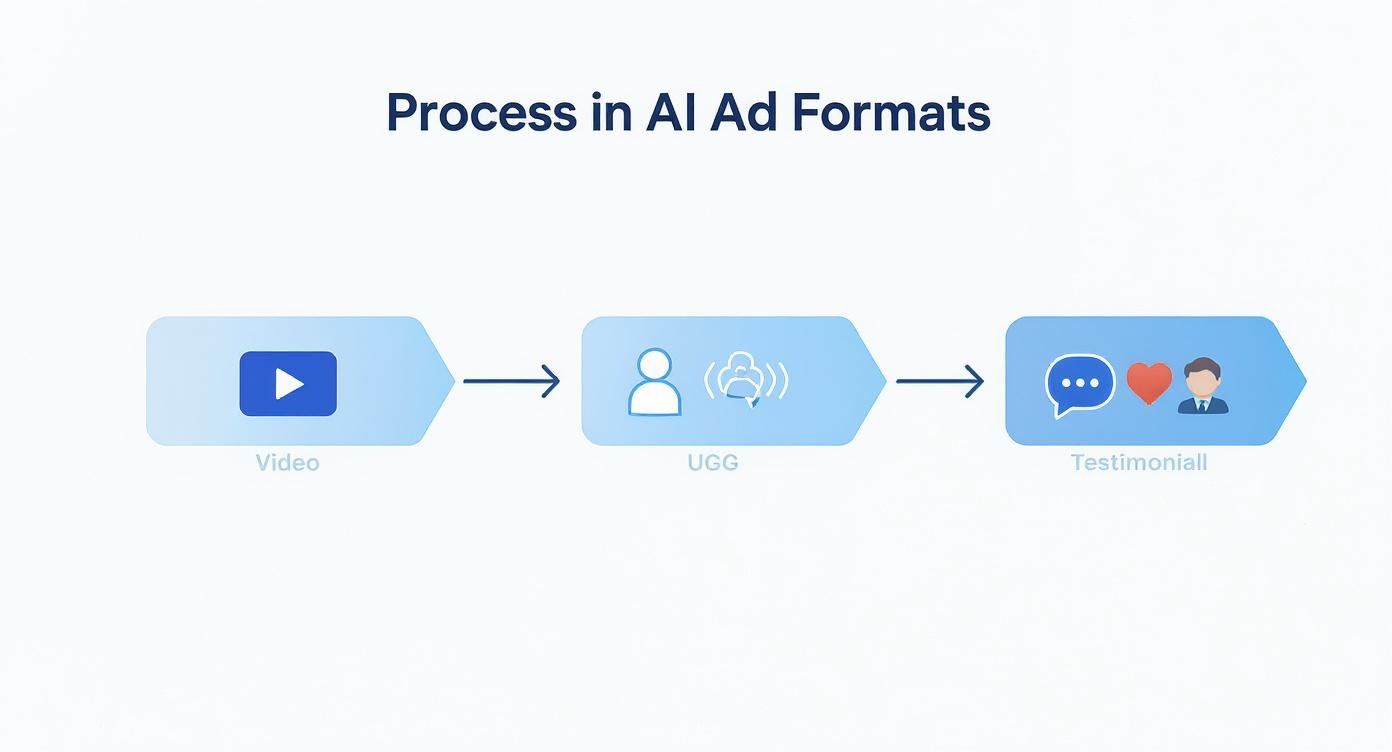
The real magic here is how AI can seamlessly adapt your message into formats that resonate more deeply and build genuine connections with viewers.
Step 4: Generate and Review Variations
Okay, this is the fun part. Once your prompt and brand assets are locked in, the AI will generate a whole batch of ad variations in just a few minutes. Instead of getting just one creative, you get an entire suite of options to pick from.
Go through each one. Look for the ads that best capture your brand’s voice and nail your campaign goal. Don’t be afraid to go back, tweak your prompt, and regenerate if the first round isn't quite there. This is where you really dial things in and find the winning creative.
Step 5: Launch and Integrate
After you’ve picked your favorite ads, the last step is getting them out into the world. The best platforms, like Aicut, often connect directly with major ad networks like Meta, TikTok, and Google.
This kind of integration makes launching a breeze. You can push your new ads directly into your ad accounts, set your budgets, and go live without ever leaving the platform. It closes the loop, taking you from a simple idea to a live campaign in one smooth, efficient motion.
Best Practices for Maximizing Ad Performance
Just because you have access to an AI ad creative generator doesn't mean you'll instantly get amazing results. Think of it like a professional camera—it has the potential to take incredible photos, but you still need a skilled photographer to frame the shot. To really see a jump in performance, you need to pair the tool’s power with a smart, human-led strategy.
The old saying "garbage in, garbage out" is especially true here. The quality of the ads the AI creates is a direct reflection of the quality of what you give it. This means feeding it sharp, high-resolution product photos and clear, detailed brand guidelines. When the AI has great raw materials to work with, it can spin up creatives that look polished and on-brand.
Treat AI as Your Creative Partner
It’s tempting to just hit "generate" and hope for the best, but the real magic happens when you work with the AI. Don't think of it as a replacement for your creative team, but as a tireless assistant that can brainstorm hundreds of ideas in minutes. Your job is to provide the strategic direction and the creative spark.
Think of the AI as your co-pilot. You set the destination—a clear campaign goal and a strong creative brief—and the AI helps you explore all the possible routes to get there, faster than you ever could on your own.
This partnership is all about a continuous feedback loop. You guide the initial creation, review what it comes up with, and then provide tweaks and refinements. This human oversight is what keeps the ads from feeling generic or off-brand, ensuring they connect with your audience on an emotional level. It’s this mix of machine speed and human intuition that produces winning campaigns.
Iterate Based on Performance Data
Your job isn't done when the ads go live. In fact, that's when the real work begins. An AI ad creative generator makes it incredibly easy to produce dozens of variations, which is perfect for A/B testing.
- Find the Winning DNA: Look at your top-performing ads. What do they have in common? Is it a certain color, a specific headline style, or a particular call-to-action?
- Create a Feedback Loop: Take those data-backed insights and feed them back into the machine. Tell the AI to create more ads that use those winning elements.
- Study the Competition: To get the most out of your ads on platforms like TikTok, it helps to see what’s already working. You can uncover great strategies by using spy tools on TikTok ads) to analyze winning campaigns.
This cycle of generating, testing, analyzing, and refining turns ad creation from a one-time task into a system of constant improvement. By feeding real performance data back into your AI ad creative generator, you're essentially training it to get smarter and more effective with every campaign. To see how this works in practice, check out our complete guide on creating AI video ads that convert.
Measuring Success and Optimizing with Data
Making great-looking ads with an AI ad creative generator is a fantastic start, but it’s only half the battle. The real magic happens when you connect those visuals to actual business results, and that means you have to measure what’s working and what isn’t.
This whole process boils down to tracking a few key numbers. Think of these metrics as your audience telling you exactly what they like and what makes them scroll right past. If you ignore them, you're essentially flying blind.
Key Performance Indicators to Watch
Don't get bogged down by every metric under the sun. Instead, zero in on the few that truly show you how your campaigns are doing and whether they're actually helping you grow.
Click-Through Rate (CTR): This is your first signal. It tells you if your ad is interesting enough to stop someone's scroll. A high CTR is a great sign that your visuals and copy are hitting the mark.
Conversion Rate: This is where the rubber meets the road. Of the people who clicked, how many actually followed through and made a purchase, signed up, or took the action you wanted? This metric tells you if your ad is genuinely persuasive.
Return on Ad Spend (ROAS): This is the bottom-line number. For every dollar you put into your ads, how many dollars did you get back? ROAS tells you, in no uncertain terms, if your campaigns are actually making you money.
When you start digging into these numbers, you'll uncover patterns. Maybe it was a specific color scheme, a certain kind of headline, or a particular call-to-action that did all the heavy lifting. That's the gold you're looking for.
This is where the true power of an AI ad creative generator comes to life. It’s not just a production tool; it's a strategic partner in an ongoing cycle of optimization.
Creating a Powerful Feedback Loop
Once you've figured out what makes your winning ads tick, you can start building a feedback loop. Take everything you learned—the headline formulas, the visual styles, the successful CTAs—and feed those insights right back into the AI for your next set of creatives.
Let's say you find out that ads showing a real person using your product have a 30% higher conversion rate. Boom. Your next prompt for the AI should be all about creating more variations of that exact style.
This simple step closes the loop. You're turning cold, hard data into smarter, more effective ads, creating a cycle where every campaign gets a little better than the one before it.
A Few Common Questions We Hear
As more marketers start looking into AI ad creative generators, a few questions pop up time and time again. Getting these sorted out can really help you see where this tech fits and how to make it work for you.
Will AI Replace My Creative Team?
This is probably the biggest one. And the short answer is no—think of it more like a partnership. The best work happens when AI does the heavy lifting (cranking out dozens of ad variations in minutes) while your team provides the big-picture strategy, creative spark, and brand knowledge. AI is an incredibly powerful assistant, not a replacement for human creativity.
How Do I Keep My Ads On-Brand?
It's a valid concern. You don't want your ads to look like generic, AI-made content that could belong to anyone. Top-tier platforms, like Aicut, have this figured out. You can upload a complete "brand kit"—your logos, specific fonts, and exact color codes. This sets up guardrails, making sure every single creative the AI generates feels like it came straight from your team.
Is This Going to Break My Budget?
The assumption is that this kind of tech is wildly expensive, but that's rarely true anymore. Many platforms use a tiered pricing model, with starter plans often coming in under a hundred dollars a month. This puts incredibly powerful creative generation within reach for small businesses, startups, and even solo marketers.
Seriously, How Much Faster Is It?
The speed is what usually blows people away. A task that might take a human designer a full week—like creating 10 completely different video ad concepts with unique hooks and visuals—can literally be done in a few minutes with AI. This isn't just a small improvement; it's a massive acceleration that lets you test more, launch faster, and stay way ahead of the competition.
Ready to accelerate your ad creation and go viral? Aicut gives you the templates, models, and automation to produce high-performing video ads in minutes. Start creating with Aicut today!