So, what exactly is AI UGC content? Think of it as a partnership. It takes the genuine, trustworthy feel of user-generated videos and reviews and pairs it with the efficiency and power of artificial intelligence.
The goal isn't to churn out fake content. It's about using AI to take real human stories and make them hit harder, turning them into high-impact assets for your marketing campaigns without all the manual grunt work.
Why Authenticity Is Your New Marketing Superpower

Let's get real for a second. People are just plain tired of slick, overproduced ads. Today's consumers, especially younger crowds like Gen Z, can spot a phony marketing message from a mile away. They're looking for genuine connections and trust voices that sound like their friends, not a corporate script.
This is a huge problem for traditional advertising. A big-budget ad is like a Hollywood blockbuster—it looks amazing, but you know a massive studio is pulling all the strings. On the other hand, user-generated content (UGC) is more like that indie film that goes viral. It's raw, relatable, and feels honest, which is why a staggering 88% of people trust reviews from their peers far more than they trust messages from brands.
The Rise of Relatable Content
This is where UGC really shines. It builds a bridge of trust between a company and its customers by showing off real experiences from actual people. When a potential buyer sees a product review from someone just like them, it connects on a completely different level than a paid actor ever could.
This hunger for authenticity is what fueled the meteoric rise of platforms like TikTok and Reddit, where unfiltered, community-driven content is king. Brands winning in these spaces get it: people trust other people, not faceless logos. The big challenge, though, has always been how to scale this kind of content. Finding the best nuggets of gold in a sea of reviews and videos is a massive time sink.
AI UGC closes the gap between authenticity and scale. It uses technology not to fake stories, but to find, polish, and broadcast the most compelling human experiences people are already sharing about your brand.
Introducing AI UGC Content as the Solution
This is exactly where AI UGC content comes in, offering a game-changing tool for modern marketers. It’s not about replacing human creativity with cold, robotic scripts. Far from it. Think of AI as your expert editor and distributor, working behind the scenes to make your authentic content shine.
AI can sift through thousands of customer reviews to spot powerful themes, help draft scripts that sound like they were written by a real person, and even automate parts of the video creation process. It gives the raw, trustworthy appeal of that indie film the production quality and reach of a major release—all without losing its soul. It's the key to connecting with an audience that prizes genuine stories above all else.
What Is AI-Powered User-Generated Content?

So, what exactly is AI UGC content? First, let's clear up a common misconception. This isn't about using bots to write fake reviews or generate synthetic testimonials. Not at all.
It’s about using artificial intelligence as a smart assistant to amplify and scale your entire user-generated content strategy—a strategy built on real, genuine feedback from your customers.
Think of it like this: your customers are already creating incredible content, from detailed product reviews on Amazon to unboxing videos on TikTok. AI acts as a super-powered production crew that helps you find the gold in all that raw material, identify the most impactful moments, and quickly turn them into compelling ads and social posts.
AI UGC is the strategic use of artificial intelligence to inspire, manage, scale, and analyze authentic content created by real users. It’s a tool that empowers human creativity, not one that replaces it.
Breaking Down the AI UGC Workflow
The process essentially breaks down into three core stages, and AI gives you a serious leg up in each one without losing that crucial human touch.
1. Analysis and Insight Mining: Everything starts with data. AI can sift through thousands of customer reviews, comments, and social media posts in minutes. It pinpoints recurring keywords, common pain points, and—most importantly—the exact emotional language your happiest customers use. This gives you a data-backed blueprint of what truly matters to your audience.
2. Ideation and Creative Assistance: Armed with those insights, AI becomes a fantastic brainstorming partner. It can take the most praised features from your best reviews and help you generate dozens of script ideas for short-form videos. It's no surprise that 62% of marketers already use AI to speed up their creative process, making it a central part of their strategy.
3. Automation and Production: Finally, AI takes over the tedious parts of video production. We're talking about tasks like automatically adding captions, generating natural-sounding voiceovers from your scripts, and editing raw footage into polished, engaging videos.
This blend of human insight and machine efficiency is what makes AI so valuable in modern marketing. To learn more, check out our full guide on demystifying AI UGC and its role in content creation.
From Manual Effort To Optimized Output
To really grasp the shift, let's compare the old way of doing things with the new AI-enhanced approach. The table below lays out how AI injects speed and intelligence into every step of the UGC lifecycle.
| Workflow Stage | Traditional UGC Process (Manual) | AI UGC Process (Automated & Optimized) |
|---|---|---|
| Discovery | Manually searching social media, forums, and review sites for good content. | AI scans thousands of sources instantly, flagging top-performing content and influential creators. |
| Analysis | Reading through content one by one to find key themes and positive sentiment. | AI analyzes text and video for sentiment, keywords, and emotional triggers, delivering actionable insights. |
| Ideation | Brainstorming script ideas based on a handful of selected reviews. | AI generates dozens of script variations and creative concepts based on data from top-performing reviews. |
| Production | Hiring creators or editors, managing timelines, and handling manual editing tasks. | AI automates voiceovers, captioning, and video editing, producing ready-to-use assets in minutes. |
| Testing | Manually creating A/B test variations and tracking results in spreadsheets. | AI produces multiple creative variations and helps analyze performance data to identify winning ads quickly. |
| Distribution | Uploading content to each platform and manually adjusting for different formats. | AI can help resize and reformat content for different channels, streamlining the distribution process. |
The difference is night and day.
Manually sourcing, scripting, and editing UGC is slow and expensive. It’s a process that limits most brands to just a handful of user-created ads a month.
Bringing AI into the mix turns that bottleneck into a powerful growth engine. What once took a team weeks can now be done in a fraction of the time, allowing you to produce a steady stream of authentic, high-performing content. This is the core advantage of adopting an AI UGC content strategy.
Why User-Generated Content Is So Powerful
Let’s be honest, who do you trust more for a restaurant recommendation? A friend, or a billboard?
The answer is obvious, and it gets right to the heart of why user-generated content (UGC) has become such a force in marketing. We're all getting better at tuning out slick, polished corporate ads. They often feel distant and, frankly, a little fake.
But when you see content from a real person—an unboxing video, an honest review, a selfie with a product they genuinely love—it just hits differently. It’s a real recommendation, not a sales pitch, and that authenticity cuts through the noise. This is the kind of social proof a massive ad budget can't buy.
The Psychology of Trust and Social Proof
The magic of UGC is all about psychology. When we see someone just like us using and loving a product, it triggers a powerful principle called social proof. It’s a mental shortcut that tells our brain, "Hey, people like me approve of this, so it must be a good choice."
This immediately lowers the risk we feel about making a purchase. Instead of a faceless brand telling you how great their product is, you’re seeing living proof from a community of actual users.
It completely changes the dynamic. Marketing stops being a one-way street where a company shouts at you and becomes a genuine conversation.
The real power of UGC is that it transforms your happiest customers into your most believable advocates. Their stories build a kind of trust that even the most clever ad campaign struggles to replicate.
This is especially true for younger audiences like Gen Z and Millennials. They grew up online and have finely tuned radars for anything that feels inauthentic. They actively look for peer reviews and recommendations, making UGC an absolute must-have for any brand trying to connect with them.
The Explosive Growth of the UGC Market
This shift toward authenticity isn't just a hunch; the numbers are staggering. The global user-generated content market is on track to explode from $5.36 billion to an incredible $32.6 billion by 2030. This isn’t a passing fad—it’s a fundamental change in how people and brands connect.
Just look at the immediate impact: businesses that feature UGC on their websites see a 20% increase in return visitors. And those visitors? They spend 90% more time on the site. You can dig into more of these user-generated content statistics to see just how big this is.
This growth is directly linked to real-world results that businesses can see and measure. When you showcase real customer experiences, you can expect:
- Higher Engagement: People actually want to see and interact with content from their peers. It gets more likes, more comments, and more shares.
- Increased Conversions: Seeing UGC gives shoppers the confidence they need to click "buy." It's the ultimate reassurance.
- Stronger Brand Loyalty: When you feature your customers' content, they feel seen and appreciated. That feeling builds a deep connection that turns them into lifelong fans.
At the end of the day, UGC makes your brand stickier. It creates an online space that’s more trustworthy and engaging, bringing new customers in and giving them a reason to stay. This is the powerful foundation that AI UGC content builds upon—taking a format people already trust and figuring out how to create it at scale.
How Brands Are Actually Using AI UGC Content
Alright, let's move past the theory and look at what’s happening on the ground. The real magic of AI UGC content clicks into place when you see how smart brands are already using it. This isn't some futuristic concept; it's a real-world strategy businesses are using right now to create authentic, high-converting content at a scale that was previously unthinkable.
Instead of just giving you a list of formats, I want to pull back the curtain on the mechanics behind some of the most effective types of AI UGC. These examples show how a little human strategy combined with smart automation can turn raw customer feedback into seriously compelling marketing.
Turning Text Reviews into Video Testimonials
One of the most powerful plays is transforming those static text reviews into dynamic video testimonials. Think about it: you might have hundreds of glowing reviews for your product on Amazon, Reddit, or your own site. Digging through them all manually to find the perfect soundbites is a massive headache.
This is where AI puts on its data analyst hat.
- Step 1: The Analysis: An AI tool can tear through thousands of text reviews in minutes. It pinpoints the good stuff—recurring positive themes, frequently mentioned features, and the exact words customers use that pack an emotional punch.
- Step 2: The Script: Using what it learned, the AI generates a cohesive video script. This isn’t just a jumble of quotes. It’s a real narrative that weaves together the most common points of praise into something that sounds natural and conversational.
- Step 3: The Production: Finally, that script gets plugged into an AI video generator. With a realistic AI avatar and a natural-sounding voiceover, the tool spits out a finished video testimonial that feels like one real person summarizing their great experience.
What you've just done is turn a mountain of messy text data into a sharp, persuasive video that speaks with the collective voice of your happiest customers.
Crafting Authentic Selfie-Style Videos
That "selfie-style" video is the gold standard for authentic UGC on TikTok and Instagram. It’s raw, it's direct, and it feels incredibly personal. But getting a creator or customer to deliver a message that sounds natural without being robotic can be surprisingly difficult.
Here, AI acts as a scriptwriting sidekick, making sure the language connects without sounding like a corporate memo.
A platform like Aicut can generate scripts that sound like how people actually talk on social media. By analyzing top-performing UGC, the AI gets a feel for the right cadence, slang, and sentence structures that resonate with your audience. The creator gets a script that serves as a guide, helping them deliver a message that feels genuine and off-the-cuff, even when it’s been strategically planned.
The goal isn’t to put words in someone's mouth. It's about providing a data-backed framework that helps them tell their story more effectively, ensuring the final video captures that coveted, authentic "I just had to share this" feeling.
The platform makes generating this kind of content incredibly straightforward.
This screenshot shows just how simple the workflow is. You can feed it prompts and get video content back without needing any technical skills, bridging the gap between a great idea and a finished, shareable video.
Narrating Compelling Forum Stories
Forums like Reddit and Quora are absolute gold mines. They’re filled with long, detailed stories and personal experiences related to brands and products. These stories are dripping with authenticity, but let's be honest—most people aren't going to read a giant wall of text.
AI UGC tools are fantastic at turning these text-based stories into the kind of narrated videos that have blown up on YouTube and TikTok.
Here’s how it usually works:
- Find a Gem: You spot a powerful story or thread on a forum that shines a positive light on a customer's experience.
- Generate the Voice: The text from that story is used to create a natural, human-sounding voiceover. Modern text-to-speech AI is good enough to add the right tone and emotion, bringing the story to life.
- Add the Visuals: While the story is being told, the AI automatically finds and syncs relevant stock footage, B-roll, or simple animations to match what's being said. This keeps the viewer hooked and adds context.
This automated workflow turns a powerful but static block of text into a highly shareable video that can connect with a much bigger audience. For brands wanting to squeeze every drop of value from their positive feedback, learning how to unlock the power of AI UGC content for your brand is a critical next step. These tools make it possible to tap into real stories and serve them up in a format built for how people consume content today.
Building Your Own AI UGC Content Engine
Alright, let's move from theory to reality. This is where the true power of AI UGC content really starts to shine. Creating a system that pumps out authentic, high-quality content isn't about finding some magic button—it's about building a solid, repeatable workflow. Once you structure your process, you can transform what might be a random effort into a predictable and scalable content machine.
This whole engine is built on a simple four-stage framework. It's designed to take you from raw customer feedback all the way to a polished video that you can track and measure. At every step, we'll use AI to make things faster and more effective, but without losing that genuine spark that makes UGC so trustworthy in the first place.
Stage 1: Sourcing And Curation
First things first: you need to find the gold. Your customers are already creating amazing content for you on platforms like Amazon, Reddit, TikTok, and Instagram. The problem is, trying to sift through all that digital noise by hand is a nightmare.
This is where AI listening tools are a game-changer. Think of them as your brand's digital ears, constantly scanning the web for any mention of your products. They can pick up on sentiment, spot recurring themes, and highlight the most glowing, well-written feedback. This automated curation makes sure you’re building your entire strategy on a foundation of genuine customer love.
Stage 2: Ideation And Scripting
Once you've gathered a collection of top-tier reviews and comments, the next hurdle is turning that raw feedback into a compelling story. This is where AI switches from being a listener to your creative partner.
Instead of just guessing what might resonate, you can feed your best-sourced UGC directly into an AI script generator. The AI will analyze the core ideas and emotional language to brainstorm unique video angles and draft scripts for you. This approach ensures your content is data-driven and rooted in the authentic voice of your customers—making it far more relatable than a stuffy, corporate-written script.
This diagram lays out the entire journey, from raw customer reviews to a finished video asset.
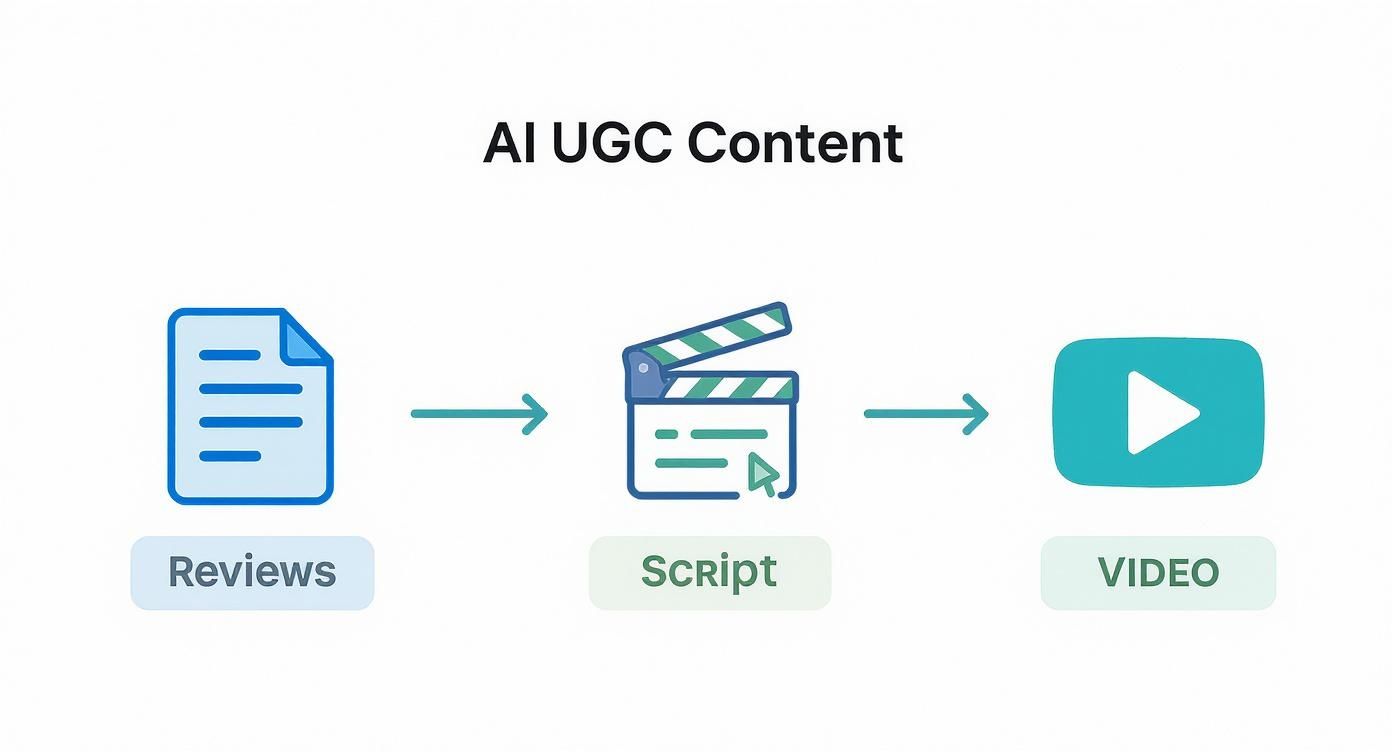
As you can see, AI acts as the connective tissue between each stage, turning a jumble of text into a structured script and, finally, a video ready to be shared.
Stage 3: Production And Automation
With a great script in hand, it's time for production. Traditionally, this is the most expensive and time-consuming part of the process. It involves cameras, creators, editors—a lot of moving parts. AI-powered platforms like Aicut completely flip that script by automating the heavy lifting.
You can take that AI-generated script and turn it into a finished video in just minutes. This could look like:
- Generating a natural-sounding voiceover directly from the text.
- Automatically matching the narration with relevant stock footage or your own product B-roll.
- Using an AI avatar to deliver the testimonial right on camera.
This automated workflow slashes production costs and turnaround times, letting you create content at a scale that just wasn't possible before. For a closer look at how this works, check out our guide on mastering AI UGC product videos for engaging content.
Stage 4: Distribution And Analysis
The final step is getting your content seen by the right people and figuring out what’s actually working. AI tools can help here too, automatically resizing and reformatting your videos for different platforms like TikTok, Instagram Reels, and YouTube Shorts.
But the real magic is in the analysis. AI-driven analytics can track key performance indicators (KPIs) to show you the true impact of your AI UGC content.
Crucial KPIs to Track:
- Engagement Rate: Are people liking, commenting, sharing, and saving?
- Click-Through Rate (CTR): What percentage of viewers are clicking your ad’s call-to-action?
- Conversion Rate: How many of those clicks turn into actual sales or sign-ups?
- Cost Per Acquisition (CPA): How much are you spending to get each new customer?
Keeping an eye on these numbers creates a powerful feedback loop. The insights you get from your top-performing videos feed directly back into your sourcing and scripting stages, making your content engine smarter and more effective with every cycle. For more hands-on advice and strategies, the branditok blog is a fantastic resource. This constant cycle of create-measure-learn is what keeps your brand ahead of the curve.
How To Use AI UGC Content Ethically
Pairing the creative spark of AI with the raw authenticity of user-generated content can be a game-changer. But with this new power comes a serious responsibility—to your audience and to the original creators whose content you’re using. Getting the ethics right isn't just about playing defense; it's about building trust that lasts.
The cornerstone of any ethical AI UGC content strategy is simply being honest. It boils down to transparency. Your audience should never feel like they've been tricked. If an AI had a hand in creating or tweaking a piece of content, you need to make that crystal clear. Trying to hide it can blow up in your face and cause way more damage than any temporary engagement bump is worth.
This goes for honoring the original creator, too. Their content is the starting point, and your job is to amplify their message, not overwrite it. The finished piece should always stay true to the creator’s original positive sentiment.
Securing Permission and Respecting Rights
Before you even dream of using AI to spin a customer’s review into a video, you have to get their explicit permission. Just because you found a piece of content online doesn't mean it's a free-for-all for your marketing.
Make sure you always follow these steps to lock down usage rights:
- Just Ask: The easiest way is to reach out directly to the creator on the platform where they posted. Be upfront about what you want to do with their content.
- Use a Simple Agreement: Have a straightforward usage agreement ready that explains where and how you’ll use the content. Ditch the dense legal jargon.
- Offer Something in Return: It’s not always mandatory, but offering a small payment, a free product, or even a discount code is a fantastic way to show you value their contribution and build a positive relationship.
This isn’t just about being nice; it's a legal must-do. Copyright law is on the creator's side, and using their work without asking can land you in some serious hot water, both legally and financially.
Disclosing AI's Role Transparently
Okay, so you've got permission. The next ethical checkpoint is disclosure. How do you let people know that AI helped shape what they're seeing? The key is to be upfront without making it a huge distraction.
The core ethical test for AI UGC is whether a reasonable person would feel misled. If the content appears to be a direct, unedited testimonial but was scripted and voiced by AI, you have an obligation to disclose it.
This doesn't mean you need to slap a giant warning label on every post. A simple, clear disclaimer is often all it takes.
Examples of ethical disclosure:
- A small text overlay like #AIenhanced or "AI-Assisted Voice."
- A quick line in the caption or description: "We used AI to bring this customer's glowing review to life."
- For AI avatars, add a note like, "This testimonial is voiced by an AI avatar based on real customer feedback."
As more brands jump into AI-powered content, getting familiar with comprehensive AI policy guidelines is crucial for using these tools responsibly. At the end of the day, treating your audience with respect and being honest about your process is always the winning strategy.
Your Top Questions About AI UGC Answered
Jumping into the world of AI UGC can bring up a few questions. It’s a new frontier, after all. Let's walk through some of the most common ones so you can get started with clarity and confidence.
Can AI Completely Replace Human Creators?
Nope, not a chance. Think of AI as a co-pilot, not the pilot. The real power of user-generated content is its authenticity—the raw emotion and unique personality that only a real person can bring. An AI can't fake the genuine excitement in a customer's unboxing video or the clever humor in a creator's personal story.
What AI can do is handle all the tedious, time-consuming tasks. It can sift through a mountain of product reviews to pinpoint the most powerful quotes or automate the nitty-gritty parts of video editing. This frees up your team and creators to do what they do best: dream up great ideas and be their authentic selves. The end result is a perfect partnership of human creativity and machine-level efficiency.
What's the Real Difference Between AI UGC and Synthetic Content?
This is a really important distinction to make. Synthetic content is 100% computer-generated. The AI creates everything from scratch with very little human direction, which is why it can sometimes feel a bit soulless or detached from reality. It's essentially inventing a reality that never happened.
AI UGC content, however, is grounded in something real. It starts with an actual human element—a genuine customer review, a real testimonial, or a video clip someone actually filmed. Then, it uses AI to repackage or enhance that content. A great example is turning a written review into a short video using an AI voice and avatar. The core message still comes from a real person's experience, not just an algorithm.
The key difference is the source of truth. AI UGC amplifies a real person's opinion, while fully synthetic content creates one from thin air.
How Do I Get Legal Permission to Use Customer Content?
Using someone's post without asking is a big no-no, both legally and ethically. The good news is that getting permission is usually pretty simple if you approach it the right way.
Here’s a quick-and-easy checklist:
- Reach Out Directly: Just send the creator a friendly DM or email. Be upfront about why you're contacting them and how much you loved their content.
- Explain Your Plan: Let them know exactly how you want to use it. Will it be an Instagram ad, a post on your website, or part of a larger campaign?
- Offer Something in Return: This isn't always mandatory, but offering a small payment, a free product, or even a discount code is a great gesture. It shows you value their contribution and helps build a stronger relationship.
- Get It in Writing: A simple "Yes, you can use it!" in an email or DM is often all you need. This creates a clear record that they gave you the green light.
Always make getting explicit permission your top priority. It’s the best way to protect your brand and show respect for the awesome customers and creators in your community.
Ready to scale your content production with authentic, high-converting videos? Aicut gives you the tools to turn real customer feedback into compelling AI UGC content in minutes. Start creating for free today and see how easy it can be.