
A short-form video can collect a million views while your bank account barely changes. You may see strong reach, comments, and follower growth, yet still lose money after paying for AI credits, editing, music, ad distribution, software, refunds, and the hours you spent managing the campaign.
That gap is where profitability analysis earns its place. It connects every revenue source to the production and distribution costs required to generate it, then shows whether a video, campaign, channel, customer, or platform contributes profit. Views help you understand attention. Profit tells you whether the operation can continue.
Why View Counts Alone Will Not Make You Profitable
Revenue is not profit. A platform payout, affiliate commission, sponsorship fee, or product sale only becomes useful after you subtract the costs required to earn it. For a creator, those costs often include more than the obvious subscription or ad invoice. They include writing, prompting, revisions, voiceovers, editing, publishing, community management, paid reach, platform fees, and the opportunity cost of time.
A practical profitability analysis starts by separating your operation into revenue streams and cost layers. Revenue might come from short-form platform payouts, sponsorships, affiliate links, digital products, services, or sales generated for a client. Cost layers usually include direct production costs, labor, promotion, software, and delivery costs specific to each platform.
Practical rule: Treat every video as a small business unit until your data proves that grouping it with other content gives you a clearer decision.
Aggregate averages hide weak performers. A channel can look healthy overall while one format consumes disproportionate editing time, one customer demands endless revisions, or one platform produces attention without meaningful conversion. Segment-level analysis exposes those differences instead of allowing profitable content to subsidize loss-making content.
Start with contribution, not applause
For each video or campaign, record:
- Revenue generated: Attribute sales, commissions, sponsorship income, and platform earnings to the relevant content.
- Direct costs: Include AI generation credits, voice tools, stock assets, music licensing, and paid distribution.
- Labor cost: Value your editing, scripting, review, client communication, and publishing time consistently.
- Contribution profit: Subtract direct and assigned operating costs from attributable revenue.
- Channel result: Combine video-level results only after you understand which formats and audiences create the contribution.
You can then compare the operation's return on capital with a weighted average cost of capital, or WACC, benchmark. WACC represents the opportunity cost of capital used for the relevant activity, so a business line should be judged against the return that capital needs to earn, not only against whether it produced positive revenue. The UK government profitability framework describes this segment-level approach and warns against relying on a single company-wide view.
If you're evaluating monetization options beyond views, map each one to its required effort and cost. This practical guide to making money on social media can help you identify possible revenue paths, but your own cost ledger decides which path is sustainable.
Key Metrics Every Video Creator Must Track
Short-form dashboards are built to make attention easy to see. Profitability analysis requires a second dashboard that connects attention to economics.
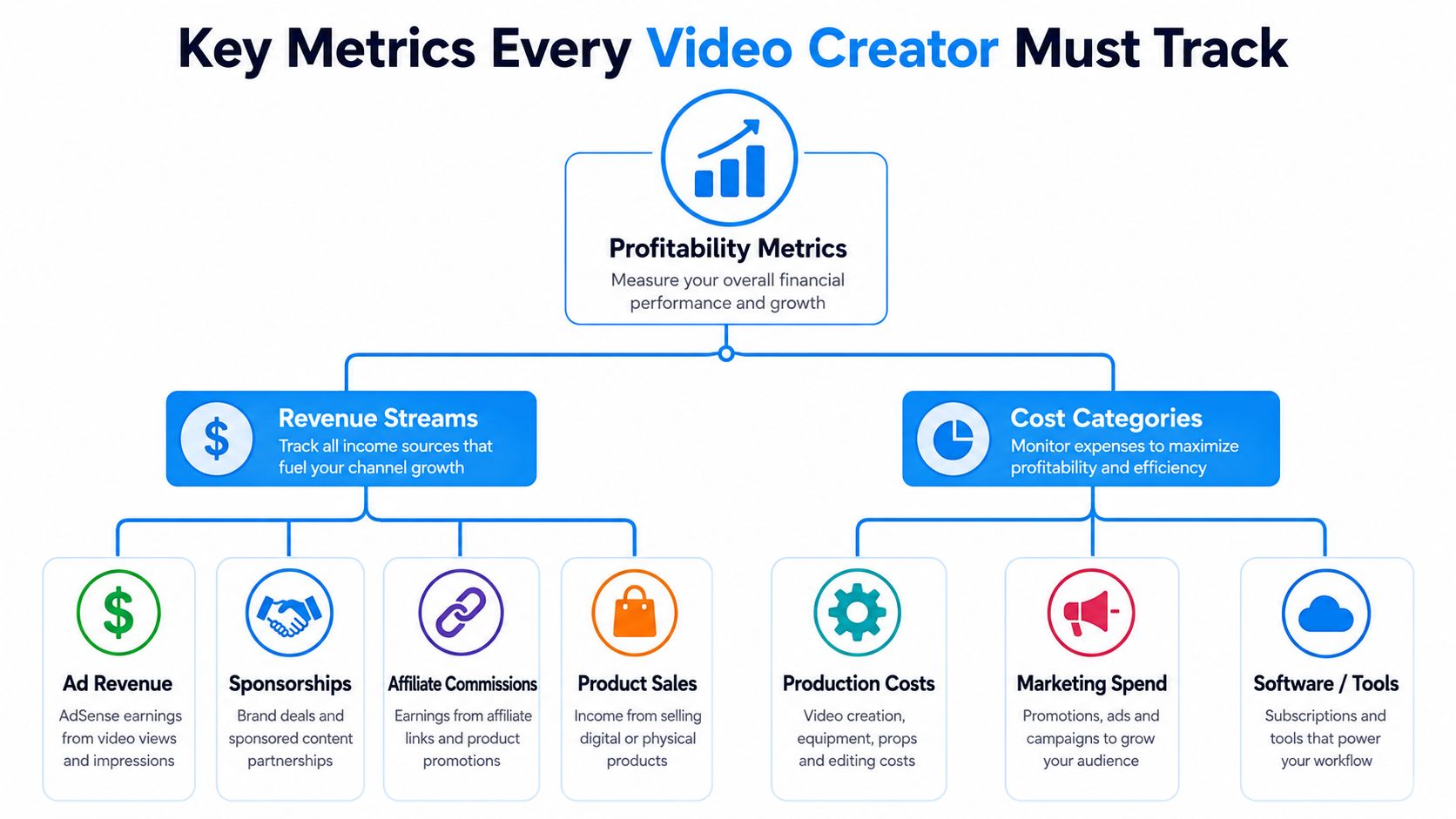
Revenue metrics
Revenue per video shows what each asset contributes, but don't treat platform revenue as the complete answer. A video may earn little direct payout while generating affiliate clicks, product sales, qualified leads, or sponsor value. Tag links, discount codes, landing pages, and client campaigns so you can attribute downstream revenue instead of assigning all value to the last interaction.
Conversion rate tells you whether viewers take the action that matters. For an affiliate video, connect clicks to completed purchases. For an agency campaign, connect views to leads or sales when the tracking setup allows it. A high view count with weak conversion may indicate a mismatch between the hook, audience, offer, and landing page.
Customer acquisition cost, or CAC, includes the full cost of winning a customer. For a faceless channel, that can include paid promotion, creative production, testing, and the creator's time. If you only divide ad spend by customers acquired, you'll understate CAC whenever unpaid production work plays a meaningful role.
Lifetime value, or LTV, estimates the contribution a customer creates over the relationship. A sponsor who books recurring campaigns may be more valuable than a one-off deal, but only if account management, revisions, and delivery costs leave a healthy contribution.
Cost and efficiency metrics
Cost per mille, or CPM, helps compare the cost of reaching audiences, especially in paid distribution. It doesn't tell you whether the campaign is profitable. A lower CPM can still produce poor economics if viewers don't click, buy, or retain.
Cost per completed video combines AI credits, editing time, voiceover, music, review, and publishing. Track it by format, because a visually complex series may consume more resources than a templated format even when both receive similar reach.
Gross margin measures what remains after direct production costs. Operating margin also accounts for operating expenses such as software, management, and campaign support. Net margin includes the full set of costs that affect the bottom line. The distinction matters because a video can look attractive at gross margin level and become weak after labor and promotion.
For context, a U.S. market benchmark reported a 37.76% gross margin, 14.39% operating margin, and 9.74% net margin across roughly 5,994 publicly traded firms as of January 2026, based on the cited dataset from profit margin by industry. Those figures aren't targets for every creator. They're reference points that show how much profit can disappear between direct costs, operating expenses, and the final result.
Pull these figures weekly, then review them by content format, platform, customer, and campaign objective. Keep views and engagement in the report, but place contribution profit, CAC, conversion, and cost per completed asset close to the top. For a broader engagement view, use the engagement metrics guide alongside your financial dashboard.
Calculating Campaign Profitability Step by Step
Take a faceless YouTube Shorts campaign and build the analysis from the ground up. Start with the campaign boundary. Decide which videos belong to the sprint, which revenue sources count, and how you'll assign shared tools or labor. Without that scope, your spreadsheet will produce precise-looking numbers that answer the wrong question.
Build the revenue side
List every attributable revenue source in separate rows:
- Platform revenue: Record the payout assigned to the videos or period.
- Affiliate revenue: Match tracked commissions to the relevant links or content group.
- Sponsorship revenue: Allocate a sponsor fee across the deliverables covered by the agreement.
- Product or service revenue: Use a defensible attribution rule, such as a tracked landing page or campaign code.
Then add direct costs. AI video generation credits, voiceover software, stock music, and paid assets belong to the content that uses them. Editing labor should be valued even if the creator doesn't pay an external editor. Otherwise, the spreadsheet rewards a workflow only because the owner is working for free.
Use a campaign ledger
A simple working example can look like this:
| Line Item | Amount (USD) | Notes |
|---|---|---|
| Platform revenue | 420 | Attributable campaign payout |
| Affiliate commissions | 280 | Tracked campaign links |
| Sponsorship allocation | 600 | Portion assigned to the video batch |
| Total revenue | 1,300 | All attributable sources |
| AI generation credits | 180 | Video and image generation |
| Voiceover and music tools | 70 | Direct media costs |
| Editing labor | 420 | Assigned time at an internal rate |
| Scheduling and publishing tools | 60 | Campaign share of subscriptions |
| Boosted distribution | 200 | Paid reach allocated to the batch |
| Total costs | 930 | Direct and assigned operating costs |
| Campaign profit | 370 | Total revenue minus total costs |
The campaign's gross margin would use revenue after direct production costs, while operating margin would include assigned labor, tools, and promotion. Net margin should include any remaining business expenses that belong to the campaign or period. Use the same definitions every time, or comparisons across campaigns won't mean much.
A spreadsheet should show results at both the video level and the batch level. The batch may appear profitable because strong affiliate content covers several weak videos. That's useful for judging the campaign, but it shouldn't stop you from identifying which formats deserve more production capacity.
Reconcile disconnected systems
Creators and agencies often keep customer data, orders, platform analytics, ad costs, and production records in separate systems. Research on customer profitability analysis identifies the inability to trace differentiated cost-to-serve across ERP, CRM, and SCM data as a central challenge, with data accuracy and availability particularly limiting for smaller businesses. The same problem appears in creator workflows when platform dashboards show performance but production tools hold the cost information.
Use a consistent campaign ID across your content planner, ad account, affiliate links, client invoices, and time tracker. If you're comparing paid campaigns, a return on ad spend calculator can help with the advertising portion, but ROAS isn't a substitute for full profitability. It excludes costs such as editing, AI credits, software, and account management unless you add them separately.
Comparing Organic Versus Paid Versus Sponsored Campaigns
Organic, paid, and sponsored content can all be profitable, but they monetize different advantages. Organic campaigns exchange time and uncertainty for distribution without a direct media invoice. Paid campaigns buy faster feedback and reach, but every experiment exposes your CAC. Sponsored campaigns provide clearer contracted revenue, while the creator carries delivery, revision, and relationship costs.
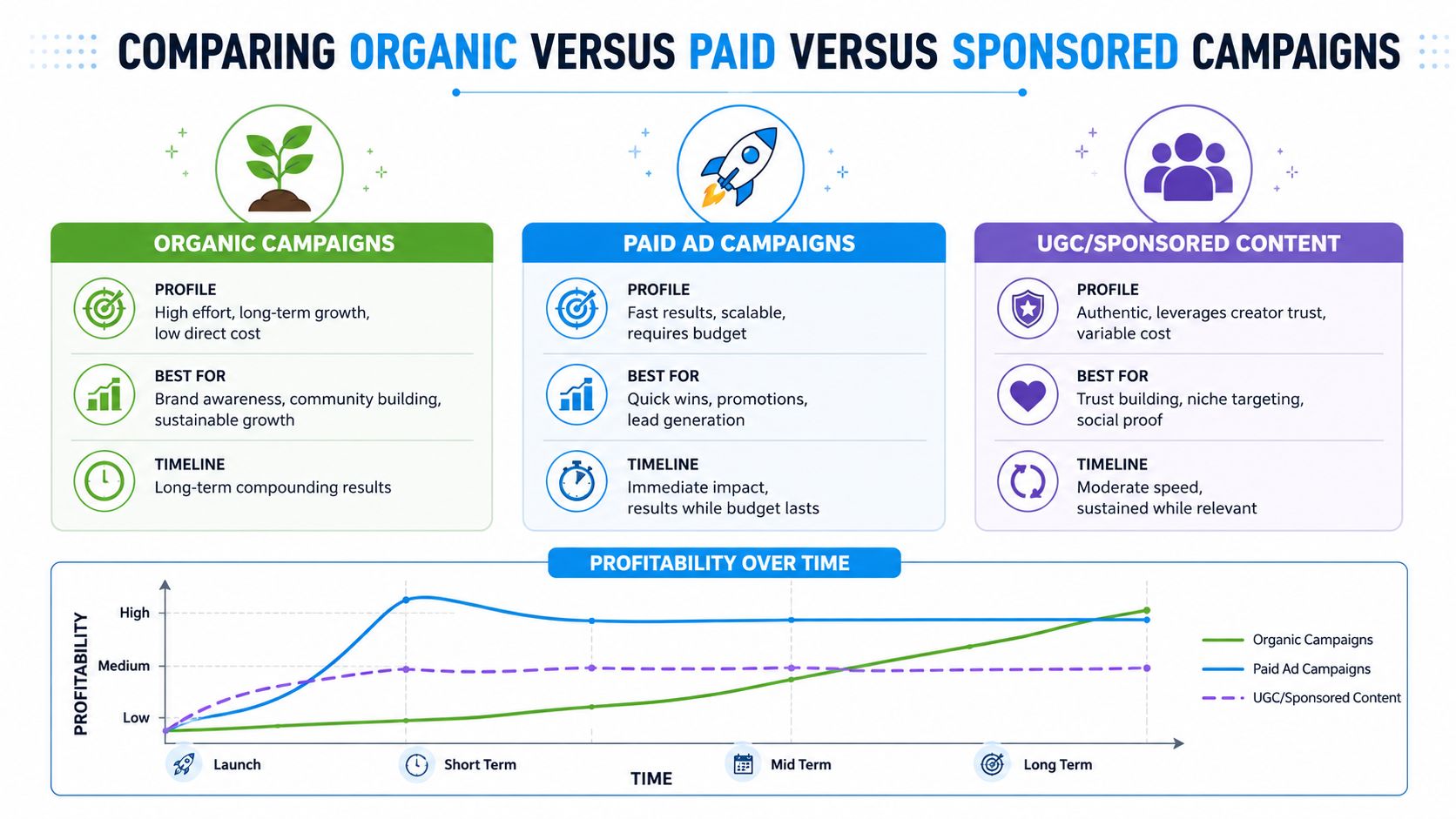
The trade-offs by campaign type
| Campaign type | Main economic advantage | Main risk | Best profitability question |
|---|---|---|---|
| Organic posting | Low direct distribution cost and reusable audience attention | Revenue timing and reach are unpredictable | Does the format create enough attributable value to justify production time? |
| Paid advertising | Fast testing and controlled delivery | CAC can rise when conversion weakens | Does contribution after media and production costs exceed the acquisition target? |
| UGC or sponsored content | Contracted revenue and clear deliverables | Revisions and service time can erode margin | Is the fee sufficient for creation, communication, usage rights, and delivery? |
Organic content often has the highest upside because one efficient format can continue attracting attention without a matching increase in media spend. It also has the least reliable timeline. A creator may produce consistently before a format proves whether it can support affiliate sales, products, or sponsorship demand.
Paid campaigns make the feedback loop clearer. You can pause a weak creative, compare hooks, and move budget toward the combinations that produce stronger conversion. But paid traffic magnifies bad economics. If the offer or landing page doesn't convert, more views only increase the cost of the mistake.
Sponsored content can look profitable at invoice level and still disappoint after revisions, approvals, usage requests, and client communication. Price the complete service, not only the final video. Include briefing, research, scripting, production, review cycles, publishing, reporting, and any rights the client receives.
Decision filter: Choose the campaign type according to the constraint you're solving. Use organic for compounding attention, paid for controlled learning, and sponsored work for contracted cash flow.
A blended portfolio can reduce dependence on one outcome. Keep a repeatable organic format running, use paid campaigns where tracking is reliable, and accept sponsored work only when the delivery burden fits the fee. Review each category using its own margin logic rather than forcing every campaign into one benchmark.
Reducing Production Costs to Accelerate Profitability
The quickest margin improvement often comes from reducing the cost of producing each usable asset. That doesn't mean removing quality control. It means eliminating repeated work that viewers never see, such as rebuilding the same visual structure, searching for similar footage, recreating prompts, or publishing each platform version manually.

Automate the repeatable parts
A creator can reduce production waste by standardizing the parts that don't require a fresh creative decision:
- Template selection: Start with a proven visual structure instead of inventing every scene from a blank page.
- Prompt reuse: Preserve prompt logic, camera direction, character details, and pacing so new concepts don't require full reconstruction.
- Asset variation: Change characters, backgrounds, hooks, and endings without rebuilding the entire project.
- Batch production: Generate related videos together, then review them in one focused session.
- Distribution: Schedule and publish platform versions from one organized workflow where possible.
Aicut is one option for this workflow. It offers viral-ready templates, prompt cloning, AI character and background swaps, voiceovers, scheduling, and one-click posting for short-form channels. Those features can reduce manual handoffs, but they don't automatically create profit. Keep measuring credits, review time, publishing effort, and the revenue attributed to each format.
You can find additional workflow ideas in this guide to saving editing time with Aicut. The useful test is simple: compare the old process with the automated process using the same cost definitions. If the creator saves time but fills that time with more revisions or more complex concepts, the expected margin improvement may not appear.
A practical margin review should ask:
- Which steps consume the most paid or unpaid labor?
- Which steps can be templated without lowering audience response?
- Which tools are used often enough to justify their recurring cost?
- Does batch creation reduce cost per finished asset, or only increase unfinished inventory?
- Does faster publishing create attributable revenue, or just more dashboard activity?
For a broader cost-control perspective, the Wojo Media practical playbook offers a useful reminder to examine pricing, delivery, and operating costs together.
The winning workflow isn't the one with the most automation. It's the one that lowers cost per finished, publishable asset while preserving the creative elements that drive conversion and retention.
Building Your Repeatable Profitability Framework
A durable system needs more than a monthly glance at revenue. Use a fixed workflow that turns campaign data into an investment decision.
Define the unit you're judging
Start by choosing the segment. That could be a platform, content format, customer, product, geography, campaign objective, or production method. A faceless storytelling format on one platform may have completely different economics from UGC ads produced for an e-commerce client.
Next, normalize the inputs. Use consistent rules for revenue attribution, labor valuation, AI credits, shared subscriptions, ad spend, refunds, and revisions. Then calculate gross margin, operating margin, net margin, ROA, ROE, and ROIC where the available data supports those measures. The DuPont system links ROE to profit margin, asset turnover, and financial leverage, while ROA is commonly expressed as net income divided by average total assets, as explained in this DuPont analysis reference.
Explain movement, not just results
Run variance analysis against your budget, prior period, and forecast. Separate changes caused by price, volume, mix, and cost. If a campaign's result improved, identify whether the gain came from a stronger offer, a cheaper production workflow, a different audience mix, or a temporary distribution spike.
A recent earnings review illustrates why published results can conceal forward risk. India's Nifty 50 PAT rose 0.8% year over year in Q4 FY25, while consensus estimates for FY25 and FY26 were cut by 3.0% and 2.1% for top covered companies, according to the NSE corporate earnings review. For creators, the parallel lesson is to track forecastable margin risk, not only the profit from a recent viral period.
Use this monthly checklist:
- Scope: Which formats, platforms, customers, and campaigns are included?
- Inputs: Are revenue, labor, credits, promotion, and shared costs assigned consistently?
- Margins: Which segments produce contribution, operating, and net profit?
- Variances: Did price, volume, mix, or cost create the change?
- Durability: Would the result survive without one viral post, temporary ad performance, or unpaid labor?
- Action: Which format gets more budget, which needs redesign, and which should stop?
Profitability analysis becomes valuable when it changes what you publish, sell, automate, and discontinue. Use the framework on the next campaign before you scale it, not after the budget has already disappeared.
Aicut gives short-form creators and agencies tools for templated AI video creation, prompt cloning, editing, voiceovers, scheduling, and cross-platform publishing. Use Aicut to reduce repetitive production work, then connect the resulting time and credit savings to your profitability analysis so you can invest more confidently in formats that contribute profit.