
Most lists of viral campaign examples stop at the same point. They show a famous stunt, praise the creativity, then leave you with the least useful takeaway in marketing: “be original.”
That's not enough in 2026. If you're running a faceless channel, a product page, or a short-form media account, you don't need inspiration alone. You need repeatable mechanics. You need formats that survive after the first hit, adapt across platforms, and can be rebuilt with AI tools instead of a full production team.
That's the fundamental gap. People study virality like it's lightning. In practice, it behaves more like a system. Strong hooks, pattern interruption, emotional payoff, visual consistency, and fast iteration still do the heavy lifting. AI just makes those parts easier to test at scale. For creators trying to turn attention into income, that shift matters even more. The ultimate win isn't one breakout clip. It's building a workflow that keeps producing watchable, remixable content and supports building YouTube creator income.
One early proof still matters. Hotmail grew to 12 million users in 18 months by adding “Get your free e-mail at Hotmail” to outgoing emails, turning users into the distribution channel instead of buying traditional reach, as documented in the viral marketing history of Hotmail. The platforms changed. The mechanic didn't. Viral growth still happens when the content carries its own distribution.
1. The Skibidi Toilet Phenomenon
Absurdist horror works because it doesn't ask for permission. It shocks first, explains later, and leaves just enough narrative residue for viewers to want the next episode. That's why faceless creators keep returning to this format. You can build a recognizable universe without showing your face, hiring actors, or relying on polished realism.

The core mechanic is simple. Take one bizarre visual premise, make it immediately legible in the first second, then serialize it. The audience doesn't need logic. They need a pattern they can recognize and a twist they haven't seen yet. Short-form absurdism spreads because people share it with the same caption every time: “What did I just watch?”
How to clone the mechanic
Use AI to lock the style first, not the plot. A lot of creators make the mistake of generating random weird clips that look unrelated. That kills repeat viewing. The winning move is to keep the world stable while escalating the events inside it.
- Keep one visual universe: Reuse the same environment, lighting style, character type, and camera rhythm across episodes.
- Open with the strangest frame: Don't warm up. Start on the reveal.
- Write for sequence, not standalone clips: Every short should hint that there's a previous episode and a next one.
Practical rule: If a viewer can screenshot one frame and identify your series instantly, the format is strong enough to scale.
This format also pairs well with prompt cloning. Instead of asking AI for “something weird,” break the viral into components: setting, character mutation, sound design, pacing, ending shock, and sequel hook. That's how you turn chaos into a reusable production system.
2. AI Influencer Deepfake Testimonials
UGC-style authority still works, even when the creator is synthetic. What matters is whether the testimonial feels specific, emotionally believable, and native to the feed. Most bad AI testimonial ads fail because they sound like ad copy read by a mannequin.
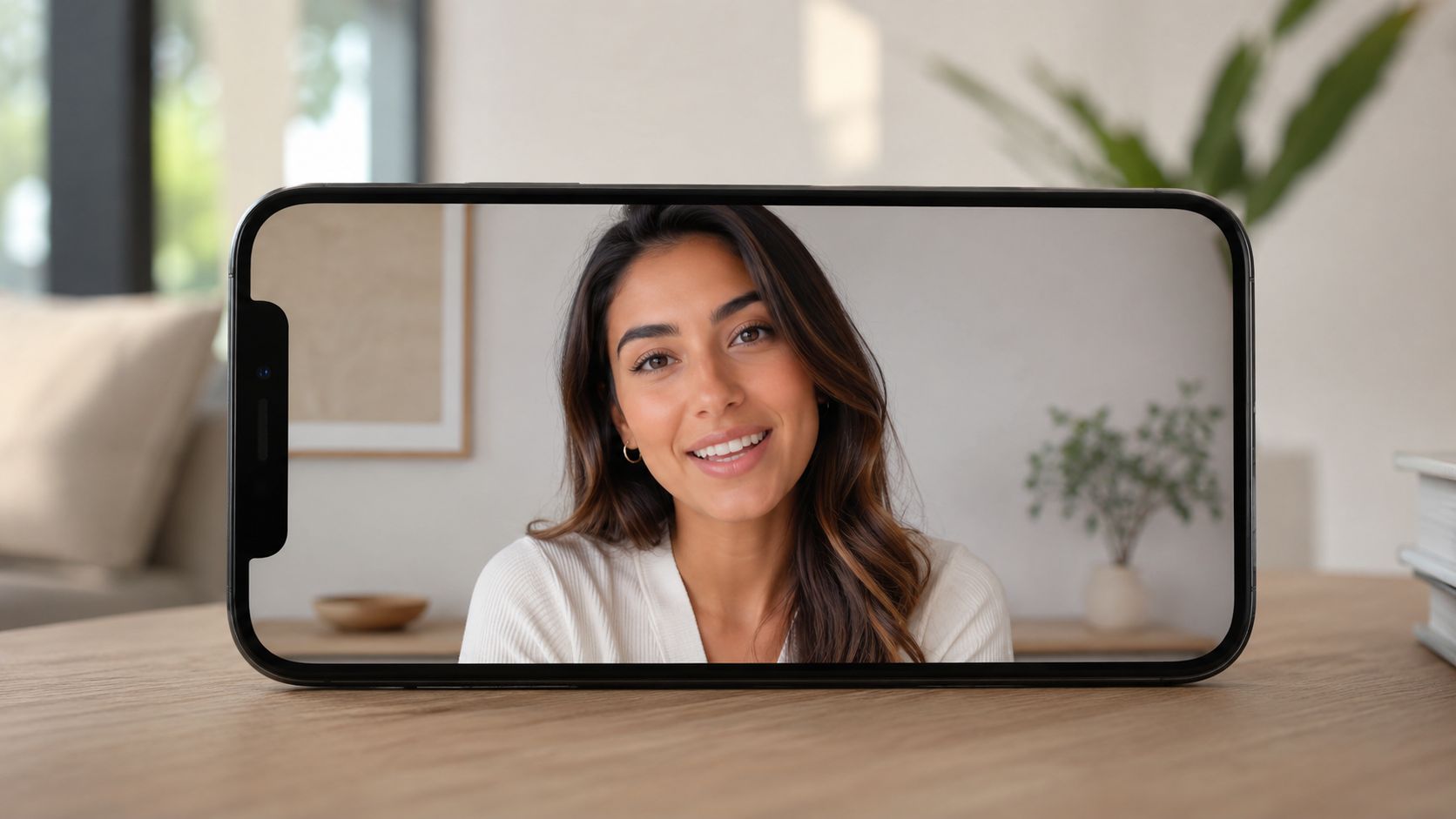
The better version looks like a quick personal recommendation. Slight imperfection helps. A natural pause helps. A concrete product reaction helps. If you're producing these with avatars, the winning frame is usually not “professional spokesperson.” It's “person who just tried something and has an opinion.”
What actually converts in this format
Pair the avatar with real product footage. That's the easiest way to avoid the synthetic feel. The face builds trust. The product shot anchors the claim.
For creators and brands using AI pipelines, the practical workflow is to test different personalities, not just different scripts. One avatar can feel warm, another skeptical, another luxury-coded. If the script stays fixed and the persona changes, you learn faster what your audience responds to. A good starting point is this guide to creating AI influencers for short-form content.
- Use one clear claim: Show one use case, one reaction, one reason to care.
- Stay short: The testimonial should feel like a social post, not a pitch deck.
- Disclose responsibly: Trust erodes fast when audiences feel tricked.
Synthetic presenters are useful when they remove production friction. They stop working when they try too hard to imitate human spontaneity.
This is one of the most practical viral campaign examples for e-commerce because it blends reach and conversion. The trade-off is fatigue. If every ad uses the same avatar cadence, viewers tune it out. Rotate personas, framing, and background context before the feed turns against you.
3. The Mr Beast Effect
Challenge videos work because they create an instant contract with the viewer. There's a premise, a test, rising tension, and a payoff. You don't need a giant budget to borrow that structure. You need clean escalation.
The faceless version strips out celebrity and keeps the engine. Mystery boxes, elimination prompts, reaction stakes, unusual comparisons, survival-style constraints. Those formats are all built on the same spine: set a rule, raise the stakes, then resolve it in a visually satisfying way.
The scalable challenge template
Creators often overcomplicate challenge content. They think the secret is scale. It usually isn't. The secret is progression. Each beat must feel bigger or stranger than the one before it.
A practical faceless workflow is to script the sequence as scenes, then generate multiple stylistic versions of the same idea. That lets you test tone without rewriting the concept. If you're building challenge-style shorts without appearing on camera, this overview of faceless YouTube video workflows is a useful reference.
- Start with a curiosity gap: The audience should understand the challenge instantly.
- Cut aggressively: Long setups kill tension.
- Use on-screen stakes: Timers, labels, score counters, and reveal text all help.
I've seen creators get this wrong by copying MrBeast's surface features instead of the sequence design. Loud music and reaction captions don't fix a weak premise. If the viewer doesn't care who wins, what breaks, or what gets revealed, the format collapses.
4. The Anatomy of a Sound-Driven Trend
Some viral campaign examples are really timing examples. The creative isn't groundbreaking. The creator just moved early on a sound, a meme shape, or a delivery pattern before the feed got crowded.
That's why sound-driven trends reward operational speed more than originality. You hear a sound rising, build several variants around it, and publish while the audience still feels discovery. Once brands arrive late with polished creative, the trend usually feels dead.
How to use trends without looking late
The easiest mistake is copying the top post too exactly. That gets you a weaker version of something the audience already watched. The stronger move is to keep the audio cue and change the visual premise.
For faceless creators, AI proves helpful. You can swap characters, settings, and visual setups while holding the same audio structure. One sound can support a horror version, a product version, a reaction version, and a transformation version.
The trend is not the asset. Your speed of adaptation is the asset.
A good operating rhythm looks like this:
- Track emerging sounds daily: Don't wait for trend recap posts.
- Prepare reusable scene templates: Characters, captions, and transitions should already be ready.
- Publish in waves: One quick post to enter the trend, then follow with stronger variations.
The trade-off is shelf life. Sound trends can bring fast reach, but they rarely build a durable content identity by themselves. Use them to pull new viewers in, then redirect those viewers into a series or format you own.
5. The Before and After Transformation Trend
Transformation content wins because the payoff is built into the premise. The viewer sees “before,” anticipates “after,” and stays for the reveal. That's one of the cleanest attention structures on short-form platforms.
It also works across almost any niche. Beauty, fitness, gaming, product redesign, room makeovers, AI art, brand refreshes. The category changes, but the mechanism stays the same. Contrast creates retention.

Why this format is easier to scale with AI
AI morphing tools are strong when the structure is visual progression. You don't need long dialogue or perfect narrative coherence. You need a believable sequence of change. That makes this format especially efficient for faceless channels.
The key is to exaggerate the gap. Too many creators produce before and after clips where the difference is subtle. Subtlety may look tasteful, but it usually weakens the viral impulse. People share obvious change.
- Make the starting state clear: Messy, plain, broken, undeveloped, empty.
- Build anticipation with intermediate frames: A sudden jump can work, but staged progress often feels more satisfying.
- Time the audio payoff to the reveal: The climax should land exactly when the transformation becomes undeniable.
This format breaks when the “after” doesn't justify the wait. If you use clickbait copy and reveal something ordinary, viewers won't come back. The lesson is simple. Promise less than the image sequence delivers, not more.
6. The E-commerce POV and Product Haul Format
Product haul content works because it lets selling hide inside storytelling. “POV” framing makes the ad feel like an experience instead of a pitch. That small shift matters. Viewers will tolerate product content much longer when it feels like personal discovery, routine, or taste.
This is why faceless creators and product marketers keep using haul structures. They can generate endless variations without reinventing the idea. One avatar, one aesthetic, a changing stack of products, and a familiar caption pattern is often enough.
Where most haul videos go wrong
They focus on the box instead of the outcome. The viewer doesn't care that the package arrived. The viewer cares how the item looks, solves a problem, fits into a lifestyle, or signals identity.
A stronger script opens with context. “POV: rebuilding your desk setup.” “POV: outfits that look expensive.” “POV: kitchen upgrades I'd rebuy.” That framing tells the audience why the objects matter before they even see them.
- Lead with identity: Sell the kind of person who buys this, not just the item.
- Show the product in use: Static hold-ups feel cheap.
- Keep the sequence tight: Every extra second without novelty lowers momentum.
This is one of the most commercially useful viral campaign examples because it can support affiliate links, storefronts, and direct-response ads. The trade-off is sameness. If every clip uses identical cadence, you'll get views but lose memorability. Change the narrative angle even when the product category stays the same.
7. The Cheating and Forbidden Knowledge Format
Curiosity still outperforms explanation. When a video implies secret access, hidden technique, or a result that “shouldn't work,” people lean in. That's why cheating-style hooks keep resurfacing across niches from food edits to productivity hacks to visual illusions.
The psychology is straightforward. The viewer wants to resolve tension between what they believe and what the opening line suggests. If the reveal is clean, they share it. If the reveal feels fake, they feel manipulated.
The right way to use the curiosity gap
You need a real payoff. That's the line between a viral format and cheap clickbait. A title like “This shouldn't work but it does” can still be honest if the visual sequence delivers a surprising result quickly.
The strongest implementation here is template-based because repetition trains the audience. They know the format, so they understand where the payoff is coming from. That's part of why creators use patterns like “Cheating Fruits” and similar high-contrast reveal structures.
Field note: Curiosity hooks buy you the first seconds. Satisfaction earns the rewatch.
One underserved piece of the viral conversation is replication. Many creators don't just want examples. They want the exact AI prompt logic behind them. One article on viral marketing campaign examples and the prompt-cloning gap highlights that missing layer, even though the public discussion around virality usually stays at the level of concepts rather than executable prompt templates.
- Open with contradiction: “Wrong” beats “useful” in the first line.
- Reveal fast: Don't stretch the mystery too long.
- Keep the ending visually neat: Messy reveals feel unsatisfying.
8. The Motion Control Deepfake Swap
This format is less about inventing a viral and more about multiplying one. Once a video concept proves it can hold attention, motion-preserving swaps let you test new faces, products, settings, and aesthetics without rebuilding the whole sequence.
That's valuable because most creators quit too early on a good concept. They post the original version, judge the result, and move on. In practice, some ideas are only one variable away from working. The hook may be right while the presenter is wrong. The pacing may be right while the background signals the wrong audience.
What to vary and what to keep
Keep the winning motion, beat structure, and message. Change the outer layer. That usually means swapping character type, wardrobe style, location, or product wrapper while preserving the underlying choreography.
This is especially useful for faceless channels and ad creatives because it gives you controlled variation. Instead of guessing what caused the performance difference, you can isolate one visual variable at a time.
- Swap one major variable first: Character, product, or scene.
- Don't publish clones all at once: Stagger them so the audience doesn't feel spammed.
- Track by visual persona: You're not just testing creative. You're testing audience alignment.
The trade-off is creative dilution. If the variations become too close, platforms and viewers may read them as repetitive. Use motion control to widen a concept's range, not to flood the feed with near-identical copies.
9. The Cross-Platform Synchronization Strategy
A lot of creators think virality is platform-specific. It often isn't. It's packaging-specific. The same core video can work on TikTok, YouTube Shorts, and Instagram Reels if you adapt the wrapper to each feed instead of dumping the same export everywhere.
That's why coordinated posting matters. Not because every platform behaves the same, but because each one can reinforce the other. A clip that starts moving on one channel can lift profile visits, name searches, and repost behavior elsewhere.
How to coordinate without reposting lazily
Treat the video idea as the master asset and the final edit as platform-specific. Keep the central visual and hook, but adjust caption density, on-screen text placement, and opening words based on how people browse each app.
This matters even more for faceless creators because you're building pattern recognition without relying on a personal identity. Repeated visual signatures across platforms can do that work for you.
One blind spot in a lot of social advice is monetization. Broad reach is useful, but faceless creators usually care whether the format can support ad revenue, sponsorships, or product sales. That's part of why the discussion in this roundup of social marketing examples that really paid off is directionally relevant, even though creators still need a more practical bridge between viral structures and monetization-ready templates.
- Design in vertical first: Don't retrofit horizontal content.
- Respect safe zones: Captions and UI overlays can block the key visual.
- Change the first line by platform: One hook rarely fits all feeds equally well.
Cross-platform publishing won't save weak content. But when the format is already strong, synchronized distribution gives it more surface area to catch.
10. The Daily Automation Strategy
The least glamorous viral strategy is often the most reliable. Batch production, scheduled posting, and systematic iteration don't feel creative, but they create the conditions where creativity can compound. This is how faceless channels stop depending on inspiration.
Most creators underproduce. They put too much pressure on single uploads. A better model is to build a small set of templates, publish consistently, then let audience response decide what deserves expansion.
Build the engine before chasing the hit
Start with formats, not topics. Topics run dry. Formats don't. If you can produce a challenge template, a transformation template, and a curiosity-gap template on repeat, you can feed them dozens of subjects.
Then automate the boring parts. Voiceovers, scheduling, caption styles, posting cadence, and asset swapping should not consume your attention every day. If you want a practical walkthrough, this guide to automating AI video creation with Aicut shows the type of workflow that supports batch production.
Good automation doesn't replace judgment. It protects judgment from repetitive work.
Use a simple production loop:
- Create a weekly batch: Generate enough content that one weak day doesn't interrupt publishing.
- Label winners by format: “challenge” or “haul” tells you more than a file name ever will.
- Reinvest in proven structures: Expand what already holds attention before inventing a new lane.
The danger here is volume without standards. Automation helps only when the templates are strong. If the base creative is weak, scaling it just spreads the weakness faster.
10 Viral Formats & Tactics Comparison
| Format | Implementation Complexity 🔄 | Resource Requirements ⚡ | Expected Outcomes 📊 | Ideal Use Cases 💡 | Key Advantages ⭐ |
|---|---|---|---|---|---|
| The Skibidi Toilet Phenomenon - Short-Form Absurdist Horror | Low–moderate: simple production but needs serialized narrative discipline | Low: basic AI templates, short editing cycles, frequent posting cadence | High virality potential but niche; strong community engagement and view spikes | Serialized short-form entertainment, rapid virality experiments | Low cost, highly replicable, strong shareability |
| AI Influencer Deepfake Testimonials - UGC-Style Authority Building | Moderate–high: requires avatar tech and compliance workflows | Moderate: AI avatar platforms, script A/B tests, disclosure/legal checks | High conversion rates; scalable testimonial volume but trust risk | E‑commerce reviews, scalable UGC ads, conversion experiments | Cost-effective influencer scaling; consistent brand messaging |
| The Mr Beast Effect - Faceless Challenge Format with AI Scaling | High: complex narratives, pacing, and often product logistics | High: production of prizes/products, advanced editing, AI voiceover | Very high engagement/watch time if funded; costly and saturates quickly | Large-scale engagement drives, subscriber acquisition stunts | Proven viral framework with strong retention metrics |
| The Anatomy of a Sound-Driven Trend - Lip Sync and Trend Jacking | Moderate–high: speed and monitoring are critical | Moderate: trend tools, template library, rapid content generation | Predictable short-term reach spikes when timely; fast decay after peak | Trend-jacking, broad-reach amplification across platforms | Massive amplification if posted fast; template efficiency |
| The 'Before and After' Transformation Trend - AI Character Morphing | Low–moderate: straightforward frame interpolation and editing | Low: source images/video, interpolation tools, short edits | Consistent high engagement and shareability (steady 4–8% engagement) | Beauty, fitness, art progression, product reveal content | Universal appeal; satisfying payoff; easy to scale |
| The E-commerce 'POV' and Product Haul Format - Narrative-Driven Selling | Moderate: narrative framing plus product access required | Moderate: product inventory/partners, AI avatars, affiliate setup | Direct sales uplift with high CTR (6–12%); ROI-driven outcomes | Product discovery, affiliate marketing, conversion-focused ads | Strong direct sales correlation; scalable through variations |
| The 'Cheating' and 'Forbidden Knowledge' Format - Curiosity Gap Exploitation | Low–moderate: template-driven but needs credible reveals | Low: large template inventory, rapid production, compliance checks | Extremely high completion rates (80–95%); risk of audience distrust | Short, high-retention hooks, listicle/hack-style content | Leading format for completion and shareability |
| The 'Motion Control' Deepfake Swap - Rapid Adaptation and Variation | Moderate–high: technical motion preservation and quality control | Moderate–high: high-quality source footage, motion-swap tools, compute | Rapidly multiplies reach (8–10x) via variations; ideal for A/B testing | Demographic testing, product swaps, fast variation generation | Fast scaling with preserved hook; efficient testing |
| Cross-Platform Synchronization Strategy - Coordinated Multi-Channel Virality | High: coordination, platform-specific optimization and timing | High: unified dashboard, localization, scheduling and monitoring tools | 2–3x aggregate reach; reduces single-algorithm dependency | Brand campaigns, resilience-focused distribution, multi-audience growth | Diversifies reach; unified analytics speed optimization |
| Daily Automation Strategy - Scheduled Batch Production and Posting | Moderate–high: operational discipline and template library needed | Moderate: batch-generation tools, scheduling, analytics, initial setup | Consistent daily views (50K–500K) by volume; data-driven hit rate improvement | Scale-focused creators, agencies, faceless channel growth | Removes viral luck; sustainable, repeatable growth through volume |
Your Viral Campaign Blueprint for 2026
Virality isn't as random as commonly assumed. It still has uncertainty, but the practical side is much more mechanical than creators admit. The strongest viral campaign examples don't just look clever. They are built on repeatable ingredients: immediate hooks, clear emotional tension, visual payoff, recognizable formatting, and fast variation after the first signal of traction.
That's the shift worth paying attention to in 2026. You no longer need to treat every post like a handcrafted one-off. AI tools make it possible to turn formats into systems. You can lock a style, clone a prompt structure, swap characters, repurpose motion, batch-produce variants, and publish across platforms without rebuilding from scratch every time. For faceless creators, that changes the game because identity can now come from format consistency instead of personal presence.
The key trade-off is discipline. A lot of creators want the benefits of a content system but still operate like artists waiting for inspiration. That usually leads to irregular posting, weak testing, and too much emotional attachment to single videos. A better approach is more operational. Pick one format from this list. Run it daily for 30 days. Track what changes when you alter only the hook, the opening frame, the persona, or the reveal. Then keep the structure that earns repeat views and cut the rest.
If I were building from zero today, I wouldn't start with the broad goal of “going viral.” I'd start with one scalable format that fits the end business model. If you want affiliate income, I'd lean toward POV hauls or testimonial-style creatives. If you want broad top-of-funnel growth, absurdist series or challenge structures are easier to repeat. If you want rapid testing, motion-control variation and automation give you more shots on goal with less production drag.
That's also why the old split between “creative” and “operations” matters less now. Viral growth comes from combining both. The idea still matters. But speed of iteration, prompt quality, variation discipline, and distribution workflow matter just as much. A tool like Aicut fits that shift because it focuses on templated short-form production, prompt cloning, editing swaps, scheduling, and multi-platform publishing. It's one practical option if you want a system instead of a pile of disconnected experiments.
The simplest plan is still the best one. Choose one proven format. Build a reusable template. Publish every day. Study what viewers reward. Then scale the version that keeps earning attention.
If you want to turn these viral campaign examples into a repeatable workflow, Aicut is built for that style of production. You can use it to generate faceless short-form videos from templates, clone prompts from winning formats, swap characters or backgrounds, schedule posts, and manage publishing across YouTube, TikTok, and Instagram from one system.