
You can feel the shift before you can fully name it.
A few years ago, making something that looked cinematic usually meant booking a crew, renting gear, lining up talent, locking locations, and accepting that every change would cost time and money. Now a solo creator can sketch a story in a text prompt, generate test scenes, swap a background, change a character, add a voiceover, and publish a finished cut from a laptop.
That doesn't mean film production has become effortless. It means the production system is changing.
For creative professionals, that's the important part. AI film studios aren't just about AI video tools that spit out clips. They represent a different way to organize creative work, budget decisions, approvals, revisions, and distribution. If you're an independent creator, a brand team, or a small agency, that shift matters more than the hype.
Welcome to the New Hollywood
A brand marketer needs a 30-second product film by Friday. An indie creator wants to test three versions of the same scene before committing to a final look. A small agency has the idea, the client, and the deadline, but not the budget for a full shoot. In each case, the question is no longer just, “Can AI make video?” The real question is how a team organizes the work.
That is the shift behind AI film studios.
An AI film studio is usually a production operation built from software, repeatable processes, and a small creative team. It may use script generation, storyboarding, image models, video generation, voice tools, editing, and approval systems. The point is not one model making a film on command. The point is replacing part of the old production stack with a new one that is faster to test, cheaper to revise, and easier to run without a large crew.
A good comparison is a kitchen that changes from cooking every dish from raw ingredients to using a mix of prep stations, tools, and semi-finished components. The chef still decides what goes on the plate. The kitchen just works differently. AI film studios follow the same logic. They shift more time into planning, prompting, editing, and versioning, while reducing some of the cost tied to sets, reshoots, travel, and physical coordination.
That matters because filmmaking is also becoming an operations problem.
McKinsey's analysis of AI in film and TV production found that about $10 billion of U.S. original content spend in 2030 could be addressable by AI-enabled processes. The same analysis reported 5% to 10% productivity gains in specific use cases, while on-location and shooting budgets had risen by 30% over two decades, according to McKinsey's analysis of AI in film and TV production. For independent creators and brands, that combination explains the appeal. Costs are harder to control. Demand for content keeps rising. Faster iteration starts to look less like a novelty and more like a business requirement.
If you are still picturing “studio” as a building with soundstages, it helps to update the definition. In this context, the studio is the system. It is the workflow that turns an idea into repeatable output.
That system can take a few different forms:
- A creator-run studio: One person or a small team producing recurring videos, shorts, or serialized stories with AI-assisted scripting, visuals, voice, and editing.
- A hybrid production company: A team that still shoots with cameras and talent, but uses AI for development, previz, set extension, cleanup, localization, or alternate cuts.
- A studio software business: A company that builds the pipeline other creators use, from scripting support to asset generation to review and delivery.
This is also why the category gets confusing so quickly. Some companies are selling tools. Some are selling services. Some are using AI to become miniature studios themselves.
If you need a clearer baseline on what qualifies as AI-generated video in the first place, this guide to what AI video tools actually do helps separate simple clip generation from full production workflows. And if your process starts with story development, resources on AI writing tools for novelists can be useful for understanding how writing support fits into a larger studio pipeline.
The headline is simple. AI film studios are changing who can produce polished video, how small teams get there, and what a “studio” can look like as a business.
How AI Film Studios Actually Work
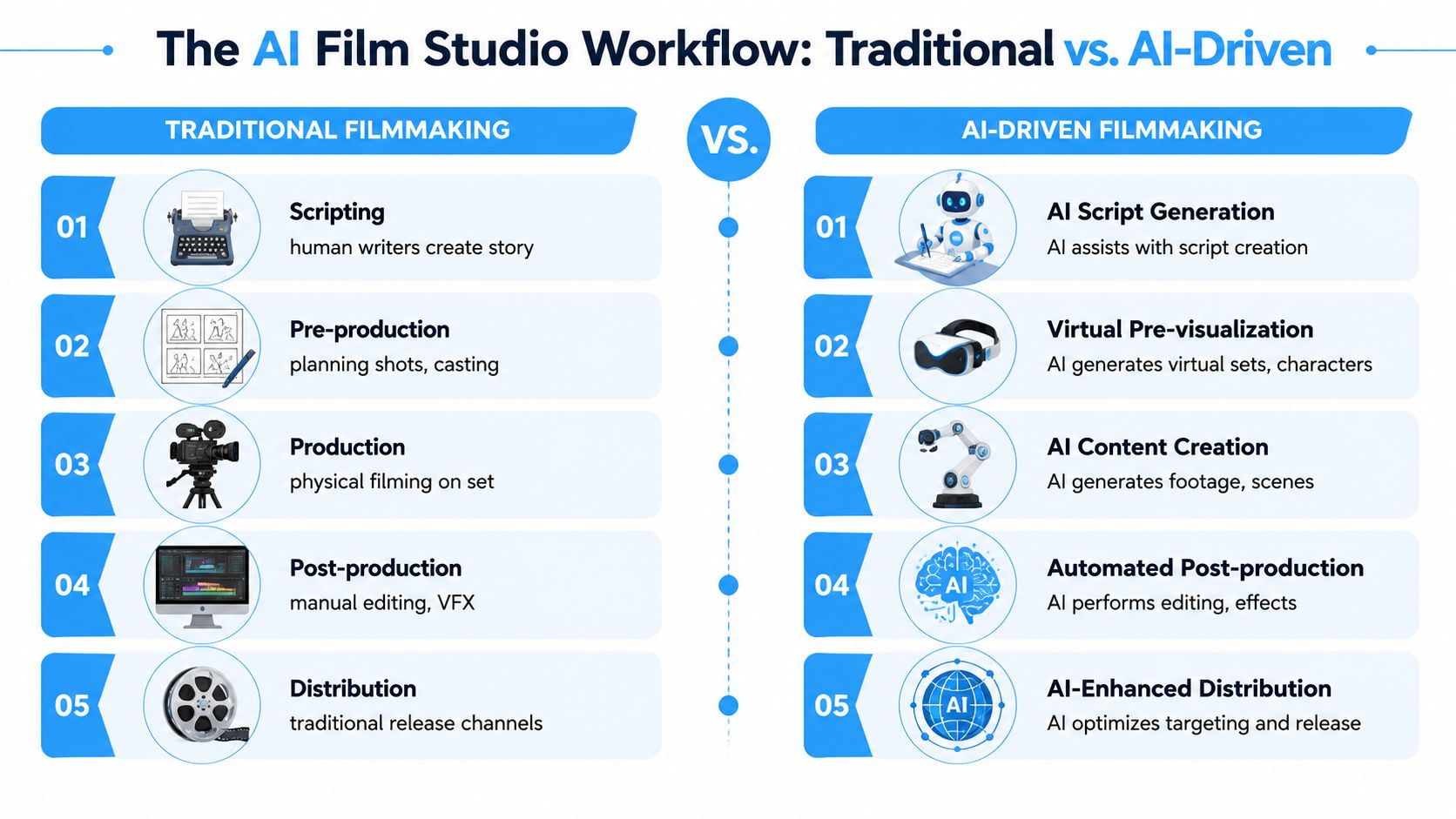
The easiest way to understand AI film studios is to think of them as a digital assembly line for stories. Not a rigid factory. More like a chain of creative stages where software handles first drafts, fast variations, and repetitive production work, while humans keep steering the result.
Industry use is already measurable. One survey found that 22.2% of projects in production were using AI tools, while a large-scale study found machine-learning indicators in 16.3% of over 10,000 films produced since 2010, according to the VAF research on AI usage in audiovisual projects. So this workflow isn't theoretical anymore.
The production chain
Most AI-led projects move through four broad stages.
Story development
A creator starts with a concept, outline, script draft, or scene list. Large language models can help brainstorm hooks, rewrite dialogue, generate alternate endings, or adapt one idea into multiple formats. Writers still need taste here. The machine can produce options, but it doesn't know which option is worth making.
If your work begins with written storytelling, resources like AI writing tools for novelists can be useful because they show how creators are using language models for ideation, drafting, and revision before anything gets visualized.
Pre-visualization
In this context, AI changes the economics fastest. Instead of hiring artists to mock up every early idea or waiting on a full storyboard process, teams can generate style frames, character references, rough environments, and shot concepts quickly. For readers who want a simple overview of this broader category, this explainer on what AI video is gives a practical foundation.
Scene generation and asset creation
Video models, image models, and animation tools create the raw material. A team might generate clips from prompts, transform still images into motion, create synthetic presenters, or build reusable characters and backgrounds. In many real workflows, the output still needs multiple passes to get continuity, motion, and composition right.
Post-production
Editing remains central, often making AI film studios appear less magical and more professional. Teams assemble clips, fix pacing, replace backgrounds, alter framing, generate voiceovers, add music, and clean up rough outputs. A lot of the “AI studio” advantage comes from compressing revision cycles, not from one-shot generation.
Traditional vs. AI film production workflow
| Stage | Traditional Production | AI Film Studio |
|---|---|---|
| Development | Writers draft scripts manually over multiple rounds | Writers use AI to generate options, outlines, and rewrites |
| Pre-production | Storyboards, casting, scouting, scheduling | Virtual moodboards, synthetic test scenes, digital character concepts |
| Production | Cameras, sets, actors, crew, location logistics | Generated footage, virtual scenes, hybrid capture, asset reuse |
| Post-production | Manual edit, effects, audio finishing | AI-assisted editing, voice generation, cleanup, reframing |
| Distribution | Fixed release plan and channel strategy | Faster adaptation for multiple formats and platforms |
Where people get confused
The biggest misunderstanding is assuming AI film studios remove the need for craft. They don't. They change where craft shows up.
Good AI production usually looks less like “press a button, get a film” and more like “generate, review, revise, combine, and direct.”
That's why many teams still spend most of their time on consistency, timing, and editorial judgment.
The New Business Models of AI Filmmaking
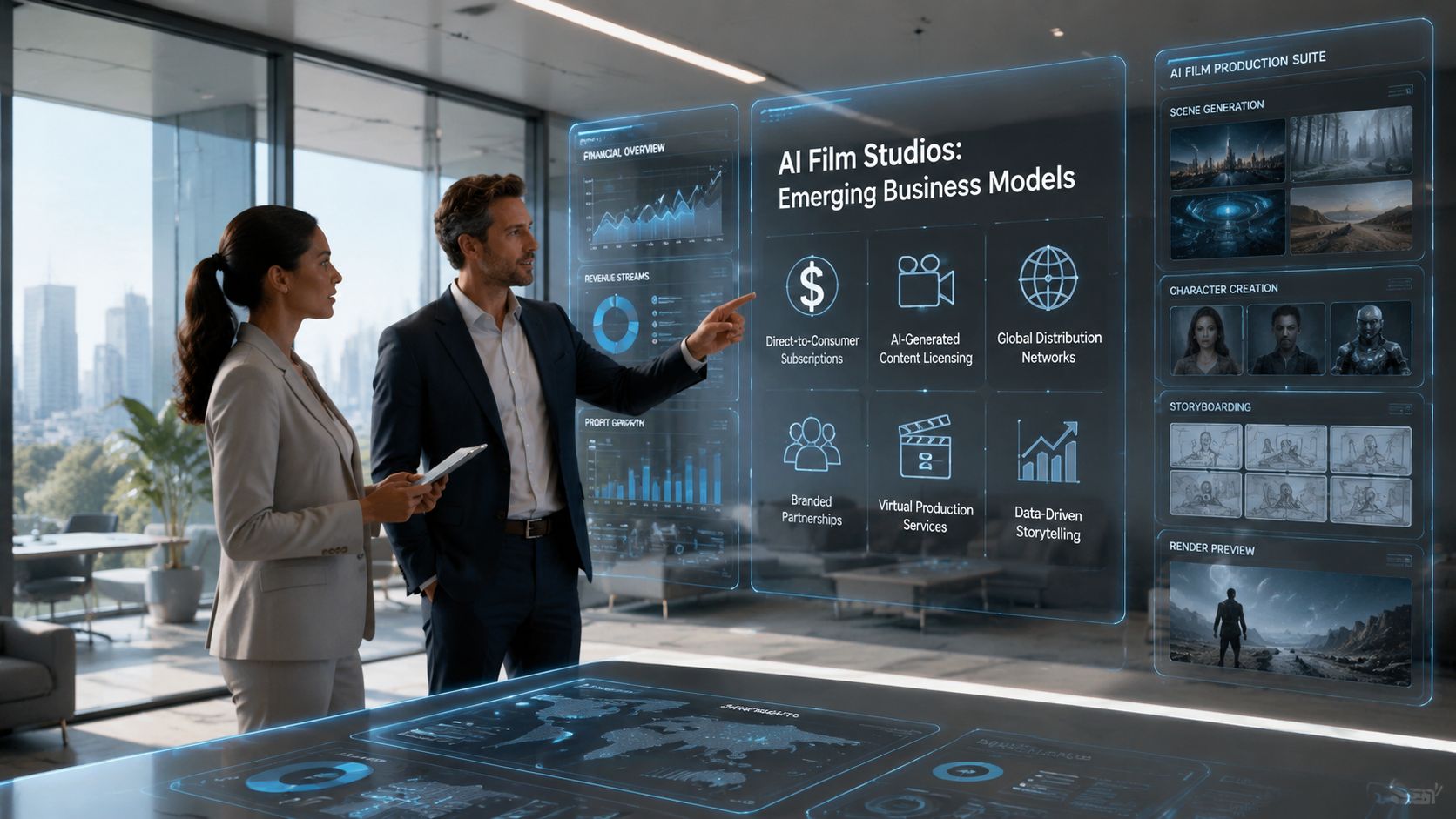
An AI film studio is only partly a technology story. It's also a business design story. The core question isn't just “Can AI make scenes?” It's “What kind of company becomes viable when production becomes more software-driven?”
Model one, the volume studio
Some AI-native teams are built around throughput. They produce lots of short-form videos, experimental series, branded clips, or niche entertainment assets. The idea is simple. If production gets cheaper and faster, the studio can test more concepts and publish more often.
This model fits internet distribution well. It's close to how some social-first media companies operate already. The difference is that AI reduces the labor needed for concept art, scene variation, voice work, and edit prep.
The weakness is obvious. More output doesn't automatically create better output.
Model two, the hybrid studio
This is likely the most durable model right now. A hybrid studio keeps humans in creative control and uses AI where it improves speed or flexibility. That might mean AI-assisted writing, virtual previz, background replacement, synthetic pickups, or style exploration before a live-action shoot.
This model works because it respects what clients and audiences still care about. They want distinct ideas, coherent stories, and controlled execution. AI helps the team get there faster, but it doesn't define the value by itself.
Model three, the platform business
Some companies won't become film studios in the classic sense at all. They'll become infrastructure providers for other creators, agencies, or brands. Their product is the workflow. They package prompt systems, templates, automation, character consistency, editing layers, publishing tools, and analytics into one platform.
That business can be attractive because the company doesn't have to bet on whether its own films become hits. It earns value by helping thousands of other teams produce content more efficiently.
Cheap production is not the same as market demand
The industry grows more honest. Commentary on AI studios keeps returning to one hard truth: low-cost production does not solve the audience problem. Stunning, inexpensive AI films may still fail because distribution, marketing, and audience taste matter just as much as production, as discussed in this analysis of AI studio economics and audience demand.
That point matters for founders and independent creators. A cheaper pipeline helps, but it doesn't create desire. If nobody wants the story, the cost of making it is almost irrelevant.
A related question for creators is how monetization changes when content production speeds up. This guide on how to make money with AI videos is useful because it connects production decisions to revenue logic instead of stopping at tool demos.
Here's a broader discussion that shows why the business model conversation has become central:
If AI lowers the cost of making content, the scarce asset becomes attention, trust, and taste.
That's why the strongest AI film studios will probably look less like automated movie factories and more like agile creative companies with sharp editorial judgment.
AI Studios for Creators and Brands
For most readers, the practical question isn't whether AI can change filmmaking at the studio level. It's whether these workflows are useful for the kind of content you need to ship every week.
They are. But the use cases differ depending on who you are.
For short-form creators
A faceless YouTube channel, TikTok page, or Instagram account already behaves like a miniature studio. You need repeatable formats, a recognizable style, a publishing calendar, and a way to turn one good idea into many pieces of content. AI fits that structure well because it helps with repetition without forcing every video to start from zero.
A creator might begin with a trend hook, generate variations of a script, create several visual directions, test different voiceovers, and then cut the same idea into platform-specific versions. That isn't filmmaking in the old sense, but it is studio logic. The creator is building a production system, not just making one video.
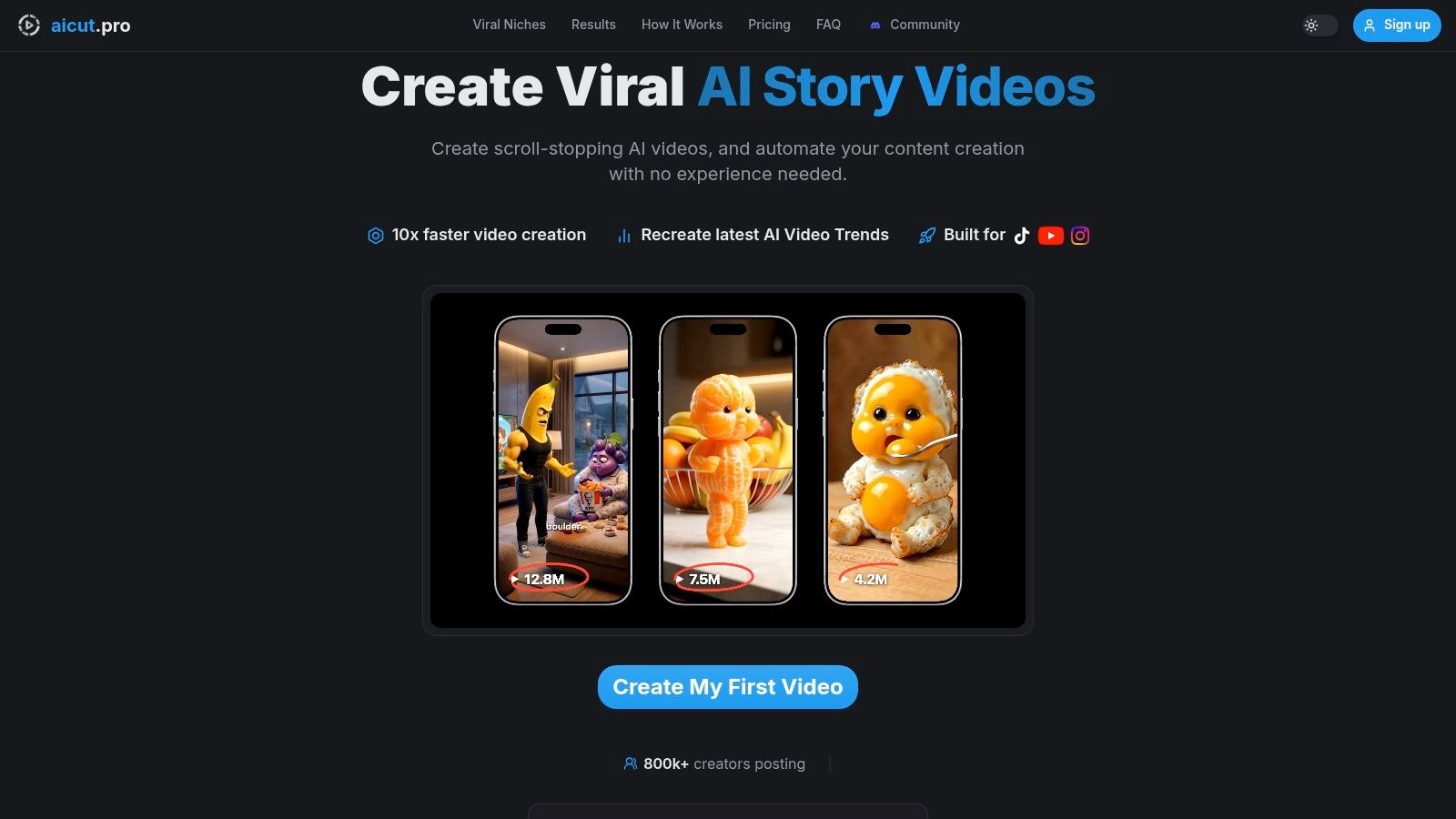
What makes this useful is control over repeatability. A creator can maintain a visual identity, reuse a proven format, and keep posting without rebuilding every scene manually. In practice, that often matters more than photorealism.
One example is Aicut, which packages this studio logic for short-form creators. It lets users work from viral-ready templates, clone prompts from existing video styles, swap characters or backgrounds in the editor, generate voiceovers, schedule posts, and manage publishing from one dashboard. That's not “a movie studio in a box.” It's a compact production workflow for creators who need regular output across social platforms.
For brands and marketers
Brands approach AI film studios from a different angle. They don't usually need a feature film pipeline. They need a way to generate and test creative assets faster.
That can mean:
- Ad variation: A team creates multiple versions of the same product concept with different hooks, visuals, or presenters.
- UGC-style content: Marketers produce social-native videos that feel informal and platform-specific without organizing a full shoot each time.
- Product visualization: Teams place a product in different environments, styles, or story setups before committing to a larger campaign.
- Fast localization: Editors adapt messaging, voice, or scene framing for different audiences and channels.
What both groups have in common
Creators and brands both benefit when AI reduces friction in revision.
A creator wants to test a new niche angle without spending days editing. A brand wants to change an offer, a product shot, or a spokesperson style without reopening a full production. In both cases, the AI film studio idea is less about spectacle and more about operational flexibility.
The strongest use case today isn't “make a blockbuster from one prompt.” It's “make more useful creative work with fewer production bottlenecks.”
That's why many teams start small. They use AI for a recurring series, an ad testing loop, a synthetic explainer, or a campaign support library. Once the workflow proves reliable, the studio model expands from there.
Navigating the Risks and Ethical Questions
AI film studios open new options, but they also create new responsibilities. The hardest issues aren't technical. They're legal, creative, and social.
Copyright and training concerns
The first tension is ownership. Creators want to know whether the tools they use were trained responsibly, whether generated outputs are safe to commercialize, and how much legal risk sits inside an AI-assisted workflow. Those questions don't have one simple answer because tools differ, licensing terms differ, and courts are still catching up.
For independent creators, the safest habit is basic caution. Know what platform you're using. Read the terms. Keep records of prompts, assets, edits, and source material. If a project matters commercially, don't treat asset provenance as an afterthought.
Deepfakes and trust
The second concern is deception. AI can generate highly persuasive people, voices, and scenes. That creates obvious creative opportunities, but it also creates risk when audiences can't tell what's real, authorized, or manipulated.
This isn't only about celebrity face swaps or political misinformation. It also affects brand trust. If a campaign uses synthetic people, cloned voices, or generated testimonials, the line between creative production and deception can get thin very quickly.
Labor and creative displacement
Another concern is work. Editors, illustrators, concept artists, VFX teams, translators, and production crews all see parts of their workflows changing. Some tasks will shrink. Others will mutate into supervision, cleanup, asset management, or direction.
That shift can feel threatening because it is a real shift. But “jobs disappear” is still too simple. In many cases, the work doesn't vanish. It becomes more pipeline-oriented. Someone still has to define style, check continuity, guide revisions, and decide what should ship.
Aesthetic sameness
There's also a creative risk that gets less attention. If too many creators rely on the same prompts, models, reference styles, and platform defaults, the output starts to blur together. The result isn't just mediocre content. It's a flattening of taste.
That's why human direction still matters. AI can produce many options, but it also tempts people to accept the first pass. Over time, that habit can make work feel interchangeable.
New tools increase creative surface area. They also increase the temptation to stop refining too early.
The ethical challenge is to use AI in a way that expands expression without reducing accountability.
Production Best Practices in an AI World
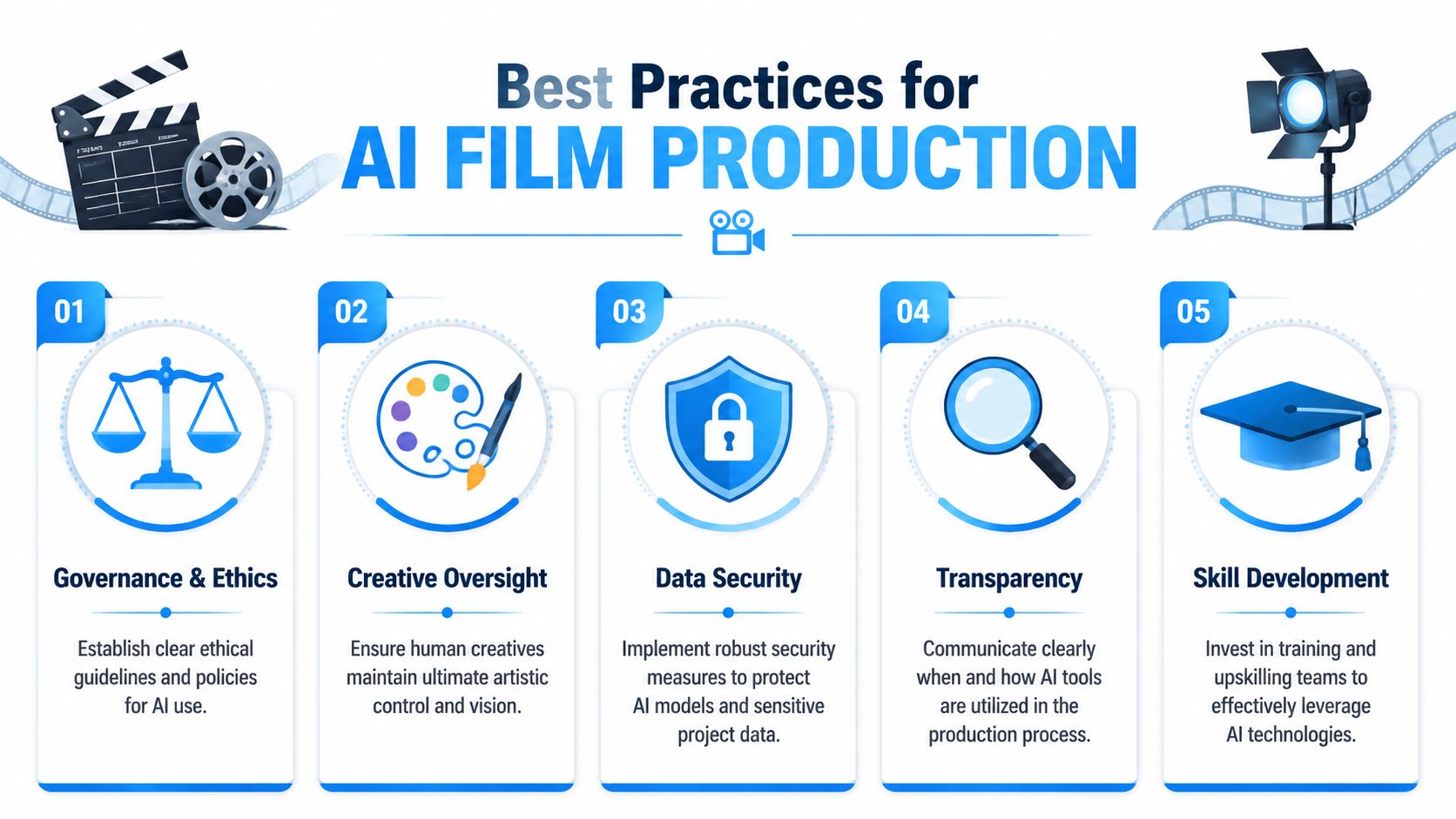
The strongest AI film studios don't run on prompts alone. They run on governance, review, and repeatable standards.
That's where the conversation in professional production has moved. Reporting notes that Amazon MGM Studios used roughly 350 AI-generated shots in House of David Season 2 and began a closed beta for AI production tools focused on character consistency, pre-production, and VFX pipelines, according to this report on AI integration in studio workflows. The takeaway isn't that AI replaced filmmaking. It's that a major studio treated AI as an operational layer inside a controlled pipeline.
Keep a human in charge
Some creators worry that AI takes away authorship. In practice, authorship often becomes more editorial. The human decides the brief, chooses references, rejects weak outputs, defines character behavior, and shapes the final cut.
If nobody owns those decisions, the work drifts. That's when continuity breaks, tone shifts randomly, and scenes feel generic.
Build for revision, not just generation
The smartest workflows assume the first output will be rough. They're designed for change.
- Save prompts and references: Reproducibility matters when a client asks for a version change later.
- Track approved assets: Character looks, environment styles, and voice settings need a stable record.
- Edit in layers: Keep narration, visuals, music, and timing flexible so you can swap one element without rebuilding the whole piece.
A lot of creators are moving toward systems that support this kind of repeated production. For teams focused on scaling output, guides about how to automate AI video are useful because they emphasize workflow design rather than one-off generation.
Treat consistency as a production problem
Character consistency, visual continuity, and shot logic are still where many AI projects fail. The fix usually isn't “use more AI.” It's tighter direction.
That means setting clear style rules before generation starts. What does the main character look like? What camera language fits the project? What shouldn't change between scenes? If you don't define those rules early, the model will improvise.
Use AI where it is strongest today
AI is especially useful when it helps you iterate without destroying previous work. Background swaps, reframing, synthetic pickups, style exploration, and post-production fixes often create more value than trying to generate an entire project in one pass.
Field rule: Use AI first where reshoots would be expensive, approvals are frequent, or variations are part of the brief.
That approach keeps control with the creator and lets the software do what it does best. Produce options quickly.
The Future of Storytelling Is in Your Hands
A small team can now operate like a studio. One person shapes the script, another manages prompts and visual references, and an editor turns those parts into a repeatable production line. That shift matters more than any single model release.
AI film studios are changing what a studio is. The old advantage was access to cameras, crews, and physical production capacity. The new advantage is having a system that can develop ideas, generate assets, revise quickly, and publish consistently without losing creative control. For independent creators, that can mean building a lean media business with a clear workflow instead of waiting for budget and infrastructure. For brands, it can mean testing more concepts and producing more versions of the same campaign without rebuilding everything from scratch.
The people who benefit most from this change are not the ones chasing every flashy demo. They are the ones who treat AI production like operations. They document style choices, set review steps, track rights, and protect the voice of the project. In practice, the competitive edge comes from judgment and process.
Storytelling is getting easier to produce. Making something worth watching is still the hard part.
That is why the smart way to start is small. Build one repeatable format. Create one set of character and style rules. Run a few projects, see where the software saves time, and notice where a human still needs to direct, edit, or say no. Studios are built that way, piece by piece.
If you're ready to apply that approach to short-form content, Aicut provides a workflow for generating, editing, scheduling, and publishing faceless AI videos from reusable templates and prompt-based systems. It's a practical way to build your own AI studio, one video at a time.