A faceless YouTube channel is exactly what it sounds like: you create videos without ever showing your face. Instead, you might use animations, screen recordings, or stock footage combined with a voiceover. This approach puts all the focus on the quality of your content, giving you privacy and making it much easier to scale your production.
The secret sauce is combining a profitable niche with a smart, AI-powered workflow.
Why Faceless Channels Are a Massive Opportunity
Ever come across those huge YouTube channels making serious money without anyone ever appearing on screen? That's not a fluke; it's a deliberate strategy that unlocks incredible creative freedom and business potential. The best part about running a faceless channel is that it removes the single biggest roadblock for most aspiring creators: the pressure of being an on-camera personality.
Instead of worrying about your appearance, lighting, or camera presence, you can put 100% of your energy into what actually matters—the value your content delivers. This model is incredibly popular for a few key reasons.
The Core Advantages
Privacy is a huge motivator for many. You get to share your expertise, tell great stories, or just entertain people without tying your personal identity to your work. This creates a much healthier work-life balance and shields you from the intense public scrutiny that on-camera creators often deal with. If you want a broader look at the concept, this overview of Faceless Video creation is a great place to start.
The real power of a faceless channel is its scalability. When the content isn't dependent on one person's face or physical presence, it transforms into a media asset that’s far easier to systematize, delegate, and grow.
This structure lets you build a true content engine. You can bring on writers, voice actors, and editors to handle production, turning your channel into a brand that runs like a well-oiled machine.
A Focus on Smart Execution
At the end of the day, success in this space comes down to smart execution, not personal charisma. By using powerful AI tools for scripting, voiceovers, and even generating visuals, the entire production process becomes remarkably efficient. You can dive deeper into how this has become a true game-changer by reading our guide here: https://www.aicut.pro/blog/the-rise-of-faceless-videos-a-game-changer-for-content-creators.
Think of this playbook as your blueprint for building a channel that thrives based on what you create, not who you are.
Finding a Profitable Niche You Can Dominate

Before you record a single second of audio or generate one frame of video, you have to pick your niche. This decision is everything. It's not just about what you like; it’s about finding a specific audience and giving them exactly what they’re looking for. You're aiming to carve out your own profitable corner of the internet.
The best faceless content usually fits into categories where the information or the vibe is the real star, not the person on camera. This is why channels dedicated to guided meditations, ambient music, or complex finance explainers do so well. The viewer isn't there for you—they're there for the value your content delivers.
The trick is to find that perfect overlap between what you’re genuinely interested in and what has proven demand. Your passion will get you through the early days, but the data will tell you if an audience is actually out there waiting.
Sizing Up Demand and Competition
Once you have a few ideas, it's time to see if they have legs. The simplest way to start is right in the YouTube search bar. Type in your keywords and pay close attention to the autocomplete suggestions. These are real-time clues into what people are actively searching for.
Next, go full-on detective mode. Look at the existing channels in that niche. Are the top videos all from huge, established creators, or are smaller channels breaking through? Seeing new channels find success is a fantastic sign—it means the algorithm isn't a closed shop. Look for their weak spots. Is the audio fuzzy? Are the thumbnails bland and uninspired? Every weakness you spot is an opportunity for you to do it better.
A classic mistake is picking a niche that's way too broad (like "gaming") or so specific it has no audience (like "1980s turn-based MS-DOS strategy games"). You want to find the sweet spot: a defined sub-niche like "beginner guides for modern soulslike games" that targets a clear, hungry audience.
Matching Your Content Style to the Niche
With a solid niche in mind, you need to think about the how. The format you choose will define your entire production workflow.
For example, different niches demand different approaches:
- True Crime: This is all about telling a great story. You can build an incredibly compelling video with nothing more than a solid voiceover, some well-chosen stock footage, and simple text animations.
- Tech Tutorials: Clarity is everything here. People want to see what you're doing, so screen recordings paired with crisp, no-nonsense narration is the way to go.
- Financial Summaries: You're dealing with complex data. Whiteboard animations or slick infographics are perfect for breaking down complicated ideas into visuals that are easy to understand.
To give you a better idea of what's out there, here’s a quick breakdown of some popular niches and what it takes to succeed in them.
Top Faceless YouTube Channel Niches
| Niche Idea | Content Style | Monetization Potential | Production Effort |
|---|---|---|---|
| Guided Meditation | Soothing voiceover, ambient music, peaceful visuals (stock or animated). | High (AdSense, affiliate marketing for wellness products, sponsorships). | Low |
| Financial Summaries | Data visualization, whiteboard animations, screen recordings, clear voiceover. | Very High (AdSense, high-ticket affiliate programs, courses, sponsorships). | Medium |
| Tech Tutorials | Screen recordings, voiceovers, animated graphics to highlight steps. | High (AdSense, affiliate links for software/hardware, sponsorships). | Medium |
| Reddit Narrations | Text-to-speech or human voiceover reading popular threads, simple background gameplay. | Medium (AdSense, merch). | Very Low |
| True Crime Docs | Storytelling voiceover, stock footage, archival photos, simple animations. | High (AdSense, sponsorships, Patreon). | High |
| Ambient Soundscapes | Looping audio (rain, fireplace), static or subtly animated image. | Medium (AdSense, primarily driven by long watch times). | Very Low |
As you can see, the path you choose has a direct impact on how much work you'll be doing and how you'll eventually make money.
The potential for these formats is staggering. Some of the biggest channels on the planet are faceless, proving you don’t need to be on camera to build an empire. A channel like '5-Minute Crafts,' with its 81 million subscribers, is projected to earn over $38 million a year from ads. That’s the power of creating great anonymous content. If you want to dive deeper, you can explore more about these high-earning channels to see what they're doing right.
Bringing Your Ideas to Life: The AI Production Workflow
This is where the magic really happens. Forget needing a studio or a camera crew—your content engine is a smart, repeatable workflow. We're going to break down the entire process, from a blank page to a published video, into a few simple, AI-powered stages.
Starting with a Killer Script
Every great video starts with a great script. This used to be the hardest part, but now it's where AI gives you an incredible head start.
Instead of staring at that dreaded blinking cursor, you can fire up a tool like ChatGPT and feed it a simple prompt. Ask it for a detailed outline on a topic, a full-blown script, or even five different video ideas based on a single keyword. This doesn't just crush writer's block; it helps you structure your content for viewer retention right from the start.
From Text to Voice
Once your script is locked in, you need a voice. In the past, this meant buying a decent microphone and learning audio editing or hiring a voice actor. Today, AI text-to-speech (TTS) has completely changed the game.
Modern AI voice generators are shockingly good. They can create natural, human-sounding narration in different styles, accents, and tones. You just copy-paste your script, pick a voice that matches your channel's vibe, and download a professional audio file in minutes. For anyone looking to create a faceless YouTube channel and produce content consistently, this is an absolute must.
The rise of automation and AI narration has revolutionized the faceless YouTube landscape in 2025, making it easier for individuals and agencies to manage multiple channels efficiently. Agencies now routinely run networks of 10 to 50 faceless channels, each targeting different niches. Discover more insights about running faceless channels at scale from Unkoa.com.
A quick word of caution: YouTube is perfectly fine with AI voices, but only if the content provides real value. Your videos need to be well-researched and thoughtfully produced, not just low-effort spam.
Finding the Right Visuals
With your narration ready, it's time to build the visual side of your video. This is where you get to define your channel's unique style, and AI can streamline the whole process.
You've got a few great options here:
Stock Footage: Sites like Pexels and Pixabay are goldmines for free, high-quality video clips. The key is to pick footage that captures the feeling of your script, not just a literal depiction of the words being said.
AI-Generated Images: This is where you can get really creative. Tools like Midjourney or DALL-E 3 let you create completely custom images from a simple text prompt. It's perfect for making one-of-a-kind thumbnails or specific visuals that you'd never find in a stock library.
AI-Generated Video: The new frontier. Platforms like Aicut, using models like Sora, can generate stunningly realistic video clips from text prompts alone. This unlocks endless possibilities for creating dynamic B-roll or even entire animated scenes without ever touching a camera. If you're curious, you can check out this curated list of the best AI video creation tools to see what's out there.
Putting It All Together
The final step is the edit. This is where you combine your voiceover, visuals, and maybe some background music into a polished final product.
Don't be intimidated—user-friendly editors like CapCut or Descript make this surprisingly easy. Many now come with built-in AI features that automatically cut out awkward silences or generate captions for you.
Tools like Aicut are built to make this even faster. You can upload your script, and the platform helps generate matching visuals and sync them perfectly with an AI voiceover. This kind of integrated workflow drastically cuts down your production time, letting you focus on what really matters: creating great content consistently and growing your channel.
Getting Your Videos Seen on YouTube
Making a great video is a huge accomplishment, but it's only half the job. The other half is making sure people can actually find it. You have to feed the YouTube algorithm the right signals, and that goes way beyond just stuffing a few keywords into your description.
Think of your title, thumbnail, and description as a coordinated set of instructions for YouTube. When they all work together, the algorithm knows exactly who to show your video to. Get it right, and you’ll see your views and subscribers climb. Get it wrong, and even a masterpiece can get buried.
Writing Titles and Descriptions That Get Clicks
Your video title is your digital handshake. It’s the first thing people see and a massive factor in how you rank in search results. The trick is to find that sweet spot between sparking human curiosity and satisfying the algorithm.
A title like "My New Video" tells nobody anything. It's a complete waste. But something like "How to Animate History Videos for a Faceless Channel" is a different story. It's specific, packed with keywords, and promises a clear solution to a real problem.
Your description is where you can really give YouTube the full picture. Don't just toss in a single sentence and call it a day. Write a solid paragraph or two that naturally includes your main keywords and any related terms. Explain what the video covers and what viewers will walk away with. This extra context helps YouTube understand your content on a deeper level, which means better recommendations.
A well-optimized video description is like a detailed memo to the YouTube algorithm. The more you tell it about your content, the better it can match your video with the right viewers. This is a huge lever for boosting your organic reach.
The Art of the Clickable Thumbnail
Thumbnails are basically your video's billboard on a very crowded highway. The data doesn't lie: 90% of the best-performing videos on YouTube use custom thumbnails. People see your thumbnail before they even read your title, so it has to make them stop scrolling.
For a faceless channel, a winning thumbnail usually has a few key ingredients:
- High Contrast: Think bold, bright colors that pop against YouTube's white, gray, and black interface.
- Minimal Text: Stick to three or four powerful words that create a sense of mystery or urgency.
- Clear Imagery: The image itself should instantly communicate what the video is about.
This flowchart maps out the entire AI-driven production process, from writing the script all the way through to generating the final visuals.
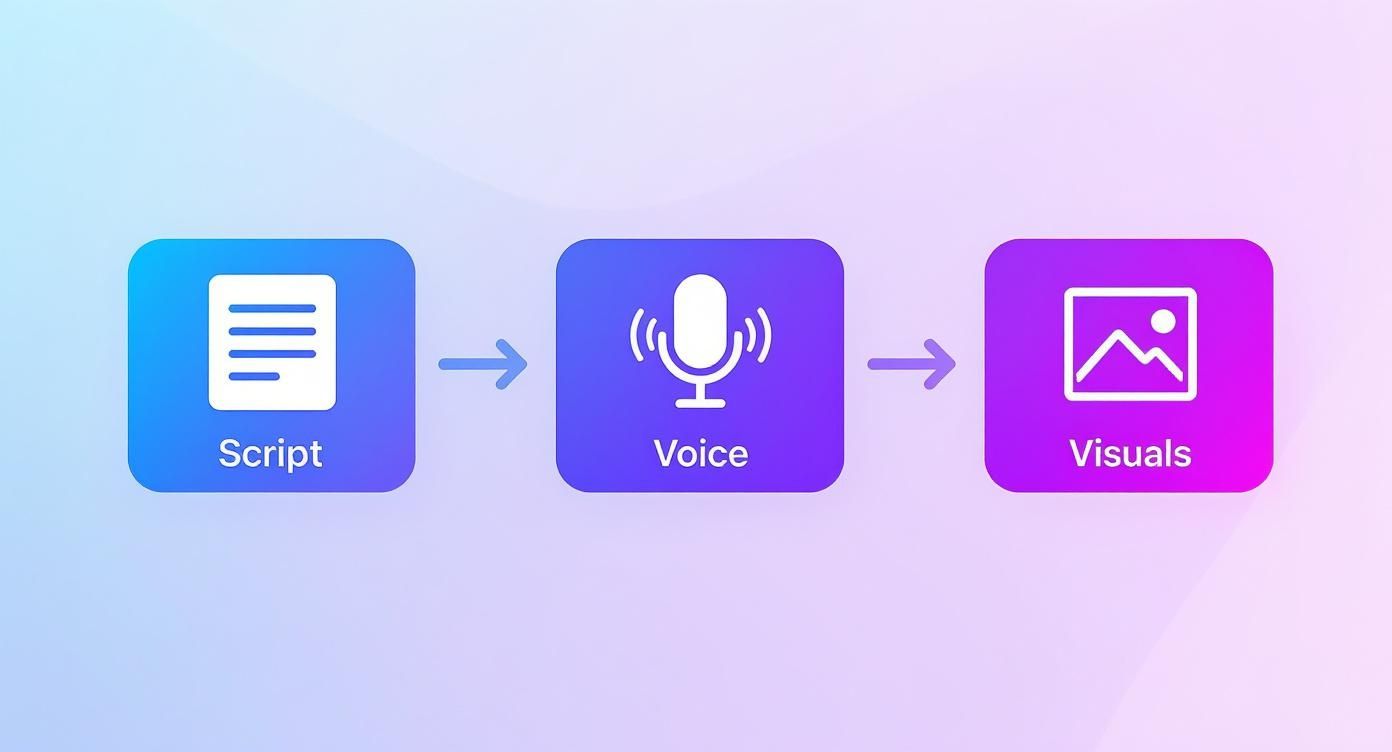
It’s a good reminder of how each step logically flows into the next. Having a structured process like this is key to keeping your quality high and your workflow efficient.
Sticking to a Consistent Publishing Schedule
Consistency is one of the most powerful signals you can send, both to your viewers and to YouTube. When you publish on a predictable schedule—whether it’s once a week or twice a month—you start building a real relationship with your audience. They know when to show up for new content, which turns casual viewers into loyal subscribers.
This rhythm also tells the YouTube algorithm that your channel is alive and kicking. To really make your faceless channel take off, you need to combine a steady content schedule with smart optimization. Mastering the latest YouTube SEO best practices is non-negotiable if you’re serious about growing your audience and building a sustainable channel.
Monetizing and Scaling Your Faceless Channel

Okay, so your content engine is humming and you're starting to build a real audience. What's next? It's time to think bigger and turn this channel into an actual business. Getting into the YouTube Partner Program is a great first goal, but relying on ad revenue alone is a rookie mistake. It's like having a business with only one customer.
Think of ad money as your base salary. It's the proof that you've got an audience that cares. But the real wealth is built on top of that foundation. This is where being faceless is a massive advantage—you can focus entirely on the business side without getting bogged down by personal branding.
Diversifying Your Income Beyond Ads
The smartest faceless channels I've seen treat ad revenue as just one part of their income pie. They're masters at weaving other monetization methods into their content, which not only makes them a lot more money but also gives their audience more value.
Here are a few of the most effective income streams that work incredibly well for anonymous creators:
Affiliate Marketing: This is the lowest-hanging fruit. You simply recommend products, software, or services you genuinely believe in. When someone buys through your link, you get a cut. If you run a channel about productivity software, you link to the tools you use. If you have a meditation channel, you can link to wellness products. It just makes sense.
Selling Digital Products: This is where you can build serious, scalable income. Your content is all about sharing knowledge, so why not package up your best insights into a premium product? This could be an ebook, a set of templates, a detailed guide, or even a full online course that solves a major pain point for your viewers.
Sponsorships: Once your channel gets some traction, brands will start noticing. They'll pay to get their message in front of your audience. Since you're not on camera, these are super easy to produce—usually just a simple voiceover read integrated into your video.
A Real-World Monetization Example
The potential here isn't just a few extra bucks; it's life-changing money. Take a channel like 'How to AI,' for example. It's estimated to pull in around $80,000 every single month. The crazy part? Only about $10,000 of that is from YouTube ads. The other $70,000 comes from a smart mix of course sales, affiliate links, and brand sponsorships. That's how a faceless channel becomes a multi-million dollar business.
Knowing When and How to Scale
Once the money starts rolling in, you'll hit a new challenge: scaling without burning yourself out. The solution is to reinvest a portion of your profits back into the business to buy back your time.
Don't fall into the trap of doing everything yourself forever. The goal is to transition from creator to business owner. Your first hire, whether a freelance scriptwriter or a video editor, is a major step toward building a sustainable media brand.
Figure out what the biggest bottleneck in your workflow is. For most creators, it's editing. Hiring a good editor can instantly free you up to focus on the high-level strategy, research, and planning your next batch of videos. As you grow, you could even launch a second channel in a related niche to build your own little media empire.
For a deeper dive into these strategies, check out our guide on https://www.aicut.pro/blog/how-to-earn-money-with-faceless-youtube-videos.
Common Questions About Faceless Channels
Jumping into the world of faceless content creation usually brings up a handful of good questions. It's a different way of doing YouTube, so it's smart to get some clarity before you dive in. Let's tackle some of the things I hear most often from new creators.
Can You Really Make Money with This?
Absolutely. The idea that you have to be an on-camera personality to make a real living on YouTube is a total myth. I’ve seen countless faceless channels become incredibly profitable—often pulling in more revenue than traditional vlogging channels.
Success isn't about your face; it's about the value you deliver. If you lock in on a high-demand niche, consistently create amazing content, and get smart about monetization, you can build a legitimate business. Ad revenue from the YouTube Partner Program is a great start, but the top earners don't stop there.
The most successful faceless channels treat ad revenue as just one piece of the puzzle. They build multiple income streams through affiliate marketing, selling their own digital products like templates or guides, and securing brand sponsorships.
Are AI Voices and Content Allowed on YouTube?
Yes, but there's a huge catch. YouTube is perfectly fine with AI-generated or synthetic media, including AI voices, as long as it adds value and isn't just lazy, spammy content. The platform wants to reward videos that engage and inform people, no matter how they were made.
So, for example, using a high-quality AI voice to narrate a well-researched documentary? Totally fine. Just churning out auto-generated videos with repetitive, low-effort content? That's a quick way to get your channel flagged. What really matters is your creativity and the originality of your ideas.
How Much Does It Cost to Start?
Starting a faceless channel can be surprisingly cheap. You can genuinely get going with a budget of $0 by using free tools for video editing, thumbnail design, and grabbing stock footage from sites like Pexels. This makes it one of the most accessible online businesses you can start today.
That said, a small investment can make a huge difference in your workflow and the quality of your content. Spending $20 to $100 per month on subscriptions for premium stock footage, or advanced AI tools for scripts and voiceovers, can seriously speed things up. That initial investment often pays for itself pretty quickly through faster growth.
How Long Until You See Results?
This is the million-dollar question, and the honest answer is: it depends. Hitting the YouTube Partner Program requirements—1,000 subscribers and 4,000 watch hours—is the first major goal for most. Some creators manage to do this in three to six months, but for others, it might take a year or more.
The biggest things that will affect your timeline are:
- Your Niche: A high-demand, low-competition niche will get you there much faster.
- Content Quality: Genuinely engaging videos earn more watch time, which is the key metric.
- Consistency: A regular publishing schedule tells the algorithm your channel is active and worth recommending.
Ready to streamline your video creation and build your faceless empire faster? Aicut provides the AI tools you need to generate scripts, voiceovers, and high-quality visuals in minutes. Start creating with Aicut today!