So, you're thinking about starting a faceless YouTube channel. The good news is that you can build a seriously profitable brand without ever showing your face on camera. It really boils down to four key moves: picking a solid niche, building a repeatable content system, using AI tools to do the heavy lifting, and setting up your channel to get discovered.
The Modern Blueprint for Faceless YouTube Success
Running a faceless YouTube channel has gone from a niche hobby to a full-blown business model. It's a huge part of the creator economy now. What used to be a little trick for camera-shy creators is now a strategic choice for people who want efficiency and scalability without being tied to a personal brand. This guide is your complete blueprint, designed to take you from a simple idea to making real, consistent income.
The whole concept is to build a content engine that just works. You're not the star of the show; the content is. The goal is to deliver value through systems that are repeatable and, eventually, automated. This is exactly where modern AI tools come in, transforming what used to be a grueling editing process into a much simpler workflow.
The Big Shift in the Creator Economy
The move toward faceless content is picking up serious steam. Back in 2022, faceless channels on YouTube and TikTok made up only about 12% of new monetized channels. Fast forward to today, and projections show they could hit 38% by 2025. That’s a massive 217% jump in just three years.
What this means is that nearly four out of every ten new monetized creators are building anonymous brands right from the start. They're leaning on AI voiceovers, stock footage, and generative AI instead of filming themselves. It's a fundamental shift in how content gets made.
This isn't just about hiding your face; it’s about building an asset. A faceless channel is a scalable media property that can generate revenue through ads, affiliate marketing, and digital products without being tied to a single person’s identity.
Your Foundational Pillars for Success
To make this work, you need to nail a few key areas. Just knowing what is a faceless YouTube channel is step one; the real challenge is in the execution. Think of yourself as running a small media company, not just being a vlogger. It’s all about the system.
Let's break down the essential pillars you need to build your channel on. Getting these right from the beginning will save you a ton of headaches later.
Core Pillars of a Profitable Faceless Channel
| Pillar | Key Objective | Example Action |
|---|---|---|
| Niche & Format Selection | Find a profitable audience and a content style you can produce consistently. | Choose the "Reddit Story Narration" format in the high-CPM finance niche. |
| AI Content System | Create an efficient workflow for scripting, voiceover, and video editing. | Use a tool like Aicut to generate a voiceover from a script and then create visuals with AI. |
| Channel Optimization | Maximize discoverability with smart branding, SEO, and killer thumbnails. | Research keywords like "passive income ideas" and design a high-contrast thumbnail that pops. |
| Monetization Strategy | Don't just rely on ads. Branch out with affiliate marketing, digital products, and sponsors. | Add affiliate links for financial tools you mention in your video description. |
Mastering these four pillars is the difference between a channel that fizzles out and one that becomes a reliable source of income.
Choosing Your Niche and Content Angle
Before you even think about software or video editors, we need to talk about the single most important decision you'll make: your niche. This choice is the bedrock of your entire channel. It determines who you're talking to, what kind of videos you'll make, and ultimately, how you'll make money.
Let's cut through the typical "follow your passion" advice and get real. You need a strategic approach to find a corner of YouTube you can own without ever showing your face.
It really comes down to a trade-off between two kinds of niches.
High-CPM Niches: Think finance, tech reviews, or software tutorials. Advertisers pay top dollar to get in front of these audiences, so your earnings per thousand views (the CPM) can be huge. The catch? The competition is absolutely brutal, but the financial payoff for each viewer is much higher.
High-Volume Niches: This is the world of meditation music, true crime stories, or relaxing nature scenes. The CPM is lower, no doubt, but the potential audience is enormous. Your strategy here is to rack up millions of views to build a serious income stream.
Neither one is better than the other—it all depends on your goals. Are you aiming to build a tight-knit, high-value community, or are you chasing the thrill of going viral with content that has mass appeal?
Pinpointing Proven Faceless Formats
Once you've got a niche in mind, the next question is how you'll present your content. This is your format. If you're wondering how to get a faceless channel off the ground quickly, the answer is simple: don't reinvent the wheel. Find a proven format and make it your own.
Some of the most popular and effective faceless formats killing it right now are:
Animated Explainers: These are perfect for breaking down complicated ideas into slick, easy-to-digest animations. Channels like Kurzgesagt are masters of this, making complex science feel simple and look incredible. It's a natural fit for educational or tech-focused content.
Reddit Story Narrations: This format has absolutely blown up. It's a simple but brilliant formula: find a great story on a subreddit like r/AskReddit, narrate it with an AI voice, and lay it over some basic gameplay footage. The effort is low, but the potential for viral views is massive.
POV (Point of View) Scenarios: These videos drop the viewer directly into an experience. Using first-person visuals and immersive sound, you can create anything from a "day in the life of a pilot" to a simulated walking tour of ancient Rome.
The most important thing here is consistency. A simple video that you can reliably publish every single week will always beat a complex masterpiece that only comes out once a month.
The Aicut Advantage: Viral Templates
This is where you can really speed things up. Instead of building every video from the ground up, you can use templates designed specifically for these proven formats. For instance, a tool like Aicut offers viral niche templates that give you a ready-made structure for popular styles like Reddit narrations. This takes a ton of the guesswork out of production, letting you focus on what really matters—finding great stories and ideas.
To make sure you're not building a channel around a dying trend, it's smart to do a little research and learn how to find what's trending right now. And for a much deeper dive into which niches are popping off, we put together a guide on the best faceless YouTube niches that looks at the actual data behind today's biggest opportunities.
Aligning Niche with Monetization
Last but not least, you need to be thinking about money from day one. Your niche directly impacts your monetization options.
| Niche Category | Primary Monetization Method | Example Faceless Channel Idea |
|---|---|---|
| Finance & Investing | High-CPM Ads, Affiliate Marketing (for tools) | Whiteboard animations explaining stock market concepts. |
| Tech & Software | Affiliate Marketing, Sponsored Reviews | Screen-recorded tutorials for a new AI software. |
| Health & Wellness | Ad Revenue, Digital Products (e.g., guided meditations) | A channel with calming music and nature visuals for sleep. |
| History & Storytelling | Ad Revenue, Patreon Community | Narrated historical events using stock footage and maps. |
When you line up your niche, format, and monetization plan right from the start, you're not just creating a channel—you're building a business. This clear, strategic vision is what sets you up for real, sustainable growth long before you ever hit that first "publish" button.
Building Your AI-Powered Content Machine
With your niche and format figured out, it's time to build the engine that will actually pump out your videos. This is where the real work—and the real magic—happens. We're going to turn your ideas into polished, engaging videos, and we'll use AI to do most of the heavy lifting.
A solid workflow is what separates a channel that posts a few videos and then disappears from one that consistently grows. The goal here isn't to get bogged down in complicated software. It's to create a simple, repeatable system that's fast, scalable, and makes videos people actually want to stick around and watch.
Let's walk through it, from the initial script all the way to the final visuals.
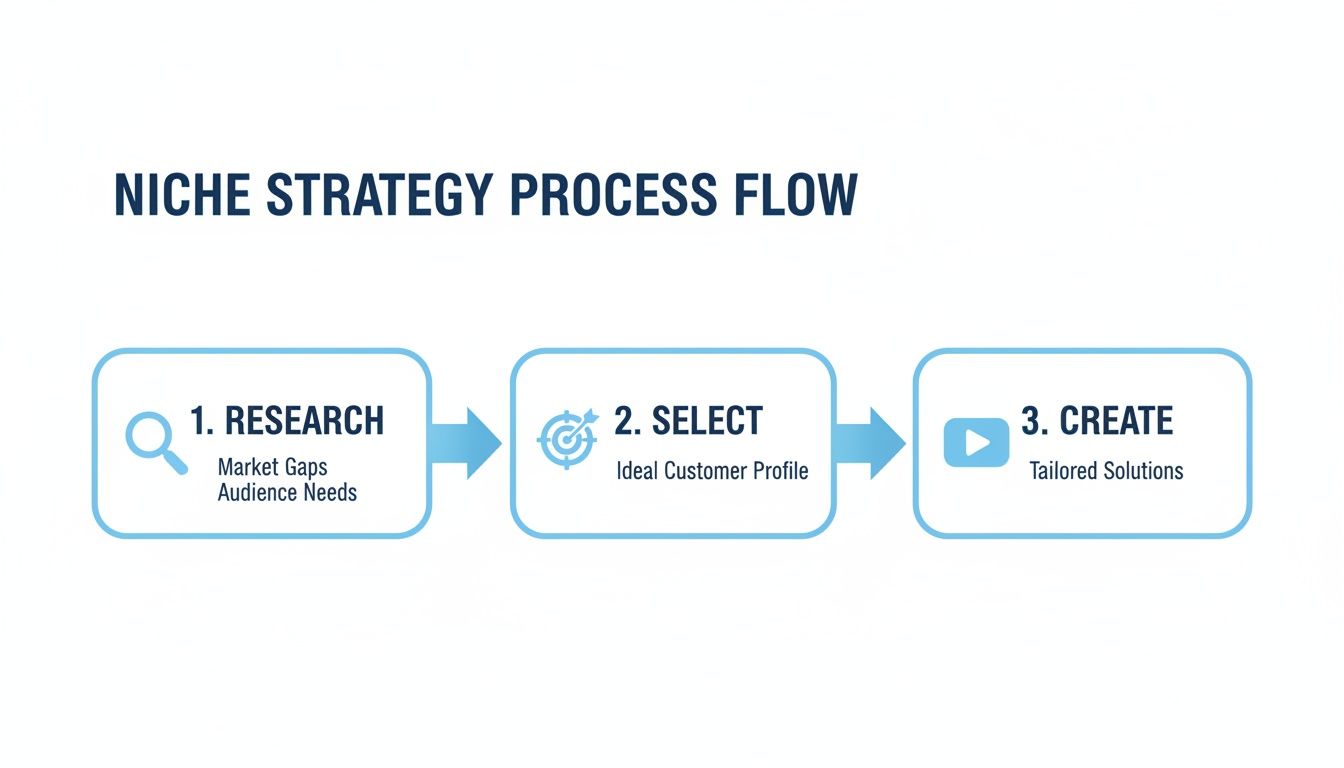
This flowchart breaks down the big picture. You research, you select a direction, and then you start creating. Having this structure in mind prevents you from just randomly making videos with no clear strategy.
From Idea to Script in Minutes
Every single good video starts with a good script. It's the foundation. But staring at a blank page is a motivation killer. Thankfully, AI can get you from zero to a full script in no time.
Let's say you have a history channel. Instead of spending hours researching and writing, you could give an AI a prompt like: "Write a 5-minute YouTube script about the Great Emu War of 1932. Make it a fun, narrative story. Start with a strong hook and end with a call to subscribe for more weird history."
Another popular method, especially for news or analysis channels, is to find a detailed article on your topic and have an AI summarize it directly into a video script. Just remember to be mindful of the ethical considerations when using AI for content creation to keep your content original and responsible.
Getting a Realistic AI Voiceover
Once your script is ready, you need a voice. The good news is you don't need a $500 microphone or the confidence of a seasoned narrator. Today's AI voice generators sound incredibly human—so much so that most viewers will never know the difference.
Modern tools give you a huge library of voices, accents, and tones to choose from. You can find the perfect voice to match your channel's vibe, whether that’s a deep, authoritative voice for a finance channel or a friendly, upbeat one for a "Top 10" list. You just paste your script, pick a voice, and hit generate.
Pro Tip: Spend a little time auditioning a few different AI voices. Once you find one that fits your brand, stick with it. A consistent voice is a powerful branding tool that helps make your channel instantly recognizable.
Creating Visuals with AI Video Generators
This is where things get really exciting. You can now generate custom video clips from text prompts, turning your script and voiceover into a full-fledged video without touching a stock footage site or learning animation. For anyone trying to figure out how to create a faceless YouTube channel, a tool like Aicut is an absolute game-changer.
Instead of just slapping your voiceover on top of generic B-roll, you can create visuals that perfectly match what you're saying. The trick is to be descriptive with your prompts.
Here’s how this works in practice for a few popular formats:
Reddit Narrations: Forget the stale gameplay footage. If you're narrating a story from r/talesfromtechsupport, use prompts like: "POV shot of a person staring at a computer screen with a blue screen of death, dark room, cinematic" or "Close-up of fingers typing furiously on a keyboard, light from the monitor illuminating the hands."
Commentary Channels: You can bring static images to life. Aicut lets you upload a photo of a person or character and animate their mouth to sync with your audio. This is way more engaging than just showing a still image while you talk.
Affiliate Marketing Reviews: Need authentic-looking user-generated content (UGC)? You can generate that, too. A prompt like, "A smiling woman in her 30s unboxing a new phone in her living room, looking excited, UGC style," can create a trustworthy visual without you ever needing to hire an actor or ship a product.
Putting It All Together
The real power here is speed. By chaining these AI tools together, you can slash your production time from days to just an hour or two. To see how you can make this even more hands-off, check out our guide on how to automate AI video production.
This integrated system means you can move from a simple idea to a finished, professional-looking video faster than ever. That speed is what allows you to maintain a consistent publishing schedule—one of the most important things for growing on YouTube.
Setting Up Your Channel for Maximum Growth
Look, making great videos is a huge part of the puzzle, but it's only half the battle. If nobody ever finds your stuff, even the best video on earth will sit there with zero views. This is where channel optimization comes in.
It’s the crucial next step that turns your content production into a real discovery machine. We're moving past the basic "create account" phase and diving into the details that actually drive growth. This means getting your channel name right, building a professional brand identity, and mastering the art of YouTube SEO.
Think of your channel like a shop on a busy street; you need a great sign out front and a clear window display so the right people walk in.
Nailing Your Channel Name and Branding
Your channel's name and visual branding are the very first things anyone sees. They have to be professional, easy to remember, and instantly tell people what you're all about. This is even more critical for a faceless channel because your brand has to do all the heavy lifting of building trust without a human face.
Start by brainstorming names that are catchy and hint at your niche. If you’re in finance, something like "Pixel Profits" or "Market Matrix" is far more compelling than a generic name. Once you land on something you like, you can use AI image generators to whip up a logo and channel banner. A simple prompt like, "minimalist logo for a history channel, ancient scroll and magnifying glass, clean lines, white background," can give you surprisingly professional results in seconds.
The Foundation of YouTube SEO
Never forget that YouTube is the world's second-largest search engine. To win, you have to treat it like one. That means doing your homework—specifically, keyword research—to figure out what your audience is actually searching for.
A great place to start is YouTube's own search bar. Just type in a broad topic from your niche, like "passive income," and watch the autocomplete suggestions pop up. Those aren't guesses; they are real searches from real people. It's a goldmine for video ideas.
Go for Long-Tail Keywords: Instead of trying to rank for a massive term like "investing," get more specific. Target long-tail keywords like "best dividend stocks for beginners 2024." The competition is lower, and the viewer you attract is much more engaged.
Analyze Your Competitors: Check out the successful channels in your space. What kinds of keywords are they putting in their titles and descriptions? Certain browser extensions can even show you the exact tags they're using on their videos, giving you a direct look into their playbook.
The sweet spot is finding keywords with decent search volume but low competition. Answering a specific question that people are actively asking is one of the fastest ways to get a new channel off the ground.
Crafting Titles and Descriptions That Actually Work
Your video title is your number one hook. It needs to be interesting enough to make someone click but also optimized for the YouTube algorithm. The best titles blend a target keyword with a powerful emotional trigger or a clear promise of value.
For instance, a bland title like "Investing Tips" will get lost. A much stronger title would be: "My 7 Favorite Dividend Stocks for Passive Income (2024)." This version has a keyword, a number to draw the eye, and a specific promise.
Your video description, on the other hand, is where you give YouTube's algorithm all the context it needs.
- The First 2-3 Sentences: This is prime real estate. Repeat your main keyword in a natural way and summarize the video's core value. This little snippet often shows up directly in search results, so make it count.
- A Detailed Summary: Below the fold, write a couple of short paragraphs that go into more detail. Weave in related keywords and synonyms to give the algorithm a full picture.
- Timestamps: Breaking your video into chapters with timestamps is a huge win. It helps viewers navigate your content and can even lead to "key moments" from your video appearing in Google search results.
Designing Thumbnails That Demand a Click
I can't overstate this: your thumbnail is arguably the single most important factor in whether people watch your video or scroll right past it. It’s your visual billboard in a sea of options.
A truly great thumbnail nails three things:
- High Contrast: Use bright, bold colors that pop off the page. A common and effective trick is to use a vibrant background with a clear subject in the foreground that has a white or black outline.
- An Emotional Hook: Even without a face, you can convey emotion. For a finance video, an image of a stock chart rocketing upwards with a big green arrow creates a feeling of excitement and opportunity.
- Minimal Text: Keep it to 3-5 big, easy-to-read words at most. The text should amplify the video's core idea, like "INSTANT RESULTS" or "AVOID THESE MISTAKES."
When you combine smart SEO with thumbnails people can't resist, you give your content its best shot at getting discovered, watched, and shared. This isn't luck; it's a system.
Scaling Your Content and Automating Operations
Once you’ve got your content machine humming and your channel is optimized, the game changes. It's no longer just about creation; it's about consistency. This is the exact point where so many creators hit a wall and burn out. But for you, this is where you’ll pull ahead by shifting your thinking from a simple YouTuber to a full-fledged media operator.
Scaling a faceless channel is all about building systems that work for you, allowing you to publish great content on a regular schedule without killing yourself in the process. Think of it as building a content engine. Like any engine, it needs a steady supply of fuel and regular tune-ups to keep it running at peak performance.
Finding Your Publishing Rhythm
The YouTube algorithm definitely loves consistency, but let's be clear: "consistency" doesn't mean you have to churn out a new video every single day. The right publishing frequency is completely tied to your niche and the kind of videos you're making.
If you’re producing intricate, animated history documentaries, getting one high-quality video out per week is a massive win. But if your channel is all about narrating Reddit stories with YouTube Shorts, you might need to post several times a day just to keep up. The goal isn't to hit some arbitrary number. It's to set a reliable schedule your audience can count on.
Here’s how to find your sweet spot:
- Production Time: Honestly, how long does it take you to get one video done from start to finish using your AI tools? No sugarcoating.
- Niche Expectations: Take a look at the top channels in your space. How often are they posting? This gives you a solid baseline for what the audience is used to.
- Content Format: Long, deeply researched videos just take more time. Shorts and clip-based content are built for volume.
Once you’ve found a rhythm you can stick with, your next job is to automate everything you possibly can.
Building Your Automation Workflow
This is where the magic of a faceless channel really kicks in. Automation isn’t about being lazy; it's about being smart. It frees you up to focus on the big-picture strategy—like brainstorming new video ideas or exploring different ways to make money—instead of getting bogged down in repetitive, manual tasks.
This is exactly what tools like Aicut are designed for. It’s more than just a video generator; it’s an operational command center for your content. You can build out entire workflows that take a simple idea and push it all the way to a published video with very little hands-on effort.
Think about it: you could schedule a full week's worth of Shorts for YouTube, TikTok, and Instagram in a single afternoon. That isn’t some far-off dream; it's what the most successful faceless creators are doing right now. Auto-posting to different platforms from one dashboard is a huge advantage.
By automating the tedious work of uploading, scheduling, and cross-promoting, you get back hours of your life every single week. This is time you can reinvest into figuring out what's working and doing more of it.
Using Analytics to Systematically Improve
Your YouTube Analytics dashboard is your roadmap. It's not just a place to see vanity metrics; it’s direct feedback from your audience and the algorithm telling you what to do next. Instead of just guessing what video to make, you can use real data to make smart decisions.
Pay close attention to these key metrics:
- Click-Through Rate (CTR): This number tells you how well your titles and thumbnails are working. A low CTR (think below 4%) is a red flag that your packaging isn't grabbing attention, no matter how amazing the video itself is.
- Audience Retention: This graph shows you the exact moment viewers get bored and leave. See a massive drop in the first 30 seconds? Your hook isn't strong enough. If everyone clicks away at the same spot, go back and analyze what's happening right there in the video.
- Traffic Sources: Where are your views actually coming from? If you see "YouTube Search" is a top source, that’s a huge signal that your SEO is working. Double down on creating more content around those winning keywords.
By checking these numbers regularly, you can turn content creation into a science. You stop throwing ideas at the wall to see what sticks and start producing videos that you know have a much higher chance of success. This data-driven approach is the final piece of the puzzle for scaling your faceless channel into a real, sustainable business.
Monetization Strategies Beyond AdSense
Getting into the YouTube Partner Program is a huge win, don't get me wrong. But thinking AdSense is the finish line is a massive mistake. For most successful faceless channels, it's just the very beginning.
The reality is, relying only on ad revenue is like building a house on a foundation of sand. The algorithm shifts, CPMs drop, and suddenly your income is unpredictable. The real money—the kind that builds a sustainable business—comes from creating multiple income streams that you control.
Unlocking Affiliate Marketing Revenue
Affiliate marketing is probably the easiest and most natural next step for any faceless channel. It’s simple: you talk about a product or service you use and like, drop a unique link, and you get a cut of every sale that comes through it. This is a goldmine for niches like tech reviews, finance, and software tutorials.
Think about it. If you run a channel reviewing AI tools, every single tool you mention can be an affiliate link. A history channel? You can link to every book you reference on Amazon. The golden rule here is authenticity. Only push products you genuinely think are valuable. Your audience can smell a disingenuous sales pitch a mile away, and trust is the only currency that matters.
For many channels, affiliate income doesn't just supplement AdSense—it completely blows it out of the water. You're being directly rewarded for the trust you've built, and commission rates often crush what you'd make from ads.
Selling Your Own Digital Products
This is where the game really changes. When you create and sell your own digital products, you're looking at profit margins close to 100%. No middleman, no platform taking a huge slice. You own the product, you own the customer relationship, and you keep the revenue.
It's also a powerful way to position yourself as an authority in your niche. Here are a few ideas that are perfect for faceless creators:
- Ebooks or Guides: A finance channel could package its expertise into a premium guide like "The Ultimate Dividend Portfolio Blueprint."
- Templates: If you teach productivity hacks, selling your custom Notion or Google Sheets templates is a no-brainer.
- Digital Assets: Running a channel with relaxing music? Sell those audio tracks. Creating cool animated graphics? Package them up and sell them.
Securing Brand Deals and Sponsorships
And yes, faceless channels get brand deals all the time. Brands don't care about your face; they care about your audience. If you have a dedicated, engaged community in a specific niche, companies will be lining up to work with you.
A gaming channel could easily land a sponsorship from a VPN company or a brand of gaming chairs. A meditation channel could be the perfect partner for a wellness app like Calm or Headspace.
The trick is to start small. Reach out to brands that are a perfect fit for your content, even if they aren't huge names. Put together a clean, professional media kit with your channel stats and audience demographics. This shows you mean business and makes it way easier for them to say "yes." This is how a simple channel becomes a real financial asset.
Your Top Questions About Faceless Channels, Answered
Jumping into the world of faceless YouTube channels usually kicks up the same handful of questions. Let's get those out of the way so you can start building with confidence.
Can Faceless Channels Actually Make Money?
Yes, without a doubt. This is probably the biggest misconception out there. The YouTube Partner Program doesn't care if your face is on screen. What it cares about is originality and value.
As long as you're not just re-uploading other people's stuff or creating low-effort, spammy videos, you're in the clear. Channels that provide unique commentary, educational deep-dives, or compelling narratives are absolutely eligible for monetization. Some of the biggest earners on the platform are completely faceless.
How Much Does It Really Cost to Start?
You'll be surprised at how low the barrier to entry is. You could technically start for free, but if you're serious about quality and speed, investing a small amount into an AI video tool is the smartest play.
A budget of $20-$50 a month is a realistic sweet spot. It gives you access to powerful tools that let you pump out high-quality videos consistently—a fraction of the cost of hiring a human editor or buying expensive software.
What Niches Are Popping Off Right Now?
Trends are always shifting, but the channels seeing explosive growth right now usually hit a combination of high-interest topics and strong emotional hooks.
Based on what's working, here are a few hot areas:
- Luxury & Motivation: Think aspirational content about success, wealth, and high-end lifestyles.
- AI & Tech Explained: These channels break down complex, fast-moving topics into simple, digestible videos for a massive audience.
- Historical Stories: People love a good story. Channels that narrate fascinating, true events from the past are killing it.
Ready to build your content engine? Aicut provides the viral templates, AI video generation, and automation tools you need to launch and scale your faceless channel faster. Start creating for free at https://www.aicut.pro.