
You've probably heard the term "real-time AI" thrown around. In simple terms, it's AI that works instantly. It processes information and gives you a result so fast you don’t even notice a delay.
Think of it as the difference between having a live, back-and-forth conversation versus waiting for someone to reply to your email. For creators, this is a game-changer. It’s how you can go from a fresh idea to a finished video in a matter of minutes, not days.
What Is Real Time AI Explained Simply
At its heart, real-time AI is all about speed. It’s like a live interpreter translating a speech as it’s happening, closing the gap between an action and its result. This instant feedback is what makes it so different from the older, more traditional AI systems you might be used to.
Traditional AI usually works in "batches." It needs to gather a whole bunch of data, chew on it for a while (minutes, hours, or even days), and then spit out an answer. It's kind of like a film photographer who has to shoot a whole roll, take it to a lab, and wait to see the pictures. It gets the job done, but it's slow.
Real-time AI, on the other hand, is like your smartphone camera—you see the picture on the screen the second you take it. For creators trying to keep up with trends, post consistently, and make a lot of content, this speed is everything. It means you aren't stuck waiting on long rendering times or fighting with complicated software.
Key Distinctions From Traditional AI
The real difference is how they handle information. Traditional AI is great for big, non-urgent projects, like training a massive language model on the entire internet. But real-time AI shines when you need an immediate result.
For you, that means generating a viral-style video clip, creating an AI avatar for a post, or automatically scheduling content without sitting around and waiting.
To make it even clearer, let's break down the differences in a quick table.
Real Time AI vs Traditional AI Processing
This table offers a quick comparison to help you understand the key differences between real-time and traditional (batch) AI systems in the context of content creation.
| Attribute | Real Time AI | Traditional AI |
|---|---|---|
| Processing Speed | Instant (milliseconds to seconds) | Slow (minutes to days) |
| Data Handling | Processes data as it arrives (streaming) | Gathers data first, then processes (batch) |
| Creator Use Case | Generating a TikTok video clip on the spot | Analyzing audience data over a month |
| User Experience | Interactive and immediate, like a conversation | Disconnected and delayed, like an email |
As you can see, the shift to instant processing isn't just a small trend—it's a massive move across the board.
This isn’t just a niche tool for techies. Businesses are jumping on board in a big way. A recent study found that 88% of organizations are already using AI somewhere in their operations. Even more telling is that 92% of businesses are planning to invest in the kind of generative AI that powers these instant video tools. AI automation is no longer a fun novelty; it's becoming a core part of doing business.
Why This Matters for Content Creation
As a creator, your most valuable asset is time. The ability to pump out high-quality, engaging content without burning out is what separates fast-growing channels from the ones that fizzle out. If you want more background, check out our guide on what AI-generated content means for creators.
Real-time AI smashes through the typical roadblocks in the creation process. Instead of spending a whole afternoon editing one video, you can create a dozen unique clips in just a few minutes.
This kind of speed lets you:
- Jump on trends while they're still hot.
- Keep a consistent posting schedule without killing yourself.
- Experiment with new formats and ideas without a huge time investment.
- Scale your output from one video a week to several every single day.
Ultimately, real-time AI gives a single creator the power of a whole production team. It levels the playing field, making it possible to compete with bigger brands and monetize your content faster than ever before.
The Technology Powering Instant Content
To get what makes real-time AI so useful for creators, you don't need a degree in computer science. It really just comes down to a few key ideas that feel a lot like things we already experience every day.
The most important one is latency. Think of it as the lag you feel in a video game. When latency is high, everything feels delayed and clumsy. When it's low, the game responds instantly. For AI, it’s the exact same principle.
Low latency is what makes an AI tool feel magical. It’s the difference between waiting minutes for a video to generate versus getting it in milliseconds. This is what separates older, slower AI from the instant-gratification world of real-time content.
The AI's Thinking Process
Next up is inference. If training is how an AI learns a new skill, then inference is the moment it actually uses that skill. It's the AI's "thought process"—taking your input, like a text prompt, and figuring out what the final video clip should be.
In a real-time system, this has to happen incredibly fast. It’s like asking a friend a question and getting an answer on the spot, instead of them having to run to a library to look it up. Speedy inference is how a tool like Aicut can produce a photorealistic video almost as fast as you can type the prompt.
This quick diagram gives you a simple visual of how real-time and traditional AI differ in their approach to processing tasks.
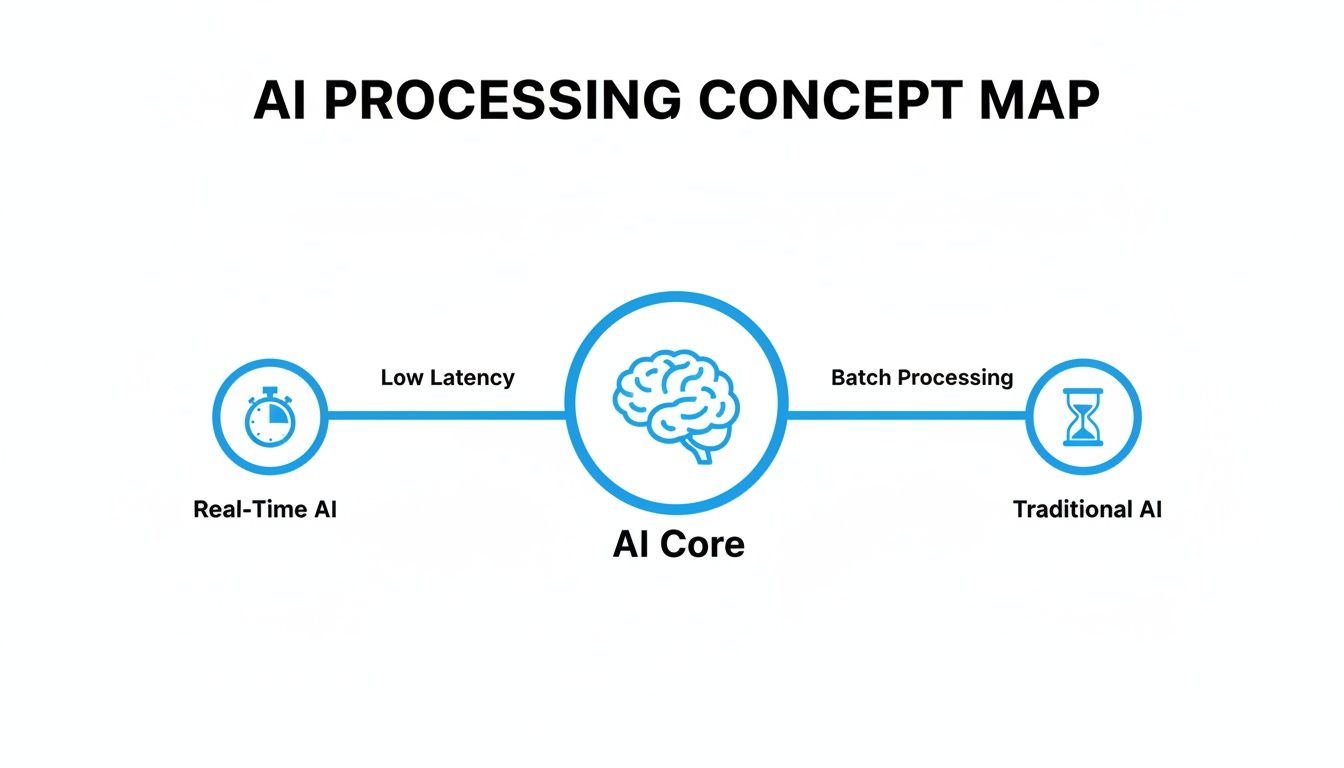
As you can see, real-time systems are built for immediate action, while traditional AI is designed for bigger, slower jobs that don't need to be done right away.
Where Does The Processing Happen?
The last piece of the puzzle is where all this thinking happens. This boils down to two concepts: Edge AI and Cloud AI.
Here’s a simple way to think about them:
- Cloud AI is like streaming a movie on Netflix. The actual work is done on powerful servers far away, and you just need an internet connection to access it.
- Edge AI is like playing a video file you’ve already downloaded to your laptop. The processing happens right on your device (the "edge" of the network), so it works instantly without needing the internet.
Both are super important for creators. A filter on your phone that adds an effect to your face during a live video is a perfect example of Edge AI—it has to work right there, right then.
But creating a complex, high-quality video from a text prompt takes way more horsepower than any phone or laptop has. That’s a job for Cloud AI. This is where platforms like Aicut come in, using massive server farms to run their advanced models, so you can generate incredible videos from any device, anywhere, without needing a supercomputer of your own.
How Top Creators Monetize Real-Time AI
 Theory is one thing, but let's get down to what really matters: how savvy creators are using the speed of real-time AI to actually make money. The idea is pretty simple. By slashing the time it takes to produce content, you can publish more, test more ideas, and hit your monetization goals way faster.
Instead of getting bogged down for hours with filming and editing, smart creators are now pumping out complete videos in minutes. This isn't just about speed; it opens the door to new kinds of content that were just too much of a grind to produce before. Let's dig into how they’re pulling it off.
Generating Viral Faceless Content
One of the biggest wins is with faceless YouTube and TikTok channels. You've seen them—those text-story or Reddit-narration videos that rack up millions of views. Making those manually used to be a real chore: screenshotting, formatting text, and syncing it all with audio.
Now, with a tool like Aicut, a creator can just paste a link to a Reddit post or drop in a text script. The AI instantly spits out a finished, engaging video with the right pacing, background, and a solid voiceover. It’s all done for you.
This workflow crushes a task that once took hours down to less than five minutes. For anyone trying to post several times a day, that’s the difference between burnout and completely owning a niche.
By churning out content this quickly, channels can hit the watch-time and subscriber numbers needed for monetization in record time. For more on that, check out our guide on how to make money on social media through consistent posting.
Creating Authentic UGC-Style Reviews
Everyone knows that user-generated content (UGC) is pure gold for brands. It feels real and builds trust. The problem is, getting it is a hassle—you have to find creators, ship out products, and manage the whole creative back-and-forth.
Real-time AI completely changes the game here. Creators and brands are using AI avatars to generate incredibly realistic UGC-style product reviews and testimonials. You just create an avatar that fits your brand, feed it a script, and it produces a video that looks and sounds just like a genuine customer.
This allows a single person to:
- Create dozens of ad variations to A/B test in a single afternoon.
- Produce review videos for an entire product line without hiring a single actor.
- Localize content by creating avatars that resonate with different audiences around the world.
For e-commerce stores, this means getting high-quality ad creative without the cost of a video shoot. For creators, it’s a whole new service you can offer to brands, delivering AI-powered UGC for a fraction of what they’re used to paying.
Automating The Entire Content Pipeline
The real endgame here is to build a content machine that practically runs itself. The smartest creators aren't just using AI to make one-off videos; they're automating their entire process from the initial idea all the way to posting it live.
Platforms like Aicut bake all of this into one seamless flow. A creator can set up a campaign that automatically finds trending topics, generates a batch of videos using proven templates, and then schedules them to auto-post across YouTube, TikTok, and Instagram every single day.
This kind of automation creates a powerful, self-running content engine. While your competition is stuck editing and uploading manually, you can focus on big-picture strategy and actually talking to your audience. Some are even learning how to get their content favored by other AI systems, using insights from guides like How To Be The Brand Chatgpt Recommends.
When you combine instant video creation with automated scheduling, you’re not just making content—you’re building a media asset that works for you 24/7. This shows how real-time AI isn't just another tool; it’s a whole new business model for today’s creator.
How to Pick the Right AI Tool (and Avoid Wasting Money)
Diving into real-time AI can feel overwhelming. A flood of new tools hits the market every week, each promising to be the magic bullet for your content creation. How do you know which one is actually worth your time and money, and which is just another subscription you'll forget to cancel?
It really comes down to four key things. Think of this as your personal checklist before you pull out your credit card. If a tool ticks all these boxes, you're on the right track to finding something that will genuinely speed up your workflow, not just complicate it.
Speed is Everything
When it comes to real-time AI, performance is the whole game. The entire point is to move fast. A tool that lags, crashes, or takes forever to spit out a video completely defeats the purpose. Speed isn't just a nice-to-have feature; it’s the main reason you're even considering AI.
A great platform is built for low latency—that’s the technical way of saying it can take your idea and turn it into a high-quality video in seconds, not minutes. This is what lets you batch-create a week's worth of content in an afternoon, jump on trends the moment they pop, and test out a dozen different video ideas without losing your mind. Always look for a free trial to test the speed yourself before you commit.
An AI tool’s speed directly impacts your ability to scale. A platform that saves you five minutes per video might not sound like much, but over hundreds of videos, that translates to weeks of reclaimed time you can invest back into your creative strategy.
Watch Out for Hidden Costs
Let's be real: AI tools can get expensive, fast. Confusing pricing plans don't make it any easier. Some platforms will lure you in, only to hit you with hidden fees, surprise charges for high-quality exports, or strict monthly limits that punish you for being productive. This is why you need to find a tool with clear, predictable pricing.
Look for a model that puts you in control. For example, a token-based system like Aicut’s is great because you only pay for what you actually use. It makes it simple to manage your budget, whether you’re creating one video this week or a hundred next week.
Here’s a quick rundown of the pricing models you'll probably run into:
- Token-Based: You buy credits and spend them as you go. Perfect for when your workload varies.
- Tiered Subscription: You pay a flat monthly fee for a set number of videos or features. Good for consistent, predictable output.
- Hybrid: A monthly subscription that includes some tokens, with an option to buy more if you need them. This offers a nice balance.
The global artificial intelligence market is exploding, and it's projected to hit $3.497 trillion by 2033. All that money is fueling incredible new tools for creators like us. As things evolve, understanding these cost structures is key to making a smart investment. If you want to dive deeper, you can explore key statistics about the AI market.
Make Sure Your Data and Ideas Are Safe
Your content ideas, scripts, and finished videos are your business. When you upload them to an AI platform, you have to be sure they’re being handled correctly. Is the company using your content to train its own AI models? Who has access to your files? And most importantly, do they try to claim any ownership over what you create?
Always, always read the privacy policy and terms of service. A trustworthy company will be crystal clear about how they handle your data and will state that your creative work remains 100% yours. This is non-negotiable, especially if you’re creating content for clients or working with sensitive brand information. Protect your intellectual property at all costs.
Look for an All-in-One Workflow
Finally, think about your entire process from start to finish. A truly great AI tool does more than just generate a single clip. The best platforms bring generation, editing, and even scheduling into one place. Trying to juggle different apps—one for scripting, another for generating, a third for editing, and a fourth for posting—is a recipe for frustration and wasted money.
When you're trying to figure out what's out there, it helps to check out guides that compare different options, like the 12 Best AI Productivity Tools Discovery Platforms. You’ll see that an all-in-one platform like Aicut, which combines viral templates, AI generation, and an auto-posting scheduler, is designed to prevent this headache. An integrated system gives you a smooth, fast path from a simple idea to a published video, saving you both time and creative energy.
Building Your First AI Video With Aicut
 All the theory is great, but the real fun starts when you actually make something. So, let's jump right in and build your first viral-style video using real time AI. I'll show you how Aicut takes the complexity out of video creation, letting you go from a simple idea to a finished clip in just a few clicks.
We’re going to go from picking a proven template to generating a polished video, showing just how quickly you can get your content machine running. The best part? You don't need any video editing experience at all.
Step 1: Choose Your Viral Template
Let’s be honest, the hardest part is often staring at a blank screen and wondering what to make. Aicut gets rid of that problem with a whole library of pre-built viral templates. These aren’t random designs; they’re based on formats that are already crushing it on TikTok, YouTube Shorts, and Instagram Reels.
Instead of starting from scratch, you get a massive head start by picking a popular style like:
- Text Story Videos: These are perfect for telling funny chat stories or those wild AITA (Am I The A-hole?) threads.
- Reddit Narrations: A super easy way to turn interesting Reddit posts into addictive video content.
- AI Avatar UGC: You can create authentic-looking "user-generated" product reviews or testimonials without ever hiring an actor.
For this walkthrough, we’ll go with a Reddit Narration template. It’s one of the quickest ways to launch a faceless channel because the content is basically unlimited and always in demand.
Step 2: Find Your Content and Craft a Prompt
With your template picked, you just need the raw material. Pop over to a subreddit like r/AskReddit or r/tifu and find a post with a great story and plenty of comments. You're looking for something that makes you want to know what happens next.
Once you find a good one, just copy the URL of the Reddit post. Back in Aicut, you’ll paste that link right into the prompt box. That's it. You don't have to manually copy and paste anything. The AI scans the entire post, identifies the juiciest parts, and organizes them into a video script automatically.
Your prompt can be as simple as: "Create a video from this Reddit URL, using a male voiceover and showing relevant background gameplay footage." The AI does all the heavy lifting, from finding the best comments to picking the right visuals.
This is what makes a smart real time AI platform so powerful. It doesn't just follow commands; it understands what you’re trying to do and turns a single instruction into a complete video concept.
Step 3: Generate and Customize Your Video
Now for the magic. With your template and prompt set, you just hit "Generate." In a matter of seconds, Aicut's advanced models—like Sora 2 and Veo 3.1—will assemble a full video for you. You get a synthesized voice reading the post, dynamic captions that pop on screen, and engaging background footage to hold viewer attention.
The first version is usually good enough to post right away. But if you want to make a few tweaks, it’s incredibly simple. Maybe you want to use a different background clip, try another voice, or change the color of the captions. All these edits happen instantly, giving you full creative control without the headaches of a traditional editor. We dive deeper into this workflow in our guide on how to create video content fast with Aicut Pro.
The whole point is to get from idea to a shareable video in under five minutes. This speed is the secret weapon that allows top creators to test tons of ideas and post multiple times a day, which massively boosts their chances of going viral.
Step 4: Schedule and Auto-Post
Your video is ready to go. Now what? Instead of the tedious process of downloading the file and uploading it to every social media app, you can use Aicut’s scheduler.
Just connect your YouTube, TikTok, and Instagram accounts. Then you can schedule your new video to go live at the best possible time. Even better, you can batch-create a bunch of videos at once and plan out your content for the entire week in one sitting. This turns content creation into an engine that works for you 24/7. Aicut is more than just a video tool; it's a full system for creator growth, backed by a great Discord community for swapping tips and tricks.
The Future of AI in Content Creation
So, where is all of this heading? The tools we have right now are just the beginning. The next wave of real time AI will move beyond just generating videos and into a world of truly dynamic, interactive experiences that we're only starting to wrap our heads around.
Think about creating content that adapts on the fly to every single person watching. Or imagine hosting a livestream where an AI co-host fields questions from the audience and even moderates the chat for you. These aren't just sci-fi ideas; they're the next practical steps for this technology.
Your Competitive Advantage
This is where you get a leg up. Getting good with today's real-time AI tools, like the ones inside Aicut, is your single biggest advantage. When you bring these systems into your workflow, you aren't just saving time—you're learning the skills that will put you at the front of the line for the next era of content creation. You’ll be an expert while everyone else is still trying to figure out the basics.
This isn’t happening in a bubble. The market for real time AI is exploding. Just look at a related niche like the wearable AI market, which is expected to jump from $23.56 billion in 2025 to an incredible $303 billion by 2035. That kind of growth, including a projected 45.5% compound annual growth rate in Europe, points to a huge global appetite for AI-powered experiences. You can dive deeper into these AI adoption statistics and expanding opportunities to see the full picture.
The takeaway is simple: real time AI is here, it works, and it’s critical for any creator who wants to grow their output and their influence. This is the engine that will separate the creators who thrive from those who get left behind.
Don't wait for the future to pass you by. Your chance to get ahead of the next big shift in content starts right now. By getting comfortable with tools like Aicut, you’re not just a user; you’re becoming a leader in a market that's changing faster than ever.
Frequently Asked Questions About Real Time AI
It's natural to have questions when you hear about something like real-time AI. Let's get into the big ones we hear from creators all the time so you can get a clear picture of how it works.
Is Real Time AI Too Technical for a Beginner?
I get it—the term 'AI' sounds super technical. But honestly, you don't have to be an engineer to use it.
Modern tools like Aicut are built specifically for creators, not tech wizards. They’ve done all the heavy lifting behind the scenes. For you, it's as simple as writing a sentence or pasting a link. No coding, no complicated video editing software. You can get a polished video done in just a few minutes.
How Much Does It Really Cost to Use AI Video Tools?
The cost is probably a lot lower than you're imagining. Most modern AI tools have ditched confusing subscription models for something much simpler: you only pay for what you actually create.
This token-based pricing means you're not locked into a hefty monthly fee, and there are no surprise charges. It's a much smarter way to manage your budget compared to hiring freelance editors or buying expensive software.
Think of it this way: the cost of a few AI-generated videos is often less than one hour of a professional video editor's time. The return on investment, in terms of speed and output, is massive.
Can AI-Generated Content Actually Go Viral?
You bet it can. Virality isn't about some secret formula; it’s about giving your audience great stories and showing up consistently. Real-time AI is a powerhouse for both.
Just look at the faceless channels on TikTok and YouTube that use AI to narrate Reddit stories or create quick text-based videos. They regularly pull in millions of views. The AI isn't the star—it's the engine that helps you produce content people already love, but at a speed you could never match on your own.
That consistency is exactly what the algorithms are looking for, which can seriously boost your chances of going viral and monetizing your channel much faster.
Ready to stop waiting and start creating? With Aicut, you can generate your first viral-style video in under five minutes. Join over 500,000 creators and build your content engine today.