Going viral isn't about hitting some random, magic number. It's about achieving rapid, exponential growth that catches on and starts spreading all by itself. The real secret is velocity—how fast the likes, shares, and comments pour in during those first few critical hours. That speed is a massive signal to the platform's algorithm that you've created something people need to see.
What Does Viral Actually Mean for Creators?
Think of it like a spark in a dry field. A regular post might get a little attention from your followers and then fizzle out. But a viral post ignites so fast that the platform's algorithm acts like a gust of wind, fanning the flames and pushing it way beyond your usual audience. This isn't just luck; it's about tapping into the mechanics of what gets people excited and what the algorithms are built to reward.
Going viral is really a chain reaction that unfolds in a few key stages:
- The Initial Spark: Right after you post, your core audience hits it with a ton of engagement—likes, comments, shares, and saves.
- The Algorithmic Boost: The platform’s algorithm notices this sudden burst of activity. It flags your content as highly engaging and starts showing it to a much wider, similar audience.
- Exponential Growth: This new audience engages, too, creating a powerful, self-sustaining loop. Shares go through the roof, and your reach explodes from hundreds to thousands, and sometimes, even millions.
The Real Trigger for Virality
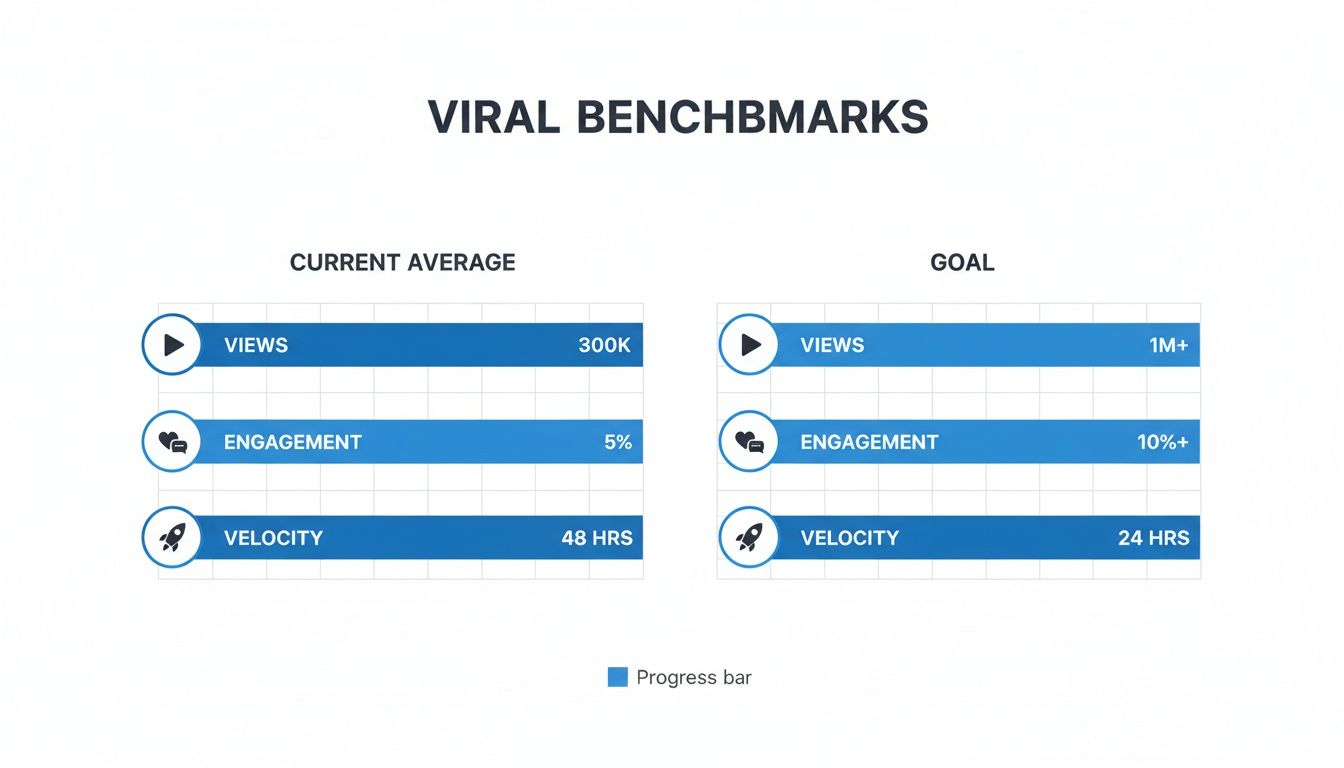
If there’s one factor that matters most, it’s velocity. A video that gets 1,000 likes over a week is doing fine. But a video that gets 1,000 likes in its first hour? That has true viral potential. This initial momentum is exactly what algorithms are designed to find and amplify. It's a clear signal that people are reacting to this right now.
The moment your content's engagement rate and share velocity dramatically outperform your account's average, you're on the path to going viral. It's not just about the final view count; it's about how quickly you got there.
This infographic gives a great breakdown of the essential benchmarks—views, engagement, and velocity—that separate a good post from a truly viral one.
What Do the Numbers Look Like in the Wild?
Every platform has its own definition of "viral," and what works on TikTok might just be a decent day on YouTube. The benchmarks are constantly shifting, but having a general idea of the numbers helps you set smarter goals.
This table offers a snapshot of what virality looks like in measurable terms on today's top platforms, helping you set realistic and platform-specific goals.
| Platform | Typical Viral View Count | Key Metric to Watch | Healthy Engagement Rate |
|---|---|---|---|
| TikTok | 1M+ in 3-7 days | Shares & Watch Time | 4-6% |
| Instagram Reels | 1M+ views | Saves & Shares | 2-3% |
| YouTube Shorts | 1M+ views | Views-to-Swipes Ratio | 1.5-2.5% |
| X (Twitter) | 200K+ impressions | Retweets & Quote Tweets | 1-2% |
| 100K+ impressions | Comments & Reposts | 2-5% |
Ultimately, a viral post is one that creates a cultural moment, no matter how small. It sparks conversations and gets reactions from people far outside your original circle. It stops being about who you are and becomes all about the idea you shared.
The Psychology Behind Why People Share Content
What actually makes someone stop scrolling and hit that share button? It’s not a random act. It's a psychological impulse, driven by some pretty deep-seated human needs. Viral content isn't just seen; it's felt, and that feeling is what makes us want to pass it on.
Think of a viral post as a digital conversation starter. For someone to share it with their circle, it has to be compelling enough to represent them. It needs to say something about their identity, their sense of humor, their values, or what they find interesting. At its core, sharing is all about connection and self-expression.

This impulse boils down to a few universal triggers. If you can get a handle on these, you’re on your way to creating content with real viral potential. They're the secret sauce behind almost every viral hit, from hilarious pet videos to game-changing life hacks.
Tapping Into Powerful Emotions
Emotion is the fuel for anything that goes viral. Content that makes us feel something strongly—joy, awe, surprise, even a bit of anger—creates a physical reaction that needs an outlet. Sharing becomes that outlet.
High-arousal emotions are especially powerful. These are the feelings that get your heart pumping and your mind racing.
- Awe and Wonder: Content that showcases something incredible, beautiful, or just plain mind-bending makes us feel small in the best way. We share it so others can feel that same sense of wonder.
- Humor and Joy: Laughter is social glue. Sharing a funny video isn't just about the joke; it's about sharing a positive moment, strengthening bonds, and being seen as someone who brings the fun.
- Surprise and Intrigue: The unexpected grabs our attention like nothing else. A wild plot twist, a shocking fact, or an unbelievable skill makes us want to shout, "You have to see this!"
The most shareable content doesn't just present information; it makes the audience feel something. This emotional resonance is what turns a passive viewer into an active promoter of your content.
This emotional payoff is exactly why short-form video is the perfect vehicle for virality. A 15-second clip can deliver a concentrated dose of humor or surprise way faster than a long article, making the decision to share almost immediate.
Providing Value Through Education and Entertainment
Beyond raw emotion, people share content that offers real value. This usually falls into two buckets: it's either genuinely useful or incredibly entertaining. We're fundamentally wired to share resources that can help our community.
This is the whole "social currency" idea in action. When we share something helpful or entertaining, we boost our own social standing. We become the friend who knows the best life hacks, finds the funniest memes, or has the most interesting stories.
Forms of Value-Driven Content
- Practical Education: Think of those clever hacks, secret tips, or tutorials that solve a common problem. When you find a brilliant solution, your first instinct is often to share it with people you know could use it.
- High-Value Entertainment: This is more than just a quick laugh. It’s about captivating storytelling, mesmerizing visuals, or ideas that really make you think. It's content that feels like a worthwhile escape from the daily scroll.
Fostering a Sense of Identity and Belonging
Ultimately, what we share is a reflection of who we are—or who we want to be. Every share is a small broadcast about our identity, beliefs, and where we fit in. This is a massive piece of the puzzle in understanding what makes content go viral.
Content spreads like wildfire when it lets people signal their membership in a group. This could be a fandom, a professional community, a political movement, or even just a group of people who get the same inside joke. When something speaks to a shared experience, sharing it is an act of solidarity. It says, "I get it. I'm one of you."
This desire to belong is incredibly powerful. It explains why niche content can suddenly explode into the mainstream—it hits a nerve with a specific community so passionately that they can’t wait to share it with the world, inviting everyone else to join their tribe.
What "Viral" Really Means on Different Platforms

Let's get one thing straight: "going viral" isn't a one-size-fits-all deal. A video that explodes on TikTok might barely make a ripple on Instagram, and that's because each platform has its own secret recipe for what it considers a hit. To have any chance at virality, you first need to understand what the algorithm is looking for.
Think of each platform as a different audience with a unique personality. TikTok is like a high-energy talent show where the crowd wants instant entertainment. Instagram is more like a curated art gallery that rewards beautiful visuals and trendy styles. YouTube is the library of the internet, valuing deep engagement and long-term value.
To win, you have to play their game, by their rules. That means tailoring your content to fit the quirks of each platform. Do that, and you dramatically increase your chances of earning that coveted algorithmic boost that launches your content into the stratosphere.
The TikTok For You Page Formula
TikTok is the undisputed king of viral content, built entirely around its lightning-fast ‘For You’ page (FYP). The algorithm's goal is simple and ruthless: find content that sparks immediate conversation and keep people glued to the app. Anyone serious about growing on the platform is focused on cracking the TikTok code by obsessing over a few key metrics.
These are the signals that make the TikTok algorithm pay attention:
- Completion Rate: Did people watch your entire video? A high completion rate is a massive green flag telling the algorithm your content is engaging.
- Rewatches: If someone watches your video more than once, TikTok sees it as exceptionally compelling and starts showing it to more people.
- Shares and Comments: This is the gold standard. A share is a direct endorsement, and comments prove your video is starting a real conversation.
This structure is what makes TikTok such a viral powerhouse. The platform boasts an average organic engagement rate of 2.50%, with the median across all industries hitting a whopping 2.63%. For a little perspective, Instagram's rate has dropped to just 0.50%. The difference is night and day.
TikTok doesn’t care if you have ten followers or ten million. It only cares about how a single piece of content performs in its first few hours. If it grabs attention right away, the algorithm will push it to the masses.
If you’re ready to master this platform, check out our deep-dive guide on https://www.aicut.pro/blog/how-to-go-viral-on-tiktok for more specific strategies.
Instagram Reels and Trending Audio
Instagram Reels plays in the same sandbox as TikTok but brings its own set of rules. Here, aesthetics and trending audio reign supreme. While immediate engagement still matters, the Instagram algorithm gives extra points to content that looks good and piggybacks on current platform-wide trends.
Going viral on Reels usually means you’ve nailed these three things:
- Using Trending Sounds: The algorithm heavily favors Reels that use popular or up-and-coming audio clips. It's one of the easiest ways to get your foot in the door.
- Visually Clean Content: High-resolution, well-lit videos almost always outperform blurry or low-quality clips. Instagram has also been clear that it de-prioritizes content with watermarks from other apps.
- High Shareability and Saves: Saves are a huge deal on Instagram. This metric tells the algorithm your content is so valuable that people want to come back to it later.
YouTube Shorts and Audience Retention
YouTube Shorts blends the fast-paced world of short-form video with the platform's long-standing obsession with audience retention. For a Short to go viral, it’s not just about the views on that one clip; it's about how that clip contributes to a viewer’s overall time on YouTube.
Here’s what YouTube's algorithm is looking for in a viral Short:
- Audience Retention: Just like with long-form videos, YouTube wants to see that you can hold a viewer's attention. A high average view duration is a critical signal.
- Views-to-Swipes Ratio: The algorithm is constantly tracking how many people watch your Short versus how many immediately swipe away. A low swipe-away rate tells YouTube you’ve created a winner.
- Subscriber Conversion: The ultimate sign of a successful Short is its ability to turn a casual viewer into a new subscriber. This tells the algorithm that your content provides real, long-term value.
Why Authenticity and Format Matter More Than Ever
Getting the psychology and algorithms right is one part of the viral equation. The other part? Packaging your idea in a way that feels real and stops people in their tracks. In today's world, authenticity and format are non-negotiable.
Think about the content that makes you pause your endless scroll. It’s rarely the slick, overproduced video. More often, it's something raw, relatable, and maybe even a little rough around the edges—content that looks like it was made by a real person, not a committee.
This isn't just a passing trend. It's a seismic shift in how we build trust online. People connect with other people, so content that feels human and genuine will almost always win against a polished advertisement.
The Unstoppable Force of Short-Form Video
If one format defines virality today, it's short-form video. These bite-sized clips are perfectly engineered to deliver the quick emotional hits and "aha!" moments that make people smash the share button.
They ask for very little of a viewer's time but deliver an instant reward—a laugh, a new perspective, or a moment of awe.
And the numbers don't lie. An incredible 78% of people prefer learning about a new product through a short video. For marketers, 35% say short-form videos deliver the best ROI of any social format, and 93% are planning to keep spending on them or even increase their budget.
Relatability Beats Big Budgets Every Time
So, why do Point-of-View (POV) stories, personal vlogs, and unfiltered reviews consistently blow up? It all comes down to authenticity. They forge an immediate connection that expensive, high-production shoots often miss entirely.
These formats just work. Here’s why:
- They feel trustworthy. An unpolished review feels way more honest than a scripted ad.
- They’re engaging. A personal story makes the viewer feel like they’re part of the conversation, not just watching a broadcast.
- They’re easy to join. When people see a simple, relatable trend, they think, "Hey, I could do that!"—sparking user-generated momentum.
In a world drowning in perfectly polished content, being real is the only way to stand out. Raw, unfiltered content cuts through the digital noise and builds a genuine connection that both people and algorithms love.
This is exactly where new tools like Aicut come in. They let anyone create authentic-style videos at scale. You can spin up realistic POV clips or selfie-style videos with AI avatars, all without ever stepping in front of a camera yourself.
To truly make content that feels real, it's crucial to understand the nuances explained in A Guide to Images for Authenticity in the AI Era.
The takeaway is simple: Stop chasing perfection. Start embracing what's real. Your audience isn't looking for a Hollywood production; they're looking for a human connection. Give them that, and you'll create something truly worth sharing.
Building a Repeatable Viral Content System

Trying to force a single piece of content to go viral is a fast track to burnout. The real pros don't chase viral moments; they build an intelligent system that creates content with viral potential over and over again. This approach swaps luck for a repeatable process, dramatically increasing your chances of catching those algorithmic waves.
Think of it less like catching lightning in a bottle and more like building a lightning rod. You're creating the perfect conditions for virality to strike by focusing on a sustainable workflow that covers smart ideation, efficient production, and strategic distribution. It’s a numbers game, but one you can definitely play in your favor.
The secret is realizing you don't need one perfect video. You need a steady stream of good content to test ideas, learn what your audience loves, and stay top-of-mind.
Step 1: Master Your Niche Ideation
Every viral system starts with ideas that are already primed to succeed. This isn’t about throwing darts in the dark and hoping something sticks. It’s about tapping into existing conversations and proven formats that are already getting traction in your specific corner of the internet.
Your idea generation should be a constant, structured process.
- Become a Trend Spotter: Actively track what’s blowing up on TikTok and Instagram Reels—the sounds, hashtags, and video styles. But don't just watch them. Break down why they're working.
- Analyze Your Rivals (and Friends): See what’s getting the most love for other creators in your niche. Look for patterns in their home-run posts and brainstorm how you can put your unique spin on those concepts.
- Listen to Your Audience: Your comment section is a goldmine. Pay close attention to the questions people ask and the pain points they share. They are literally telling you what content they want you to make.
When your ideas are rooted in what’s already resonating, you give every piece of content a running start.
Step 2: Streamline Your Content Production
To feed the algorithm and stay relevant, you need to be fast and consistent. A clunky, slow production process will kill your momentum before you even get going. The goal here is to simplify your workflow without letting the quality slide.
This is where AI tools can be a game-changer. Platforms like Aicut let creators automate the most time-consuming parts of making videos. You can jump on viral niche templates, generate realistic AI avatars for authentic-looking UGC videos, and crank out POV or selfie-style content in minutes, not hours. It’s a much faster way to create AI video that still feels human and high-quality.
The most successful creators aren't always the ones with the biggest budgets. They're the ones with the smartest, most efficient production systems. They can test more ideas, jump on trends faster, and publish with relentless consistency.
This efficient approach is what makes it possible to produce the volume you need to compete today.
Step 3: Implement a High-Volume Posting Strategy
If you want to maximize your chances of going viral, you need to post. A lot. This isn't just about throwing spaghetti at the wall; it’s about giving the algorithms more data points on what works and giving yourself more chances to catch a trend at that perfect, explosive moment.
The recommended posting frequency might surprise you. Some social media experts are now suggesting you post between 48 and 72 times per week across all your platforms to stay in the algorithm's good graces. This kind of volume is only possible because the game has changed. Authentic, value-driven content has replaced slick advertising, and it works—a staggering 90% of shoppers' purchasing decisions are influenced by this kind of user-generated content. You can dig deeper into these trends in this detailed report on social media statistics.
A high-volume strategy involves:
- Scheduling Your Content: Use a scheduling tool to get your posts lined up in advance. This ensures a consistent flow without you having to be glued to your phone 24/7.
- Repurposing Everything: Turn one long video into a dozen short clips. Take one core idea and adapt it for different platforms, tweaking the format and caption for each audience.
- Analyzing and Iterating: Use the data from all your posts to see what’s hitting. Double down on the formats and topics that work, and cut what doesn't.
What to Do After Your Content Goes Viral
Okay, your content just blew up. It's an incredible feeling, but this is the starting line, not the finish. That massive wave of attention is temporary, so your job is to turn that fleeting spotlight into a real, long-term community. Don't just sit back and watch the numbers climb—you need to act. Fast.
Your very first move? Get into the comments section. Start replying to as many people as you can, especially within the first crucial 24-48 hours. This does two things: it makes your new audience feel seen, and it signals to the algorithm that your post is still buzzing with activity, which can push it out to even more people.
Deconstruct Your Success
After the initial excitement starts to settle, it's time to put on your detective hat. You need to figure out exactly why this specific piece of content connected with so many people when others might not have. This isn’t about guessing; it’s about a cold, hard look at the data.
Go beyond the obvious metrics like views and likes. You need to look at the numbers that tell you the real story:
- Share-to-View Ratio: This is a big one. It shows how compelling your content was. A high ratio means people didn't just watch it; they felt an urge to share it with their own network.
- Follower Conversion Rate: Out of all the people who saw your video, how many actually clicked "follow"? This tells you if your video did a good job of introducing who you are and what you're about.
- Comment Sentiment: What was the vibe in the comments? Were people laughing, asking questions, or getting into a heated debate? Pinpointing the emotional reaction is the key to creating that feeling again.
A single viral video is a lightning strike. A second one, built on the data from the first, is a strategy. Figure out what worked—the hook, the format, the topic, the audio—and turn it into a formula you can use again.
Create Your Post-Viral Strategy
Now that you've got all these new eyes on you, your number one priority is to give them a reason to stay. The biggest mistake you can make is going silent. If you do, you’ll watch thousands of potential fans just drift away. You need a game plan.
Get to work immediately on follow-up content that’s directly tied to your viral hit. If a specific "how-to" tip took off, make a "Part 2" with even more advice. If it was a story, tell everyone what happened next. This gives new followers more of what they came for and proves you're worth sticking around for.
This is also the perfect moment to start thinking about turning all this attention into an income stream. For a more detailed guide on that, check out our article on how to make money with viral videos.
By engaging, analyzing, and then creating smart follow-up content, you can turn a one-time viral spike into the foundation for real, lasting growth.
Frequently Asked Questions About Going Viral
How Many Views Are Truly Considered Viral?
There’s no single magic number, but a good rule of thumb is when a piece of content gets at least 5 to 10 times more views than your account usually does. That’s a clear signal it has broken out of your immediate circle and caught the algorithm's attention.
On a platform like TikTok, for example, most people would agree that hitting 1 million views is a solid sign of true virality. But what really matters is how the content performs against your own baseline. A huge spike is a huge win, no matter the final number.
Can You Actually Plan for a Video to Go Viral?
While you can never guarantee a viral hit—lightning doesn't always strike on command—you can absolutely stack the deck in your favor. It's less about luck and more about consistently applying the right strategy to give every video its best shot.
Think of it as a checklist for success:
- Ride the wave: Use trending sounds and formats that algorithms are already pushing.
- Hook them fast: Grab attention in the first three seconds to stop the endless scroll.
- Start a conversation: Write captions that practically beg for comments and discussion.
How Fast Does a Video Typically Go Viral?
It usually happens in a flash. The first 2 to 4 hours after posting are make-or-break. If a video gets a ton of likes, shares, and comments right out of the gate, the platform’s algorithm sees it as a winner and starts showing it to more and more people.
This rapid, exponential growth typically snowballs over the next 24 to 48 hours. If your content clears that initial hurdle, you'll see it start taking on a life of its own.
The real secret is to act quickly. Don't just post and pray. Be ready to jump on the first wave of comments to keep the momentum going and show the algorithm your content is worth promoting.
What Is the First Thing to Do After a Video Goes Viral?
Engage, engage, engage. Your number one job is to get into the comments and reply to as many people as you can. This keeps the conversation going and signals to the platform that your post is a lively hub of activity, which can help extend its viral run.
Then, figure out why it worked. Was it the topic? The format? The hook? Whatever it was, create a follow-up video in a similar style—fast. The goal is to capture that new audience and turn them into loyal followers before the buzz dies down.
Ready to stop guessing and start creating content with real viral potential? Aicut offers viral templates, AI avatars, and powerful automation tools to help you produce high-quality, authentic videos in minutes. It's a system built for growth.