
You post a Short. It gets a few views, maybe a brief spike, then nothing. You refresh YouTube Studio, look for a clue, and end up with the same question every creator asks at some point. What does YouTube want?
The frustrating part is that Shorts can feel random when you're on the outside. One upload dies instantly. Another gets picked up hours later. A third seems strong, but never breaks out. That makes people chase hacks instead of learning the system.
The good news is that the YouTube Shorts algorithm isn't a mystery box. It's a distribution system with a job: show people more of what they keep watching. Once you understand that job, your strategy gets simpler. You stop optimizing for vanity metrics and start designing videos that survive the first test.
Why Your Shorts Are Stuck at Zero Views
Most Shorts don't fail because the idea was terrible. They fail because the video didn't give the algorithm enough evidence, fast enough, that viewers wanted more of it.
That usually looks like this. The opening frame is weak. The first line takes too long. The payoff arrives late. The viewer swipes before the Short earns attention, and YouTube reads that as a relevance problem, not a creativity problem.
The real reason flatlines happen
Creators often assume low views mean the channel is shadowbanned, too small, or inconsistent. In practice, the simpler explanation is usually correct. Your Short was shown to an initial audience, and that audience didn't react strongly enough for wider distribution.
Practical rule: A Short doesn't need to impress everyone. It needs to impress the first viewers who see it.
That's why "good content" isn't specific enough. A good Short for YouTube is a Short that creates an immediate reason not to swipe. If your best moment lands halfway through, the algorithm may never send enough viewers to reach that moment.
What to focus on instead
If your Shorts keep stalling, check your process against these basics:
- Open with motion: Start with visual change, not a static frame.
- Lead with the payoff: Show the result, conflict, or surprise before the explanation.
- Write for swiping behavior: Viewers are deciding in a split second whether to stay.
- Review strong hook patterns: These YouTube Shorts best practices for AI creators are useful because they focus on packaging, pacing, and repeatable structure.
You don't need luck. You need a Short that sends the right early signals.
How the Shorts Algorithm Actually Thinks
The easiest way to understand the YouTube Shorts algorithm is to stop thinking about it like a search engine and start thinking about it like a DJ testing tracks in a crowded room. A new song gets played to a small group first. If people react well, the DJ turns it up for the whole room. If people drift away, the song gets cut.
That is close to how Shorts distribution works.
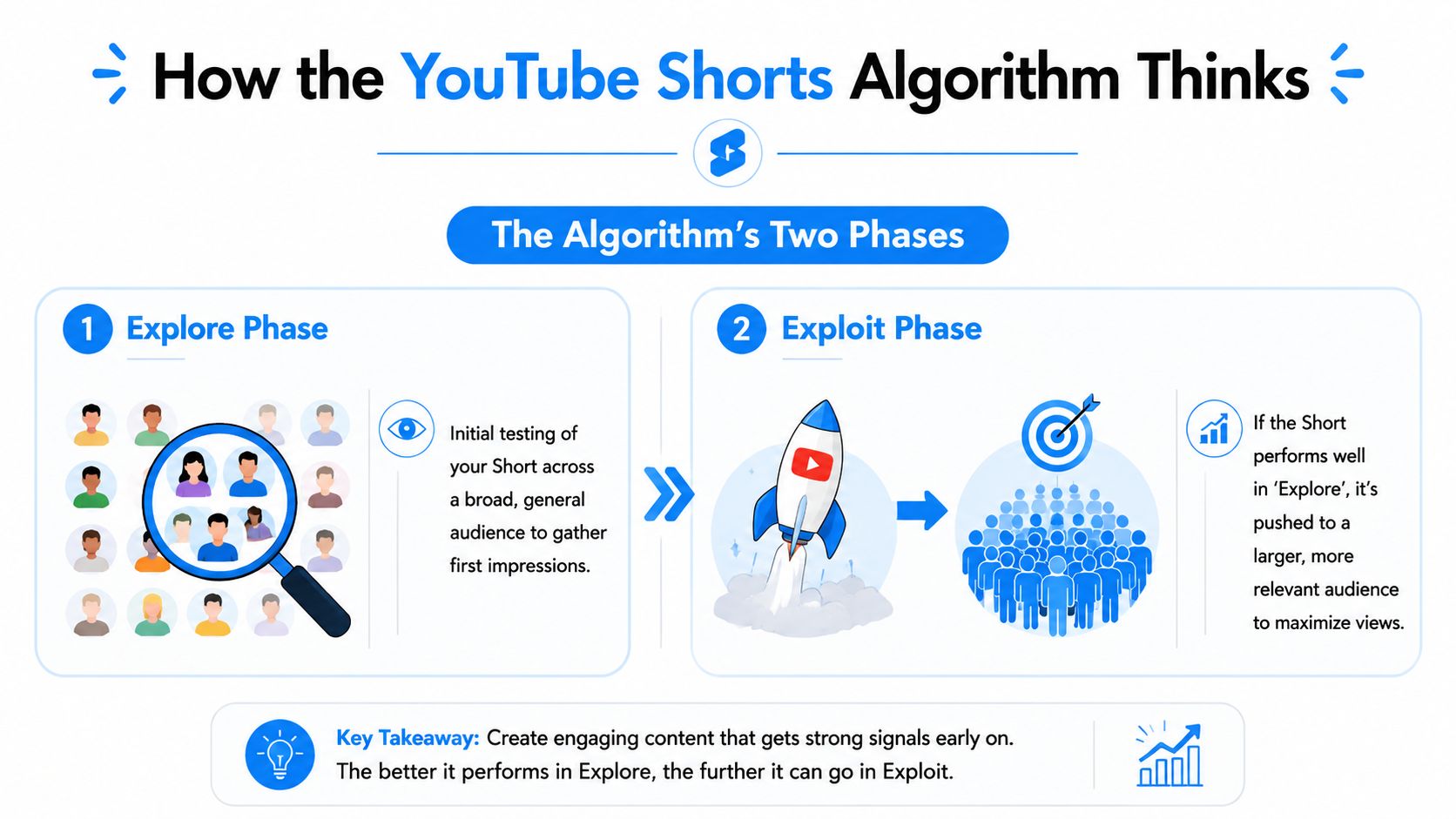
According to this explanation of the Shorts explore and exploit system, YouTube treats Shorts as a fast feedback environment. The platform needs to decide quickly whether a video deserves broader reach, so it tests performance before scaling it.
Explore is the first audition
A widely discussed model describes the Shorts system as a Multi-armed Bandit process with two stages, Explore and Exploit. In that framework, a new Short gets tested on a small seed audience of 100 to 500 users, and the first 1 to 3 seconds matter most because that window shapes whether the video gets promoted further, as described in this Reddit breakdown of the Shorts algorithm model.
You don't control who that seed audience is in a direct way. What you control is whether the Short makes immediate sense to them. If the opening is confusing, slow, or mismatched with the viewer's expectations, the test usually ends there.
Exploit is where reach expands
If the initial audience watches instead of swiping away, YouTube has a reason to keep distributing the video. That is the exploit phase. The system isn't rewarding you for effort. It's reacting to evidence that your Short can hold attention.
Many creators often misunderstand momentum. They think virality is one event. In reality, Shorts often move in waves. The algorithm tests, expands, measures, then expands again if the signals stay strong.
A stalled Short usually isn't being "suppressed." It usually failed its first audition.
What this means for your editing decisions
Once you view Shorts through the Explore and Exploit lens, a lot of common advice stops being vague and starts being practical.
- Your first frame matters more than your intro sentence: If the visual doesn't earn attention instantly, the viewer may never hear what you're saying.
- Clarity beats cleverness early: A hook that's too abstract can lose the viewer before curiosity kicks in.
- Front-load tension: Start with the question, mistake, reveal, or transformation.
- Cut setup aggressively: In Shorts, context is useful only if it doesn't delay the reward.
A creator making a faceless Short about a productivity tip shouldn't begin with "So today I want to talk about..." A stronger version starts with the problem on screen, then the fix. A cooking Short shouldn't begin with ingredients lined up in silence. It should begin with the finished result or the most satisfying action.
The system isn't judging your channel. It's judging this upload
That distinction matters. One weak Short doesn't doom the next one. The algorithm tests each upload as a fresh candidate for attention. That gives you room to experiment, but it also means every upload needs its own strong opening.
Creators who grow with Shorts usually stop asking, "Why didn't YouTube push this?" and start asking, "What did the first viewers feel in the first moments?"
That's the more useful question, because it's the one you can improve.
The Four Key Signals That Drive Discovery
If the previous section explains the machine, this is the scorecard. The YouTube Shorts algorithm looks at behavioral signals, not your intent. Your video isn't ranked because you posted consistently or because the topic seems strong on paper. It's ranked because viewers reacted in ways that told YouTube the Short deserved more placement.
Viewed versus swiped away
This is the signal that shapes everything else. As of March 31, 2025, YouTube changed Shorts views so that any start or loop counts as a view, with no minimum watch time requirement. The same update also made Viewed vs. Swiped Away the primary signal for feed placement, while separating raw views from retention metrics, according to this report on the March 2025 Shorts view update.
That matters because a high view count can now hide weak performance. If people start your Short and quickly leave, the view total may still rise. The algorithm cares more about whether they stayed.
Watch time and loops
On Shorts, rewatch behavior matters differently than it does in long-form. A Short that loops cleanly can create more starts and stronger retention signals at the same time. That's useful, but only if the loop feels natural rather than repetitive.
A good loop doesn't just restart. It resets curiosity. The ending should make the beginning feel worth watching again.
Watch for this: If your Short gains views but feels weak in downstream performance, the loop may be inflating starts without creating real interest.
Engagement still helps, but it isn't the first gate
Likes, comments, and shares are positive signals. They tell YouTube that the viewer didn't just tolerate the Short but cared enough to react. Still, engagement usually works best after retention does its job. A Short that loses viewers early rarely gets saved by comments alone.
This is why baiting comments often underperforms. If the Short isn't already holding attention, "Comment below" won't rescue it.
Session value
YouTube wants viewers to keep watching. A Short that satisfies one viewer and sends them into more content is more useful to the platform than a Short that gets a quick glance and ends the session.
You can't see session value as neatly as likes or views, but you can design for it. Series work well. So do recurring formats, familiar visual language, and topic clusters that make the next Short feel like a natural follow-up.
Shorts and long-form don't play by the same rules
Here is the cleanest way to think about the difference:
| Signal | YouTube Shorts | Long-Form Video |
|---|---|---|
| Initial decision | Feed-driven. Viewer often decides instantly whether to stay or swipe | Usually click-driven. Title and thumbnail carry more weight upfront |
| Opening priority | First moments are critical because scrolling is frictionless | Opening still matters, but the click shows stronger initial intent |
| View counting | Starts and loops count as views after the 2025 change | Views aren't defined around looping behavior in the same way |
| Retention shape | Completion and rewatch potential matter heavily | Sustained watch time across a longer runtime matters more |
| Discovery style | Fast testing and rapid distribution shifts | Broader mix of browse, suggested, search, and subscriber behavior |
If you're repurposing long-form clips into Shorts, this difference is where many uploads go wrong. A clip that worked in a ten-minute video may need a completely different opening, pacing, and payoff to survive the Shorts feed.
Actionable Tactics to Feed the Algorithm
Once you know what the algorithm is looking for, your editing choices get easier. You don't need to make every Short louder or faster. You need to make it easier to understand, harder to swipe away from, and satisfying enough to finish.

Build the first seconds like an ad for the rest of the Short
The opening has one job. It must create an immediate reason to stay.
That doesn't mean clickbait. It means compression. Put the strongest visual, the clearest tension, or the most surprising statement at the front. If you're teaching something, show the result first. If you're telling a story, start where the stakes are visible. If you're making faceless content, use text overlays that clarify the premise before the viewer has to guess.
A weak hook sounds like this: "Here's a quick tip for creators."
A stronger hook sounds like this: "This is why your Shorts die after a few views."
Use structures that fit Shorts, not long-form habits
The best Shorts usually feel simple because the structure is tight. Try these patterns:
- Problem to payoff: Show the mistake first, then the fix.
- Reveal to explanation: Open on the surprising outcome, then explain how it happened.
- Step flow: Give fast sequential value with visible progress.
- Loop close: End in a way that naturally reconnects to the opening frame.
Research based on 35 billion Shorts views found that channels publishing more than 200 Shorts saw a significant long-term increase in view velocity, and that Shorts with lengths of exactly 13 seconds or 60 seconds tended to perform best, according to this analysis of YouTube Shorts performance patterns. That doesn't mean every creator should force those exact lengths. It does mean concise structure and consistent output tend to align with how Shorts are distributed.
Treat metadata as targeting help, not a growth hack
Titles, descriptions, and hashtags don't force virality. What they can do is help YouTube understand what the Short is about so it reaches a more relevant initial audience.
Use metadata to clarify the topic. If your video is about AI video prompts, say that clearly. If it's a faceless history Short, make the theme obvious. Generic titles waste the little context YouTube gets before testing your upload.
A practical title is usually better than a vague one. "3 editing mistakes killing your retention" gives the system more to work with than "You need to hear this."
After you've tightened your hook and structure, this walkthrough can help you pressure-test your execution:
Test variables, not your entire identity
A lot of creators change too much at once. They switch niche, style, pacing, voice, and format after a few weak uploads. That makes it hard to learn anything useful.
Instead, test one variable at a time:
- Hook wording: Keep the topic the same. Change only the opening line.
- Visual open: Try face-first, text-first, or result-first intros.
- Length: Condense a concept into a very short version, then compare with a fuller version.
- CTA placement: Some Shorts perform better with no CTA until the end.
If you're testing, protect the core idea. Otherwise, you can't tell what caused the result.
What usually doesn't work
Some tactics fail because they solve the wrong problem.
- Hashtag stuffing: More tags don't fix a weak hold rate.
- Long setup: If the premise takes too long to become clear, viewers swipe.
- Template overuse without adaptation: A trending format helps only when the topic and opening still feel native to your audience.
- Talking before showing: In Shorts, the eye decides before the ear catches up.
The best creators don't just post more. They remove friction from the first moments, make the middle worth staying for, and build endings that feel complete.
How to Scale Shorts Production with AI
Understanding the YouTube Shorts algorithm is one thing. Executing against it every day is another. Most creators don't struggle because they lack ideas. They struggle because high-frequency production creates a bottleneck in scripting, editing, variation, voiceover, packaging, and publishing.
That bottleneck matters because Shorts rewards testing. If you only publish occasionally, every upload feels precious. You become conservative. You over-edit. You delay posting. Then you learn slowly because you don't generate enough creative data.
Why manual production breaks first
Manual workflows usually fail at the same points:
- Ideation drift: You spend too much time asking what to make next.
- Editing fatigue: Small revisions pile up across multiple Shorts.
- Format inconsistency: Hooks, captions, pacing, and visual identity vary too much from upload to upload.
- Publishing gaps: The content exists, but it doesn't get scheduled reliably.
For solo creators, that often means burnout. For teams, it means the process becomes expensive before the results are stable.
Where AI actually helps
AI is useful when it removes repeatable production work without flattening your creative judgment. That's the key distinction. You still need strategy. You still need taste. But you don't need to rebuild every asset from scratch.
A strong AI workflow can help you:
- Generate multiple hook angles from one idea: Useful when you want to test opening lines without rewriting the whole script.
- Repurpose one concept into several formats: For example, a story version, a list version, and a question-led version.
- Create faceless visual sequences faster: Especially for explainers, story channels, product content, and niche compilation formats.
- Standardize publishing: Scheduling and post management matter because consistency supports testing.
Why template-based creation fits Shorts
Short-form platforms reward recognizable structure. That's why template-based systems can work so well when you adapt them intelligently. A repeatable template gives you a built-in pace, visual rhythm, and editing logic. Then you swap the topic, hook, footage, voice, or background while keeping what already works.
This is especially useful for faceless creators. Formats like story-driven clips, animated explainers, AI influencer styles, product-led UGC, or rapid listicles all benefit from production systems that reduce the amount of manual assembly needed each time.
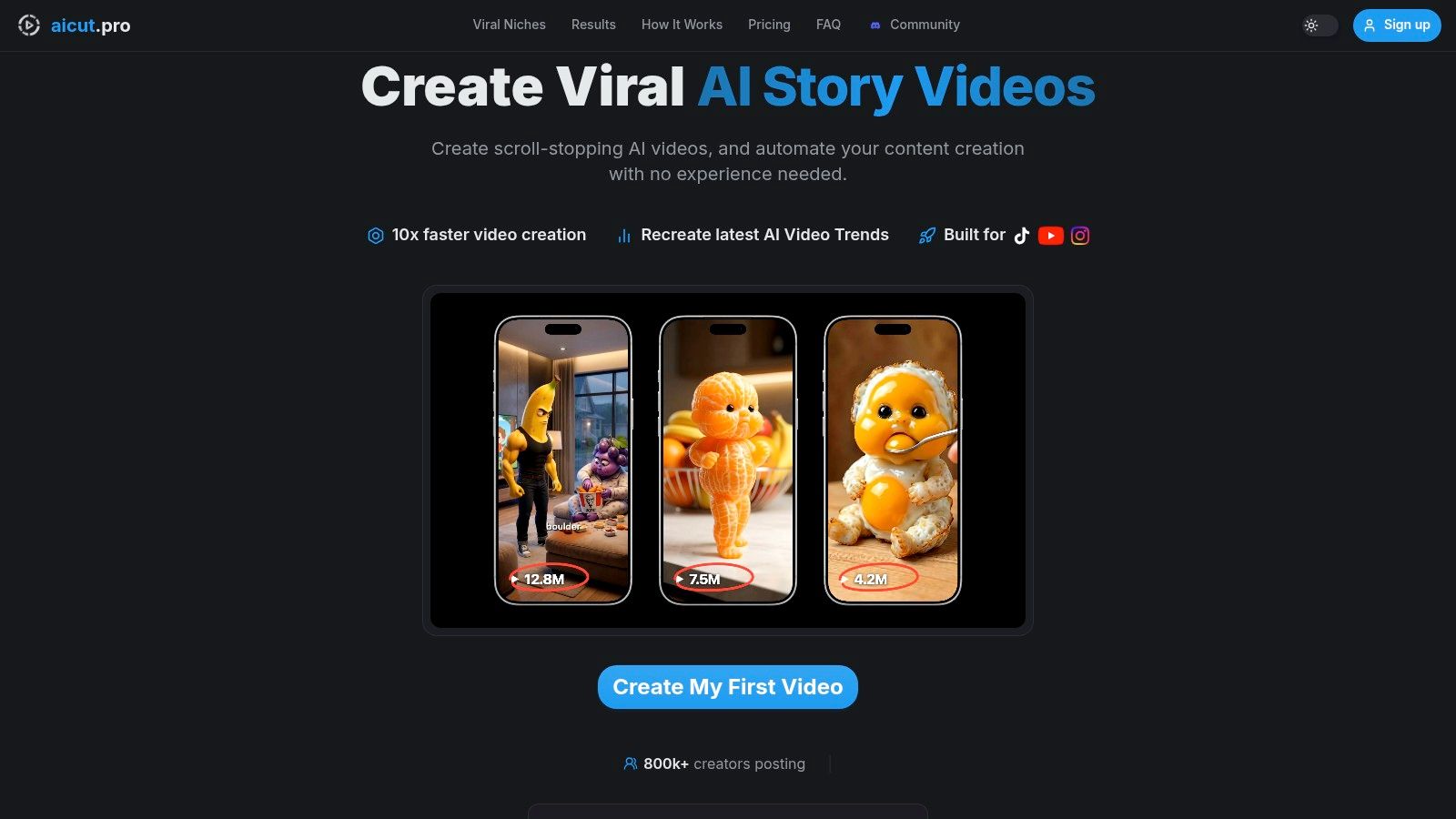
If you want to see how that kind of workflow is set up in practice, this guide on automating AI video creation with Aicut shows the operational side of turning concepts into repeatable output.
The practical advantage isn't speed alone
Creators often focus on AI as a way to make videos faster. Speed matters, but the larger advantage is creative range.
When a tool can generate variations quickly, you can test more intelligently. One idea becomes several hooks. One visual concept becomes multiple scenes. One winning format can be cloned and adapted to new niches without starting over. Features like prompt cloning, AI voiceovers, character swaps, background changes, and built-in scheduling are useful because they reduce the cost of experimentation.
That is what aligns with the Shorts ecosystem. The platform favors creators who can test, observe, refine, and repeat without collapsing under the workload.
The creators who scale on Shorts usually aren't guessing less. They're learning faster because their production system lets them test more often.
What to avoid with AI workflows
AI can also create junk quickly. That's the trade-off.
Don't rely on automation to compensate for weak hooks or poor pacing. Don't publish generic scripts that sound detached from the niche. Don't assume a trending visual style will carry a weak idea. The algorithm still responds to viewer behavior, not to how efficiently the asset was produced.
Use AI to increase volume only when the system protects quality. That means human review on hooks, tighter topic selection, stronger first frames, and packaging that matches the audience you want.
If you do that well, AI doesn't replace strategy. It gives strategy room to operate at scale.
Common Algorithm Myths and Final Thoughts
The fastest way to stall your Shorts growth is to follow advice built on folklore instead of viewer behavior. A lot of popular tips sound tactical but distract you from the signals that matter.
Myth: You should delete every Short that underperforms.
Reality: deletion rarely teaches you anything. A weak Short is data. Review the opening, pacing, topic fit, and payoff. Then make the next one better. Removing every miss can turn your channel into a lab with no notes.
Myth: Hashtags are the secret to virality.
Reality: hashtags can help clarify context, but they don't overpower retention. If viewers swipe away quickly, metadata won't save the upload.
Myth: One bad Short means the algorithm has turned against your channel.
Reality: Shorts are tested upload by upload. A weak post doesn't permanently poison the next one. That's why consistent iteration matters more than emotional reactions to a single result.
The healthiest way to approach the YouTube Shorts algorithm is to treat it as feedback, not judgment. Your job is to make stronger openings, tighter structures, clearer topics, and more satisfying endings. Then repeat that process enough times to spot patterns.
Creators who win with Shorts usually do three things well. They respect the first seconds. They test without ego. They build a production workflow that makes consistency realistic.
If you want a faster way to turn ideas into repeatable Shorts, Aicut is built for that workflow. It helps creators make faceless short-form videos, test variations, automate production, and keep publishing without getting stuck in manual editing.