So, you want to start making money from your YouTube Shorts? Let's break down exactly what you need to do to get there. The main goal is to get into the YouTube Partner Program (YPP), which is what unlocks ad revenue.
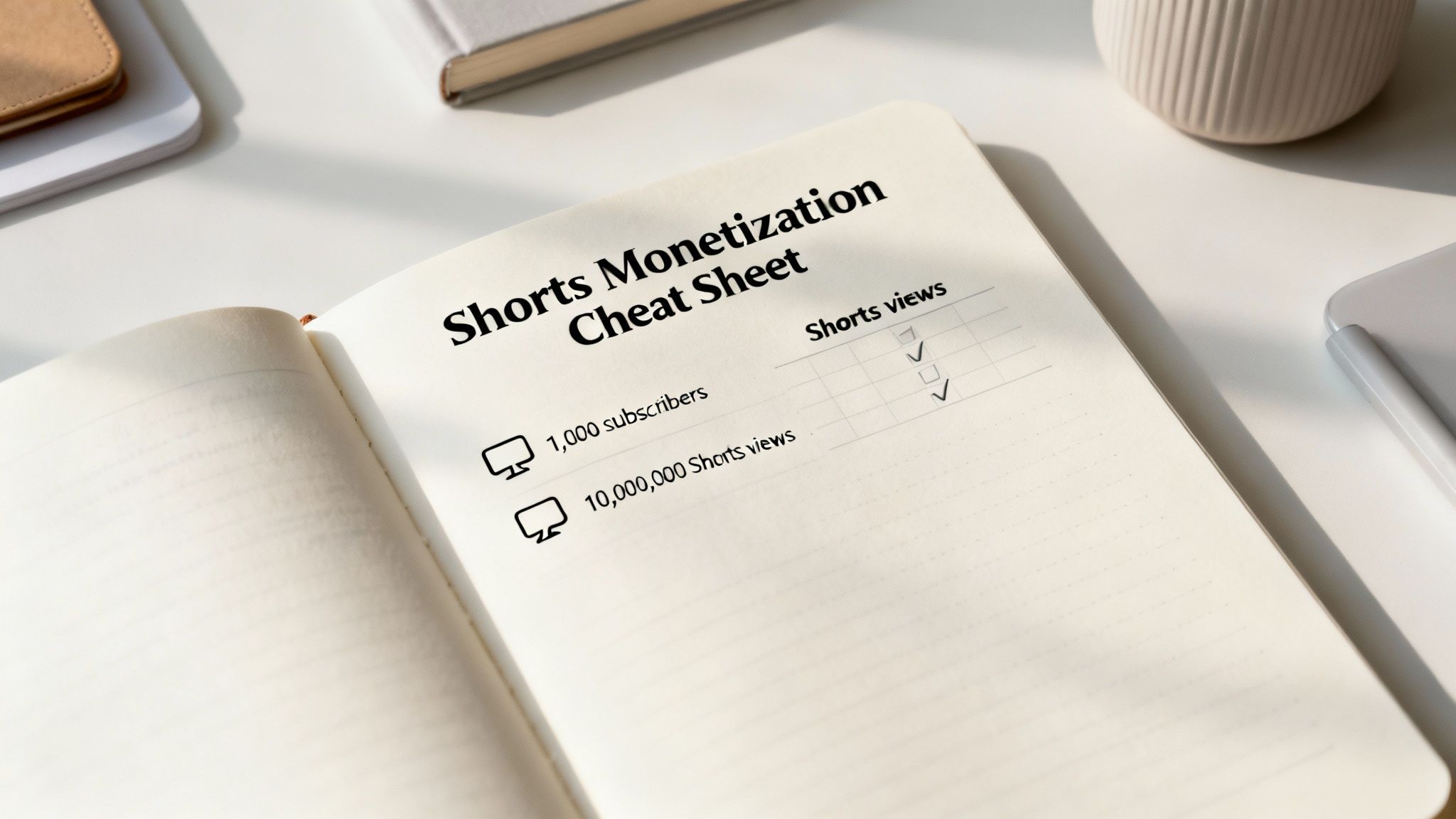
To qualify, you need to hit two key milestones. First, everyone needs 1,000 subscribers. That's the non-negotiable starting line.
After that, YouTube gives you two different ways to prove your channel has an audience. You can either get 10 million public Shorts views in the last 90 days OR you can rack up 4,000 public watch hours on your regular, long-form videos over the last 12 months.
You don't need both—just one or the other. This setup is great because it gives both dedicated Shorts creators and traditional YouTubers a fair shot at monetization.
Unlocking The Two Paths To YouTube Monetization
Think of getting into the YouTube Partner Program (YPP) like having two different keys to the same treasure chest. One key is all about the quick, explosive energy of viral Shorts. The other is about the slow-and-steady engagement you get from longer videos. YouTube did this on purpose, recognizing that creators find success in different ways.
No matter which path you take, the first step is always the same: hitting 1,000 subscribers. This tells YouTube you’ve started to build a real community that’s interested in what you have to say. Once you’ve crossed that threshold, you can focus on one of the two main routes.
The Shorts-First Path
If you're all-in on Shorts, your mission is to go viral—and do it consistently. The magic number here is 10 million public Shorts views within a 90-day window.
This path is built for speed and volume. It rewards creators who can jump on trends, create addictive loops, and capture attention in just a few seconds. It’s a sprint, not a marathon, and one hit video can make all the difference.
The Long-Form Path
On the other hand, if your channel is built around more traditional videos, you’ll be aiming for 4,000 public watch hours in the last 12 months.
This metric isn't about quick views; it’s about deep engagement. It shows YouTube that people are sticking around to watch your content for extended periods. While Shorts can definitely help you gain subscribers, this path is won by the total time viewers spend on your main videos.
To make this crystal clear, here’s a quick comparison of the two routes to full YPP eligibility.
YouTube Partner Program Eligibility at a Glance
| Requirement | Shorts-Focused Path | Long-Form Focused Path |
|---|---|---|
| Subscriber Count | 1,000 subscribers | 1,000 subscribers |
| Performance Metric | 10 million public Shorts views | 4,000 public watch hours |
| Timeframe | Within the last 90 days | Within the last 12 months |
| Best For | High-volume, viral, trend-based content | In-depth, high-retention, evergreen content |
Essentially, your content strategy dictates which path makes the most sense for you. Neither is better than the other; they just reward different styles of creation.
The diagram below really helps visualize this. It shows how both the 10 million views and the 4,000 hours are separate entry points leading to the same destination: monetization.
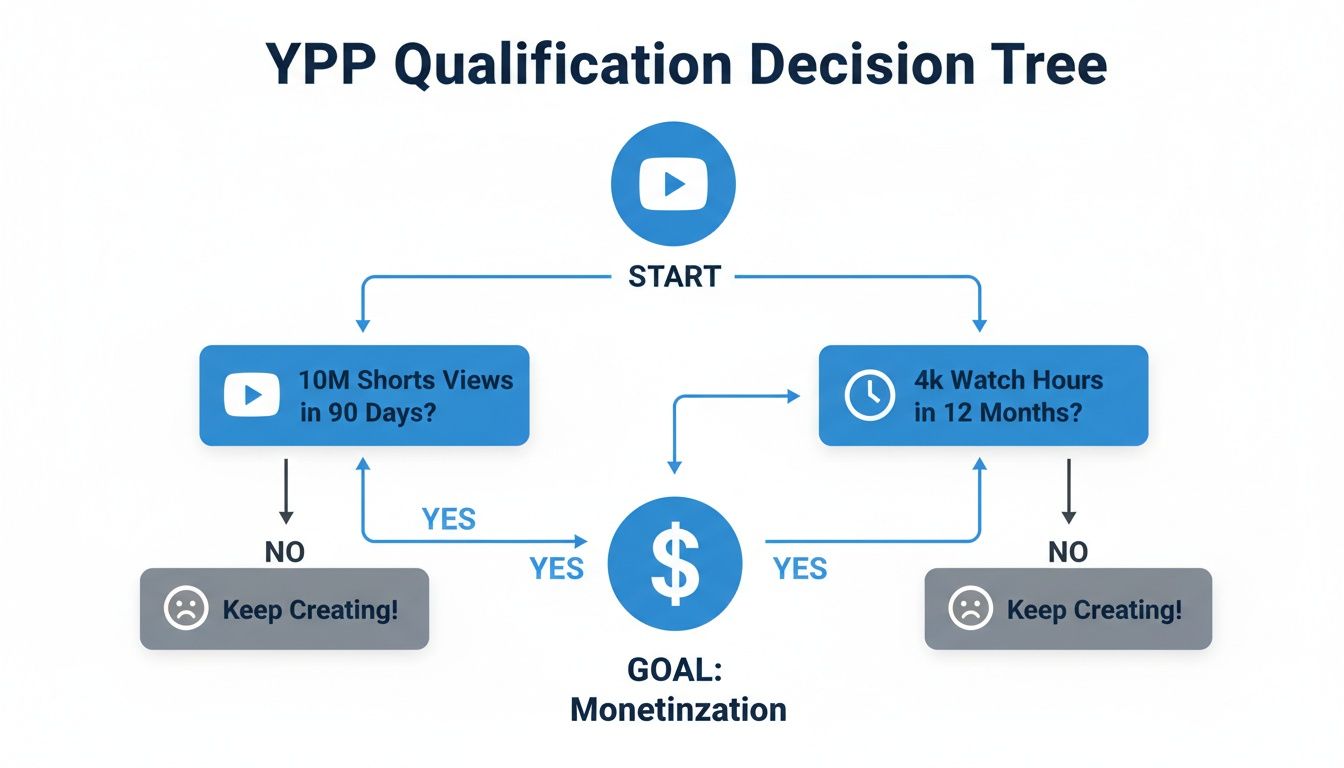
YouTube rolled out these updated requirements between 2023–2025 to level the playing field. It was a smart move that finally gave Shorts-first creators a clear and achievable way into the Partner Program.
If you want to really dive deep into building a successful channel from the ground up, many creators have found a ton of value in programs like Matt Par's Tube Mastery and Monetization course, which covers these strategies in much greater detail.
How Shorts Revenue Sharing Actually Works
So you’ve hit the big numbers and qualified for the YouTube Partner Program. That’s a massive win, but what happens next? How does the money actually flow from viewers' screens to your bank account?
It’s crucial to understand that Shorts monetization isn't like traditional, long-form YouTube videos. With longer videos, ads run directly before or during your content, and you get a cut. Shorts are a different beast entirely.
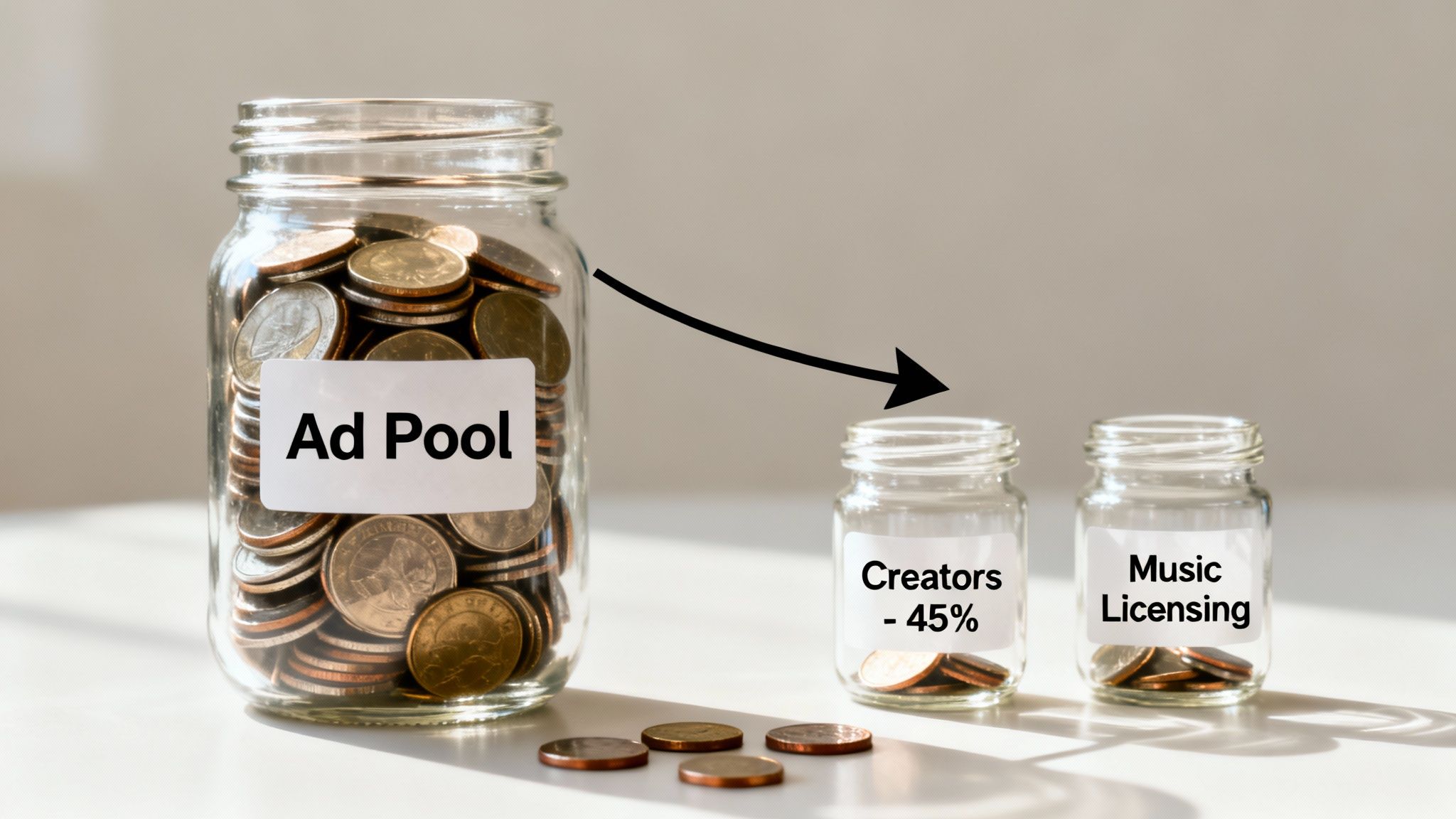
Think of it less like a direct payment and more like joining a co-op. Every month, YouTube takes all the money earned from ads that run between Shorts in the feed and puts it into one giant pot. This is a collective fund shared among all monetizing Shorts creators.
Before that pot gets divided, YouTube has to pay the bills. The first cut goes to cover music licensing costs. Since so many Shorts use popular music, this ensures the artists and labels get paid. Whatever is left over after the music industry gets its share becomes the Creator Pool.
Your Slice of the Pie
This is where your channel's performance becomes the star of the show. Your earnings are determined by your share of the total views across all eligible Shorts.
Let's say your videos accounted for 1% of all monetized Shorts views in your country this month. In that case, you get allocated 1% of the Creator Pool. It's that straightforward. The more eyeballs you bring to the Shorts feed, the bigger your piece of the pie.
Key Takeaway: You aren't paid for ads that run on your specific Shorts. Instead, you earn a share of a collective revenue pool based on how your channel's total Shorts views stack up against everyone else's.
Once your allocation is figured out, the final split happens. You keep 45% of your allocated share, and YouTube takes the remaining 55%. It’s a model built to fairly compensate millions of creators at scale. For a deeper dive, our guide on how to monetize YouTube Shorts breaks it down even further.
A Practical Example of Shorts Earnings
Let's put some real-world numbers to this to see how it plays out.
Imagine the Creator Pool for your country is $1,000,000 for the month. Across all monetizing creators, there were a total of 500 million eligible Shorts views. Your channel contributed 5 million of those views.
Here’s the math:
- Calculate Your View Share: Your 5 million views make up 1% of the total 500 million views (5,000,000 ÷ 500,000,000).
- Determine Your Allocation: You get 1% of the $1,000,000 Creator Pool, which comes out to $10,000.
- Apply the Creator Split: You take home 45% of that $10,000. Your final earnings for the month would be $4,500.
This example shows why your earnings can swing so much from month to month. Your payout depends not just on your own views, but also on the total ad spend and the total number of views from all other creators.
Based on this revenue model, reports from 2024–2025 suggest that Shorts RPM (revenue per 1,000 views) typically falls between $0.01 and $0.13. This means a Short that gets a million views could earn you anything from $10 to $130. To learn more about how this revenue is calculated, you can discover more insights about YouTube Shorts monetization.
Unlocking Fan Funding Sooner
Waiting to hit 1,000 subscribers and 10 million views can feel like an eternity, especially when you're just starting out. But what if you didn't have to wait that long to start earning? Good news—you don't.
YouTube created a special, earlier entry point into its Partner Program. Think of it as a stepping stone that lets you tap into fan-funding tools long before you qualify for the big leagues of ad revenue. This is all about giving your most dedicated viewers a way to support you directly, helping you build a loyal community from the get-go.
It’s a smart move because it rewards you for building a real connection with your audience, not just for racking up massive view counts.
The Fan Funding Requirements
The numbers for this first tier are way more achievable. Forget the 10 million view target for a second; you can get your foot in the door with just a fraction of that.
Here’s what you’ll need to unlock these features:
- 500 subscribers and 3 million public Shorts views in the last 90 days.
- OR 500 subscribers and 3,000 public watch hours from your long-form videos in the last year.
On top of that, you just need to have at least three public uploads in the past 90 days to show you're an active creator. It’s clear YouTube designed this to be a much more welcoming entry point, and we’ve seen countless channels use Shorts to blow past that 500-subscriber mark quickly. You can discover more about these tiered requirements to see the full breakdown.
What You Unlock with Fan Funding
Once you hit these numbers, you get a handful of tools that let your biggest fans support you financially. It's a fantastic way to create a tighter bond with your community.
Key Takeaway: Fan funding isn't about ad money. It’s about letting your core audience show their appreciation with their wallets, which can sometimes be more stable and meaningful than unpredictable ad payouts.
Here are the specific tools you get access to:
- Super Thanks: A viewer can buy a cool animation that pops up over your Short and leaves a colorful, highlighted comment. It’s basically a digital tip jar for your best work.
- Super Chats & Super Stickers: If you go live, your fans can pay to have their messages pinned to the top of the chat or send fun animated stickers. It's their way of getting your attention during a stream.
- Channel Memberships: This is a big one. You can set up recurring monthly subscriptions where you offer members-only perks like custom emojis, badges, or exclusive content.
This early tier of the YouTube Shorts monetization requirements is a brilliant way to build momentum. It lets you start earning and strengthening your community while you work your way toward full ad-revenue sharing.
Understanding the Must-Follow Content Policies
So, you've hit the numbers—that's awesome! But getting into the YouTube Partner Program is just one part of the equation. Staying in is the real challenge, and it all comes down to following the rules.
YouTube has a set of content policies that are non-negotiable, and they're particularly strict when it comes to Shorts. These rules are in place to keep the platform safe for everyone: viewers, advertisers, and you.
Lots of creators get snagged by one specific rule: reused content. This policy is aimed at channels that just grab videos from other places—like TikTok, TV shows, or other YouTube channels—and re-upload them without changing anything meaningful. It's a quick way to get your monetization application denied or revoked.
Why Originality is Non-Negotiable
At its heart, YouTube wants to pay creators for their creativity, not for their ability to copy and paste. To stay on the right side of this rule, your content needs to be transformative. What does that mean? It means you have to add your own unique touch.
This could be your own commentary, a funny reaction, some educational insight, or a creative edit that turns the original clip into something completely new and distinctly yours.
The Bottom Line: YouTube's monetization game is all about rewarding originality. Simply collecting cool clips from around the web won't cut it. You have to be part of the final product, whether that's through your voice, your face, or a heavy dose of creative editing.
Think of your channel as your own brand. It should have a unique feel, not just echo what everyone else is doing. Your personal perspective is what makes your content valuable.
Common Policy Traps for Shorts Creators
Aside from the big "reused content" rule, there are a few other policies that often catch Shorts creators by surprise. Knowing about them now can save you a world of trouble later on.
Here are the main ones to keep an eye on:
- Repetitious Content: This is when you upload a bunch of videos that are almost identical. If someone can't easily tell your Shorts apart, YouTube might see it as spammy or low-effort.
- Copyrighted Material: Using music from YouTube’s own Shorts library is usually fine (though it affects your revenue split). But grabbing copyrighted music or video clips from other sources without permission is a huge no-no and can earn you a copyright strike.
- Advertiser-Friendly Guidelines: Your content needs to be advertiser-friendly to make money. That means steering clear of excessive swearing, sensitive subjects, or depicting anything dangerous or harmful.
Making sure your content is accessible is also a big part of playing by the rules. Understanding how to add captions to your YouTube videos not only helps a wider audience enjoy your work but also shows you're committed to creating high-quality, inclusive content.
Applying for the YouTube Partner Program
So you've hit the numbers. Congratulations! Now it's time to take the final step and officially apply to the YouTube Partner Program (YPP). This is the part where you go from just being a creator to becoming a business partner with YouTube. The process itself is pretty simple, but you’ll want to get every step right.
First things first, you need to lock down your channel's security. This means turning on two-step verification for the Google account your channel is tied to. It’s a mandatory step and, frankly, something you should do anyway to protect your hard work. Once that's done, you'll need to read through and agree to the YPP terms—basically, the rulebook for earning money.
Linking AdSense and The Review Process
Next up is connecting a Google AdSense account. Think of AdSense as YouTube's payroll department; it’s how you actually get paid. If you don't have one, you can set one up during the application. If you already have one, you just link it. Easy.
With all the setup out of the way, your application heads into the review queue. This isn't just a bot scanning your stats. Real people at YouTube will be taking a close look at your channel to make sure it aligns with their policies and is a good fit for advertisers.
What Reviewers Look For: They’re looking for a lot more than just high view counts. They'll check out your channel's overall theme, your most-viewed videos, and your newest content to see if you’re providing real, original value. They're trying to weed out channels that just re-upload other people's stuff or post spam.
This whole review process usually takes about a month, but that can vary depending on how many people are applying.
Understanding the Decision
Once the review is complete, you’ll get an email with the verdict. If you’re in, you can head straight to YouTube Studio and start flicking on those monetization switches.
If your application is rejected, don't sweat it. It happens. YouTube will tell you why, and it's often for something like "reused content." You'll have 30 days to fix the problems they pointed out, and then you can apply again.
Getting into the YPP is a huge milestone, but it's just one piece of the puzzle. For a bigger picture, take a look at our complete guide on how to make money on YouTube to explore other strategies.
What to Do if YouTube Rejects Your Monetization Application
Getting that rejection email from the YouTube Partner Program stings, but don't let it discourage you. It’s not a permanent ban; it’s a roadmap telling you exactly what needs to be fixed.
YouTube will give you a specific reason for the rejection. For Shorts creators, the one that pops up most often is "Reused Content."
This term can be misleading. It doesn't always mean you're stealing videos. More often than not, it means your content isn't "transformative." Simply taking clips from movies, TV shows, or other creators and re-uploading them without adding your own unique spin is a fast track to getting denied. YouTube is looking for your creative input.
Think of yourself as a detective. After a rejection, your first job is to put on your investigator hat and audit your own channel. Go through your videos, especially the ones with the highest view counts, and be brutally honest. Did you add commentary? A clever edit? A new perspective?
Your Action Plan After a Rejection
Once you've pinpointed the problem videos, the path forward is pretty straightforward. You have to either delete them or edit them to add that crucial, transformative value. This part isn’t optional if you want to reapply successfully.
Here's what you need to do next:
Audit and Correct: Scour your channel using YouTube's feedback as your guide. Get rid of or rework any videos that violate the "Reused Content" policy or any other rules.
Wait It Out: After being rejected, YouTube makes you wait 30 days before you can apply again. Don't waste this time! Use it to meticulously clean up your channel and make sure everything is in order.
Reapply: When the 30-day period is over and you're confident your channel is compliant, head back to the "Earn" tab in YouTube Studio and submit your application again.
A Quick Word on Appeals: If you truly believe YouTube made a mistake and your channel follows all the rules, you can appeal the decision. You have 21 days to submit a short video explaining why you think they got it wrong. Only go this route if you are absolutely certain your content is 100% compliant.
Answering Your Top Questions About Shorts Monetization
As you get closer to hitting those big monetization numbers, the little details start to matter a lot more. It's natural to have questions pop up. Let's tackle some of the most common ones that creators run into on their journey.
One of the first things people wonder is about view eligibility. What about those Shorts you set to private or unlisted? Do they count? The short answer is a hard no. YouTube only counts views from public Shorts that have been racked up in the last 90 days.
So, if you had a video that did well but you later deleted it or set it to private, those views won't be part of your total. When it comes to monetization, only what your public audience sees truly counts.
Music, View Dips, and Your Monetization Strategy
Using that trending song is a huge part of what makes a Short go viral, but does it mess with your ability to earn money?
- Yes, you can absolutely monetize Shorts that use popular music, as long as you grab it from YouTube’s official audio library. The catch? The revenue from that Short gets split with the music's copyright holders first.
- What this means for you is a smaller paycheck compared to using royalty-free music or an original audio you created yourself.
Another big worry for creators is what happens after they get into the YouTube Partner Program (YPP). What if your views or subscribers drop below the requirements?
The great news is, once you're in, you're in. Even if your channel's numbers dip below the initial thresholds, you won't get kicked out. The key is simply staying active. If your channel goes completely dormant for six months or more, YouTube might review your status.
Finally, people often ask which goal is "better"—the views or the watch hours? Honestly, neither is superior. It all boils down to your channel's focus. If your knack is creating snappy, viral-style content, then the 10 million views target is probably your clearest path. But if you shine with longer, more detailed videos, then the 4,000 watch-hour goal is likely a better fit.
Curious about what those views are actually worth? Check out our guide on how much YouTube Shorts pay for 1 million views. The best advice is to play to your strengths and focus on the strategy that feels most natural for your content.