
Bad distribution advice usually comes from people who still treat short-form like syndicated blog content. They cut one video, export one file, post it everywhere, and wonder why TikTok stalls, Reels underperforms, and Shorts sends mixed signals.
Short-form distribution works at the edit level. Faceless channels feel this first because they cannot rely on a creator's face, voice, or personality to smooth over a weak opening. If the hook, pacing, caption treatment, and audio choice are not adjusted for the platform, the same idea can die three different deaths.
That is the true job of a content distribution strategy now. It is not just deciding where a video goes. It is deciding how one concept gets rebuilt into platform-native versions without adding hours of manual editing.
For faceless creators, algorithmic repurposing is the difference between posting more and distributing better. Tools like Aicut make that practical by letting creators swap hooks, restructure scenes, change caption rhythm, and test different character and audio combinations for each feed. TikTok usually rewards faster pattern interruption and stronger curiosity gaps. Reels often responds better to cleaner visual framing and more polished payoff. Shorts tends to give more room to clarity and search-aligned framing. Those are small production choices, but they change retention.
The foundation still starts with audience clarity. If the message is too broad, repurposing just multiplies a weak concept. A good demographic analysis for short-form video strategy helps narrow who the content is for before the platform-specific edits begin.
Laying the Foundation Your Audience and Core Message
A lot of creators think distribution problems start at posting. Usually they start much earlier. The video misses because the message is blurry, the audience is too broad, or the channel is trying to talk to three different viewer types at once.
Faceless channels feel this harder because there's no personal brand face carrying weak positioning. If the concept doesn't snap into focus in the first seconds, the platform has nothing to work with.

Start with viewer tension, not demographics
Demographics can help, but they usually aren't enough for short-form planning. What matters more is the tension the viewer already feels when they open the app.
For faceless channels, I map audience around four things:
What they want quickly
Entertainment, explanation, proof, inspiration, or a shortcut.What frustrates them
Slow tutorials, generic advice, too much talking, weak visual payoff, recycled trends.What format they already trust
AI story clips, list-style explainer videos, before-and-after edits, screen recordings, motion graphics, stitched commentary.What they'd save or share
This matters more than broad interest. A viewer might enjoy a post and still never help distribute it.
A practical way to tighten this is to study community behavior instead of inventing audience personas. Pull comments from niche creators, look at repeated questions, and group them by pain point. If you need a structured way to do that, this guide to demographic analysis for content planning is useful as a starting point.
Practical rule: If you can't describe your viewer's problem in one sentence, your distribution will feel random because your content is random.
Build a small set of content pillars
Most faceless channels overcomplicate this. You don't need endless categories. You need a narrow engine.
Use 3 to 5 core content pillars and make each one pull its own weight. A strong set usually looks like this:
Problem pillar
Content that names the frustration fast. Example: “Why your AI videos die after the first few seconds.”Proof pillar
Content that shows something working. This can be a format breakdown, visual comparison, or process clip.Process pillar
Content that shows how the thing gets made. For faceless creators, this often performs well because viewers like seeing systems.Opinion pillar
Clear takes cut through noise. “Stop posting the same Short to every platform” is stronger than soft educational framing.Experiment pillar
Tests give you repeatable material. Try two hook styles, two visual styles, or two caption structures and report what changed qualitatively.
Sharpen the core message
A channel grows faster when viewers can explain it to someone else in a few words. That requires one core message, not a pile of loosely related topics.
Use this simple filter:
| Check | Weak version | Strong version |
|---|---|---|
| Topic | AI content | Faceless AI short-form videos |
| Promise | Grow faster | Package videos for each platform better |
| Audience | Creators | Faceless creators and small teams |
| Differentiator | Repurposing | Algorithmic repurposing |
If your message is broad, every publishing decision becomes harder. If your message is sharp, distribution gets easier because you know what belongs on the channel and what doesn't.
Crafting Platform-Specific Playbooks
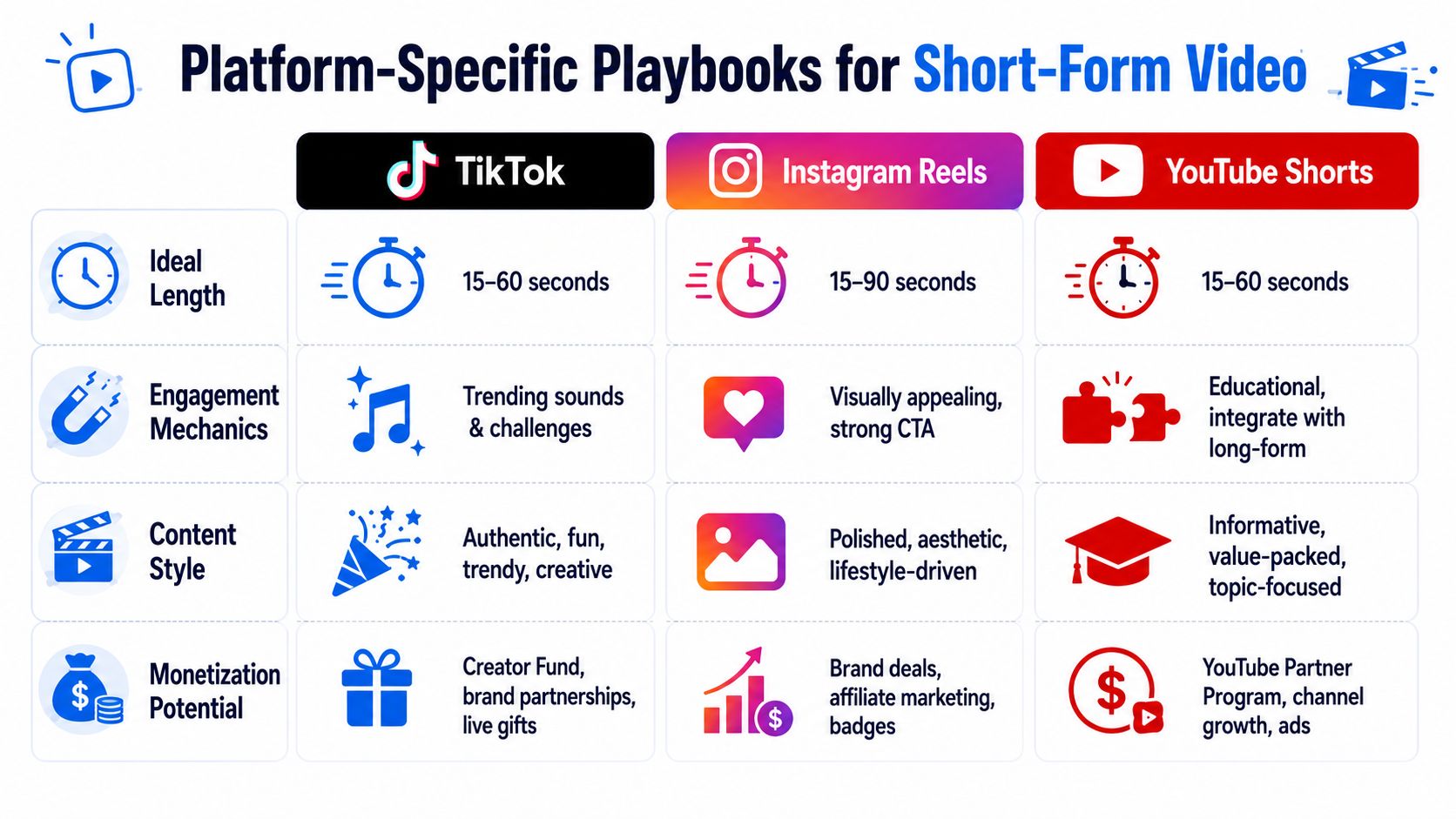
The biggest mistake in short-form distribution is treating platform differences like minor formatting changes. They're not. The feed behavior is different, the viewing context is different, and the threshold for keeping attention is different.
Expert benchmarks make this point clearly. A critical success factor is matching content types to distribution channels, and teams need channel-specific content because each platform has its own audience expectations and algorithmic behavior, according to Blumint.
TikTok rewards fast pattern interruption
TikTok is usually the least forgiving platform for slow setup. The opening has to create friction immediately. A faceless video there often works best when it feels like it dropped directly into the interesting part.
What tends to fit TikTok best:
Hooks that start mid-conflict
“This is why your faceless channel stalls.”
“Everyone copies this format wrong.”Rougher visual energy
Perfect polish isn't always the win. Movement, quick scene turns, and direct pacing usually matter more.Audio that feels current
Even with voice-led clips, the sound layer affects feel. Silence or flat stock audio can make the post feel dead on arrival.Captioning that supports speed
Keep on-screen text punchy. Long sentence blocks usually drag.
On TikTok, viewers often decide with their thumb before they decide with their brain.
Reels favors cleaner packaging and stronger identity
Instagram Reels usually asks for more visual control. Even faceless pages benefit from a more intentional look. The same core concept that feels native on TikTok can look messy on Reels if the visual framing is too chaotic.
Reels often works better with:
A stronger aesthetic frame
More consistent backgrounds, cleaner typography, tighter color choices.A clearer narrative voice
Even faceless channels need a recognizable point of view. Reels users respond well when the content feels authored, not just generated.Calls to action that feel natural
Saves and shares matter, but the CTA has to match the content. “Save this for your next edit” works better than generic engagement bait.
Shorts leans into hold and topic clarity
YouTube Shorts can carry a slightly more explanatory style if the pacing stays tight. Viewers are often open to clearer teaching, stronger sequencing, and a more complete payoff.
For Shorts, I'd prioritize:
| Platform | Hook style | Visual emphasis | Best use case |
|---|---|---|---|
| TikTok | abrupt, curiosity-heavy | movement and contrast | trends, hot takes, fast reactions |
| Reels | polished, identity-led | clean composition | branded faceless pages, lifestyle-adjacent content |
| Shorts | direct, promise-led | clarity and progression | explainers, story arcs, educational clips |
One concept, three executions
Take one idea like “why identical reposts underperform.”
On TikTok, open with tension. On Reels, open with a clean visual statement and a stronger brand feel. On Shorts, open with a direct promise and make the explanation stack logically.
That's the heart of a working content distribution strategy for short-form. Not three unrelated ideas. One idea, packaged three different ways.
The Art of AI-Powered Repurposing
Creators still waste good concepts by treating repurposing like file distribution. For faceless channels, that approach leaves reach on the table because the winning asset is rarely the exported video. It is the package of variables inside it: the first line, the speed of the first three cuts, the amount of text on screen, the voice treatment, the background motion, and the character style.
That is the job of algorithmic repurposing. AI tools like Aicut let you rebuild those variables fast enough to test platform fit without reshooting from scratch.
As noted earlier, emerging 2025 data shows that 68% of creators lose over 30% of their potential reach by using identical video files across platforms. That tracks with what I see in short-form accounts. The same idea can work on all three platforms, but the same cut usually will not.
The reason is simple. TikTok, Reels, and Shorts do not reward the same opening behavior in the same way. A faceless creator cannot rely on facial performance to smooth over a weak adaptation, so the edit has to carry more of the retention load.
What to actually change
Start with the parts that affect first-second retention and mid-video drop-off.
Hook line
TikTok usually needs interruption fast. Reels responds better to a cleaner first statement. Shorts tends to hold better when the promise is direct and specific.Character or avatar style
One AI avatar can read as fresh on TikTok and overly synthetic on Reels. Swapping the presenter, framing, or visual treatment often improves perceived originality.Background motion
Busy scenes can help one feed and hurt another. If the background competes with the text, viewers leave before the point is clear.Audio entry
Some cuts need a hard sound cue to stop the scroll. Others perform better with voice first and music tucked under.On-screen text density
If viewers have to read too much in the opening beat, retention drops. This is a common problem in AI-generated faceless videos.
A practical three-version workflow
I use one source script, then produce three retention-focused edits.
Version one for TikTok
Open with the sharpest tension point, not the cleanest explanation. Cut faster in the first five seconds. Keep text short and visual contrast high. If there is a reveal, tease it early so the viewer has a reason to stay.
Version two for Reels
Use the same idea, but clean up the presentation. Reels usually rewards stronger composition, better typography, and a more deliberate brand feel. I also reduce visual chaos here because polished faceless pages often get more trust when the edit looks authored, not auto-generated.
If you want a stronger system for that process, this guide on content repurposing strategies for short-form teams is useful.
Version three for Shorts
Lead with the clearest value statement. Shorts gives you a little more room to explain, but only if the sequence keeps progressing. I structure these edits around a promise, a quick proof point, then a payoff. If point two feels disconnected from point one, completion rate usually suffers.
This is also why many operators now discover AI tools for business growth that speed up adaptation rather than just rendering.
Working principle: Repurposing works when one proven concept gets rebuilt for three different retention systems.
A walkthrough helps make that more concrete:
Where simple cross-posting breaks
The failure points are predictable.
- TikTok loses interest before the conflict is clear
- Reels rejects the cut because it feels visually cheap or off-brand
- Shorts drops viewers when the sequence lacks a clear teaching arc
- Repeated audio and identical framing make the content feel reused
- Returning viewers treat the post like a duplicate, even when the idea is strong
Good repurposing keeps the idea and changes the delivery. For faceless channels, that difference is often the line between a post that stalls and a post that gets pushed.
Automating Your Publishing Workflow
A smart content distribution strategy collapses if publishing depends on daily motivation. Faceless channels especially need a system because the workload sits in planning, adaptation, editing, posting, and reviewing. If each step is manual, consistency disappears.
The best operating model for this is C.O.P.E.S., which stands for Create Once, Publish Enthusiastically & Strategically. The model also emphasizes a cadence that prioritizes consistency over frequency, according to WhisperTranscribe.
Build around batches, not single posts
Don't make one video, post it, then start from zero the next day. Batch work by stage.
A simple weekly workflow looks like this:
Concept day
Pick a small set of ideas tied to your content pillars.Production block
Generate or edit all base assets in one session.Adaptation block
Create the native variants for each platform.Scheduling block
Queue the content in advance and write captions in one pass.
This removes the mental tax of context switching. It also makes it easier to spot whether one idea deserves multiple variations before you move on.
Keep the cadence realistic
A lot of channels burn out because they chase volume before they've built repeatable quality. One high-quality blog post and one newsletter weekly is a recommended cadence in a broader content distribution context from WhisperTranscribe, but for short-form creators the useful lesson is the same. Consistency beats overproduction when the workflow has to hold for months, not days.
Publish at a pace you can maintain while still having time to review what actually worked.
Use automation for the boring parts
Automation shouldn't replace judgment. It should remove friction.
The useful tasks to automate are:
- Scheduling posts across channels
- Storing caption variants for each platform
- Tracking what has already been posted
- Queuing evergreen content for later reuse
- Managing a simple content calendar
For creators building a more repeatable system, this guide on how to automate social media posts gives a practical view of what to automate first.
Add an echo phase after publishing
Strong distribution doesn't stop at posting. A practical workflow includes a short echo phase after launch. Repurpose the main asset into quote graphics, short follow-up clips, or alternate openings and keep momentum alive for several days. That idea comes from the broader C.O.P.E.S. approach and is one of the easiest ways to get more life from a good asset without remaking it from scratch.
If engagement starts falling after repeated shares, pause that asset. Don't keep forcing it because it was expensive to make.
Measuring What Matters for Growth
Bad measurement creates fake lessons.
A faceless channel can post the same idea on TikTok, Reels, and Shorts, get three different outcomes, and draw the wrong conclusion from all of them. The concept was not necessarily weak. The adaptation may have been wrong for the platform. That is why measurement has to track platform fit, not just overall performance. Salesgenie notes that 41% of marketers do not consistently measure distribution results in its content marketing statistics roundup. For short-form creators, that gap usually shows up as random posting, random edits, and random conclusions.
Views are too blunt for this job.
A 200,000-view TikTok with weak completion can still be a bad template for Reels. A YouTube Short with lower reach but stronger average view duration may be the better candidate for a series. The point is to measure the part of performance that explains why the algorithm kept pushing or stopped.
Track the metrics that explain distribution
For faceless channels, the useful stack is small:
Hook retention Check whether viewers stay through the first one to three seconds. If they leave early, test a new first line, a faster visual reveal, or a different character entrance.
Average view duration and completion rate These show whether the structure held attention after the hook. Shorts usually rewards clearer payoff and cleaner sequencing. TikTok will often tolerate more tension if the opening pattern interrupt is strong.
Shares Shares signal idea spread. Reels tends to reward broadly relatable, easy-to-send clips. TikTok shares can come from stronger novelty or sharper opinions.
Saves Saves matter more than many creators admit. On Reels in particular, practical tips, templates, and repeatable workflows often earn distribution legs through saves.
Follower conversion This shows whether the video built channel demand or just borrowed trend demand.
Read each platform differently
The same metric does not mean the same thing everywhere.
On TikTok, I treat retention drops as an editing problem first. The hook may be too slow, the subtitle pacing may lag, or the character reveal may arrive too late. On Reels, weak shares and saves usually mean the post is watchable but not useful enough to pass along. On Shorts, low completion often points to structural drag. The setup ran too long, the payoff came too late, or the title promise did not match the clip.
Algorithmic repurposing transitions from theoretical to practical application. AI tools like Aicut help faceless creators change the opening line, swap visual characters, adjust subtitle rhythm, and test alternate audio beds without reshooting the whole video. That matters because the winning version on one platform often needs a different first three seconds on another.
Use a review table after each publishing cycle:
| Signal | What it usually means | What to test next |
|---|---|---|
| Early retention drop | Hook, opening frame, or audio cue missed | Rewrite first line, change first visual, shorten setup |
| Good watch time, weak shares | The video held attention but lacked a send-worthy angle | Add a sharper claim, stronger utility, or clearer payoff |
| Strong reach, weak follows | The topic traveled, but the channel identity stayed vague | Tighten niche framing and series naming |
| High saves, modest comments | People found it useful but not discussable | Add a stronger opinion or a clearer use case |
Turn winners into test inputs
Winning posts are raw material for the next round, not proof that the job is done.
Review your top clips and answer four questions:
- Which hook style kept the most viewers through the opening?
- Which character, visual format, or caption treatment made the idea easier to process?
- Which audio choice improved pacing without distracting from the message?
- Which platform gave this concept the cleanest retention curve?
That review process is how faceless channels scale without guessing. The Nereo content scaling guide is useful on the production side, but the distribution side comes down to this. Keep the idea. Change the packaging based on what each platform rewarded.
Measure every post with the same lens, and weak performance gets easier to diagnose. You can tell whether the problem was the concept, the hook, the edit, or the platform adaptation. That is the difference between posting more and achieving growth.
Scaling Your Strategy From First Post to Viral Channel
Viral channels rarely grow because they post more. They grow because they turn one proven idea into a platform-specific system.
Faceless creators feel this faster than on-camera creators do. You cannot rely on personality to carry a weak adaptation, and you cannot fix poor platform fit by reshooting every version. The practical answer is algorithmic repurposing. Keep the core concept, then rebuild the hook, character framing, pacing, captions, and audio bed for TikTok, Reels, and Shorts based on how each platform tends to reward retention.
Process content helps that system scale.
Creators who show the decision-making behind a post often get more mileage than creators who only publish the polished final cut. For faceless channels, that can mean posting the failed hook, the AI prompt that changed the character style, the side-by-side opening test, or the caption swap that improved completion rate. Those assets are cheap to produce, and they give your winning ideas a second distribution path without requiring a new shoot.
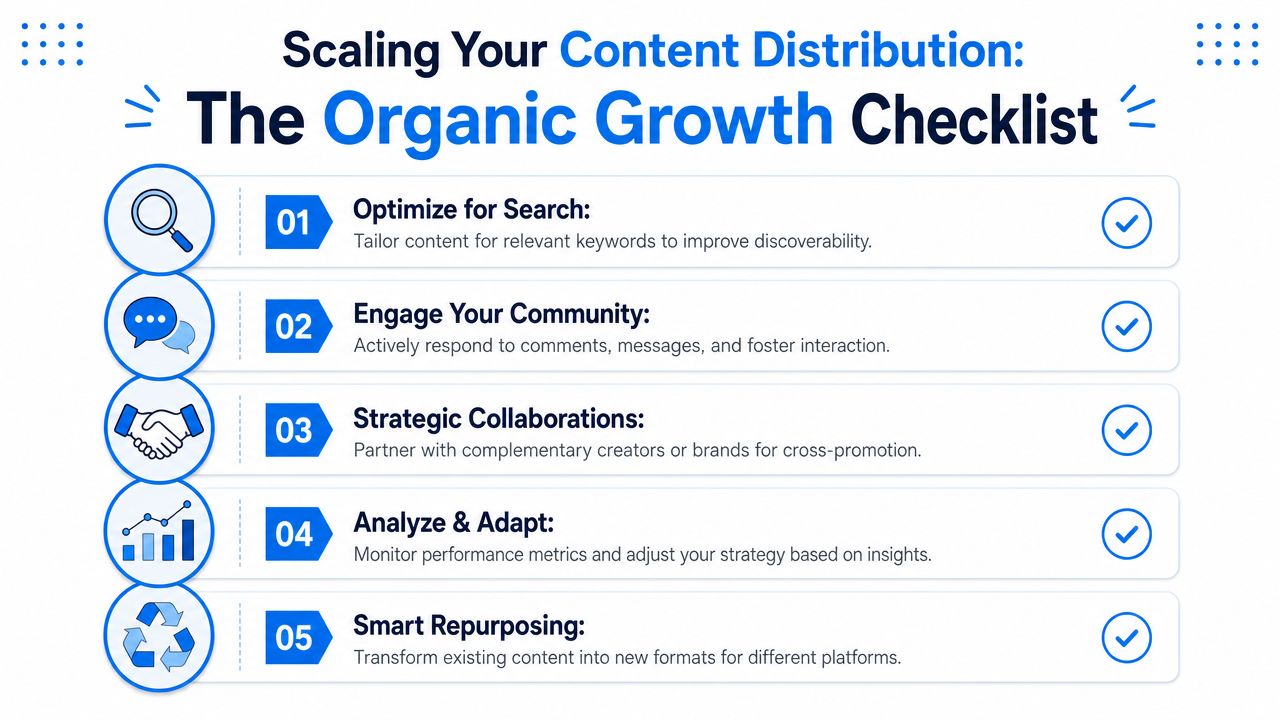
The channels that compound usually run a simple loop.
They start with one concept that already showed signs of life. Then they cut distinct versions for each platform. TikTok usually gives more room for a curiosity gap or a stronger native trend signal. Reels often responds better to cleaner visual polish and faster payoff. Shorts tends to reward tighter topic matching and less wasted motion in the first seconds. After publishing, they review the retention curve, isolate what held attention, and feed that back into the next batch.
That loop is how a single post becomes a series, and a series becomes a channel identity.
If you want a broader operational view of what that looks like as output increases, the Nereo content scaling guide is a useful companion read.
Here's the checklist I'd use:
Scale from proven concepts
Do not build a larger workflow around untested ideas. Scale the topics, hooks, and formats that already earned attention.Repurpose for the algorithm, not for convenience
A TikTok winner should not be dumped onto Reels and Shorts unchanged. Rewrite the opening line, adjust visual density, and swap audio if the platform calls for it.Turn production scraps into distribution assets
Hook tests, prompt variations, storyboard drafts, and edit notes can all become posts of their own.Build repeatable series formats
One-off wins create spikes. Named formats create recognition and follower growth.Use AI to increase output without flattening quality
Tools like Aicut work best when they produce controlled variations of a strong idea, not when they generate random volume.Commit more resources to what already travels Winning concepts deserve alternate cuts, follow-ups, stitched responses, and repost windows adapted for each platform.
Viral growth looks unpredictable from the outside. Inside the workflow, it is usually a stack of clear decisions repeated well. The creators who scale fastest are not posting blindly. They are adapting every strong idea to the retention logic of each platform, then using AI to do it faster and more consistently.
If you want to put this into practice faster, Aicut helps creators generate faceless short-form videos, adapt ideas into multiple platform-ready versions, schedule posts, and automate more of the workflow that usually slows distribution down. It's a practical option for creators who want a real content distribution strategy, not just more files sitting in a drafts folder.