
You're probably in one of two situations right now. You have content getting attention, but too much of that attention dies in DMs, comment threads, or contact forms that nobody follows up on fast enough. Or you've already tried a chatbot, and it felt like a novelty widget that answered a few questions but didn't move revenue.
That's why most advice about make money with chat falls short. It treats chat like a standalone product. In practice, the money usually comes when chat becomes the layer between attention and action. It qualifies the lead, answers objections, books the call, routes the buyer, collects the brief, and keeps the customer moving after the sale.
Chat works best when it sits inside a business model that already has demand. Content brings people in. Services solve urgent problems. Offers turn interest into cash. Chat connects all three so you don't need to handle every conversation manually.
Beyond Answering Questions Your New Business Engine
A creator publishes every day, gets steady views, and still feels stuck. Comments pile up. People ask the same questions. Brand leads send vague inquiries. A few buyers are interested, but most disappear because nobody responded when intent was highest.
That isn't a content problem. It's a conversation bottleneck.
Where the money gets lost
Most small businesses and creators don't fail because they lack offers. They fail because their sales process lives in scattered places: Instagram DMs, email, website forms, Telegram chats, and support inboxes. Every extra handoff lowers the chance of conversion.
Chat fixes that when it's designed as a business engine instead of a support add-on. A well-built chat layer can:
- Qualify visitors by asking what they need, budget range, or timeline
- Route buyers to the right product, offer, or booking page
- Collect project details before you ever open your inbox
- Handle repeat objections so your sales calls start warmer
- Support customers after purchase without making you answer the same question all week
That's why teams are now thinking in terms of transforming business with AI employees instead of just adding a chatbot to a homepage. The shift is operational. Chat can take over parts of intake, follow-up, support, and internal coordination that used to require manual work.
Practical rule: If chat doesn't sit close to an offer, a funnel, or a workflow, it usually becomes a toy.
What chat should do for your business
A useful mental model is simple. Your content gets attention. Your offer creates demand. Chat handles the messy middle.
That middle is where revenue is won or lost. A viewer clicks from a short-form video. A prospect lands on your page. A customer wants to know whether your service fits their use case. Chat can keep those moments moving without waiting for you to reply manually.
This is the reframing needed. Don't ask, “How do I sell a chatbot?” Ask, “Where do conversations currently slow down my business, and how can chat remove that friction?”
Once you think that way, monetization gets clearer. You're not selling software for its own sake. You're building a faster path from interest to payment.
Build and Sell Automated Chat Systems for Clients
The fastest way to make money with chat is often not launching your own app. It's solving a business problem for someone who already has customers, traffic, or operational pain.
Fiverr's guide on how to make money with ChatGPT points to custom GPTs, freelance services, and customer-support chatbots as real monetization paths. It also reflects a useful constraint from OpenAI community discussions: direct in-GPT monetization can be hard, so many builders get better results by using chat to drive leads to an owned site or controlled funnel.
Start with the visual workflow below.
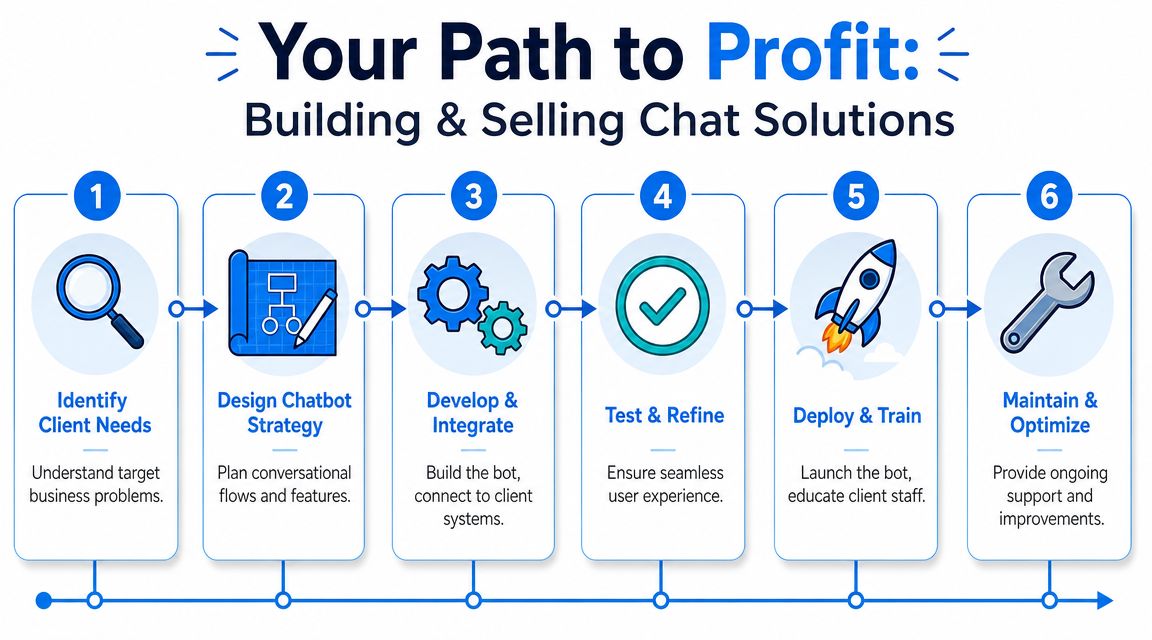
The easiest clients to sell first
Don't pitch “AI transformation.” Sell a narrow result.
The best early clients usually fall into a few buckets:
- Local service businesses who need faster lead capture and qualification
- E-commerce stores drowning in repetitive pre-purchase or post-purchase questions
- Agencies that need intake automation before strategy calls
- Creators with paid offers who want a chat layer for lead capture and FAQ handling
If a business already gets messages but responds slowly, that's a sales opportunity. If they already answer the same support question repeatedly, that's a support automation opportunity.
A useful adjacent problem is content consistency. If a client struggles to keep traffic flowing, they won't get much value from a lead bot alone. That's where tools for solving social media posting challenges can complement your chat offer by keeping top-of-funnel activity alive.
Package the outcome, not the bot
Most buyers don't care about your model choice, prompt stack, or automation platform. They care about what happens after launch.
Here's a simple packaging table.
| Package | Best fit | What's included |
|---|---|---|
| Lead generation bot | Local business, agency, coach | Website chat, qualification flow, call booking handoff, basic CRM or email routing |
| Customer support bot | E-commerce, SaaS, service brand | FAQ flows, order or policy guidance, escalation path, support tagging |
| Sales assistant bot | Productized service or info product | Offer guidance, objection handling, pricing explanation, payment or demo routing |
Discovery call questions that actually matter
A weak discovery call focuses on features. A strong one diagnoses friction.
Ask questions like:
- Where do leads currently come from? Website, ads, social, DMs, referrals.
- What happens after someone shows interest? Form, email, booking page, manual DM.
- Which questions repeat most often? Repetition gives you the first automation wins.
- Where do prospects disappear? That tells you where the chat flow should intervene.
- What systems must the chat connect to? Calendar, inbox, CRM, order data, docs.
If you need to sharpen your workflow design, this guide on prompt engineering for practical AI workflows helps with the logic behind better chat interactions, especially when you're mapping decision trees and response behavior.
After the strategy is clear, show the client a process video instead of talking in abstractions.
What makes a chat system easy to sell
The sale gets easier when you anchor the proposal to one operational pain point.
A lead bot is easy to sell when the owner already knows they miss inquiries after hours.
Don't promise magic. Promise less manual triage, faster responses, cleaner intake, and better routing. That language is credible. It also gives you room to expand later into reporting, maintenance, and funnel optimization.
Offer High-Value Chat-Powered Services
Selling chat systems is one model. Using chat to upgrade your own service is a different business entirely.
Many people make more money with chat. Not because the technology is more advanced, but because the offer is stronger. Clients buy outcomes faster than they buy infrastructure.
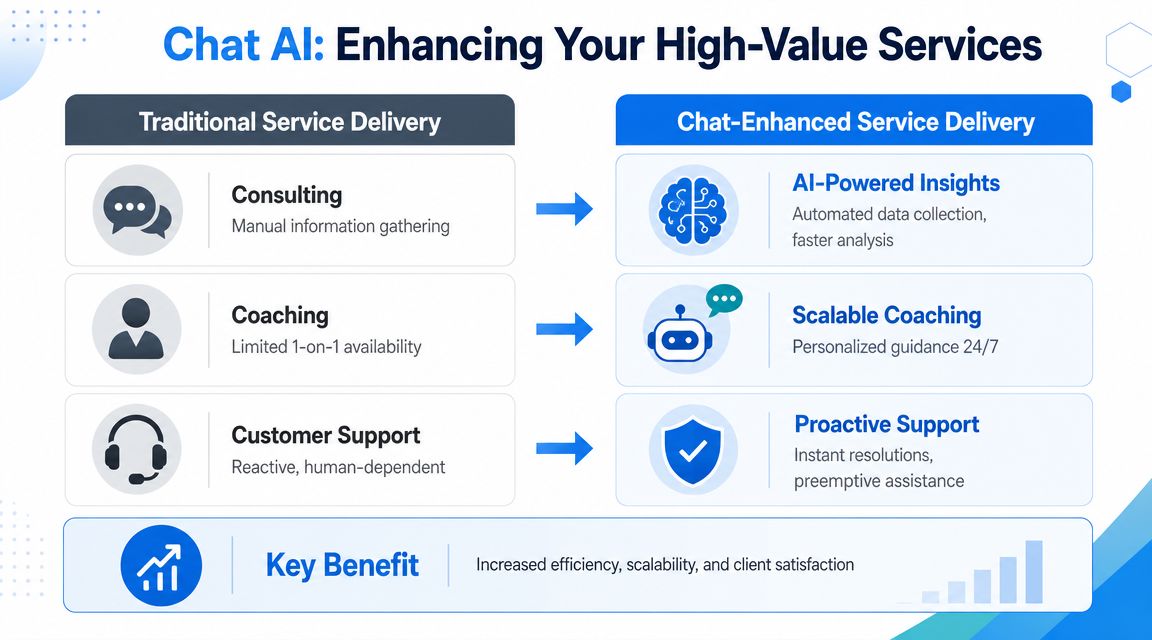
Selling the tool versus selling the result
Compare these two offers:
| Model | What the client buys | Where the value is obvious |
|---|---|---|
| Bot builder | A chatbot setup | When the client already understands automation |
| Chat-powered consultant | Better delivery, faster service, easier scaling | When the client cares about speed, structure, and results |
The second is often easier to position. A coach doesn't necessarily want “AI.” They want a system that handles onboarding, daily accountability prompts, progress check-ins, and FAQ replies so live sessions can focus on decisions and strategy.
A marketing consultant can use chat to intake assets, gather campaign goals, collect audience details, and route the client into the right service lane. A sales agency can let chat handle initial qualification so human closers spend time only on stronger leads.
Where the real leverage sits
One YouTube workflow on using ChatGPT to support service sales operations gets closer to reality than most generic AI advice. It shows chat being used to draft outreach emails, intake forms, quotes, and contracts. That matters because the bottleneck in service businesses usually isn't idea generation. It's the admin and follow-up work around winning and retaining clients.
Here's where chat helps most inside a service:
- Client acquisition: outreach drafts, lead qualification, appointment prep
- Client onboarding: questionnaires, goal collection, expectation setting
- Delivery support: reminders, summaries, progress tracking, resource recommendations
- Retention: check-ins, renewals, issue triage, upsell routing
Operator insight: If your service still relies on custom emails and manual onboarding for every client, chat can raise capacity before you hire.
Three strong service examples
Coaching
A fitness, business, or career coach can use chat before the first call to collect goals, constraints, and current blockers. That makes the paid session sharper. After the session, the same chat layer can deliver reminders and gather updates between calls.
Consulting
A consultant can use chat to turn a messy inquiry into a structured brief. That cuts down on unpaid back-and-forth and helps justify premium positioning because the process feels organized from first contact.
Creative and marketing services
If you run short-form video, ad creative, or content strategy as a service, chat can collect brand voice, content goals, product details, and asset links before production starts. It can also handle revision intake, which removes a surprising amount of friction.
The pattern is the same in each case. Don't sell “a chatbot for your business.” Sell a service that becomes easier to buy, easier to deliver, and easier to renew because chat handles the repetitive parts.
Use Chat to Power Content and Ad Funnels
Content alone rarely pays reliably. It gets attention, but attention without a next step is just noise.
The stronger model is this: content creates curiosity, chat captures intent, and your offer closes the gap between interest and purchase. That's how creators and marketers make money with chat without turning chat into the product itself.
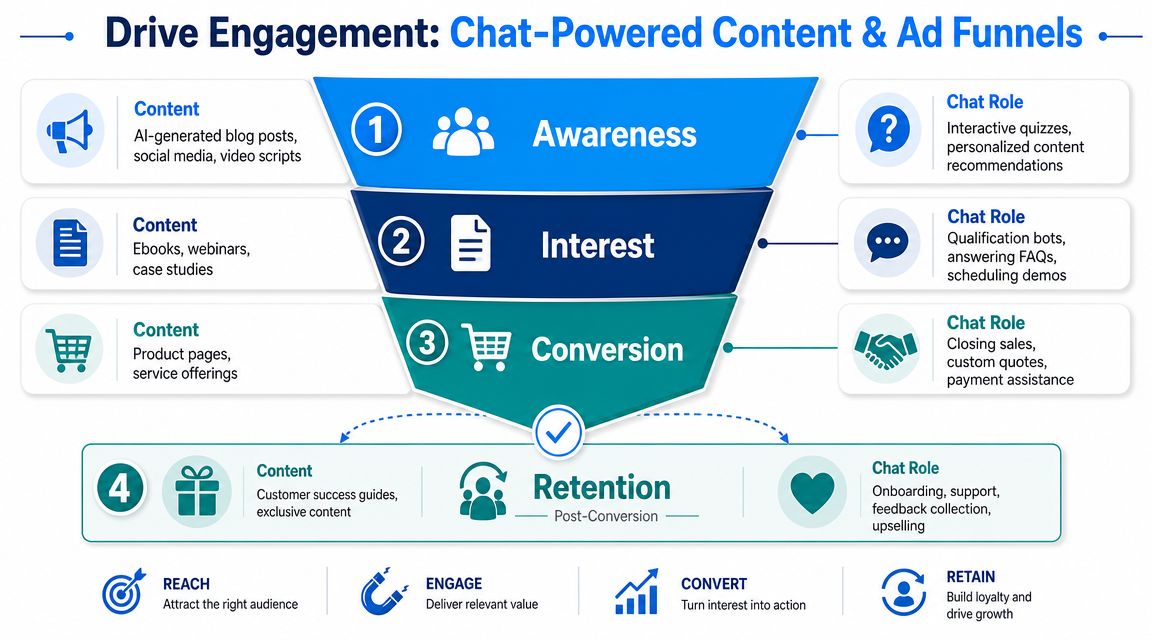
Why generic content funnels are getting weaker
A lot of AI monetization advice pushes the same playbook: AI writing, faceless channels, affiliate pages, and broad content niches. A practical discussion on underserved AI monetization angles makes the better point. Common plays are widely circulated, which means differentiation matters more than raw output.
That's especially true in short-form content. AI tools make replication easy. If your only edge is publishing faster, you'll blend in. A stronger edge is using chat to continue the conversation in a way competitors don't.
A working funnel for creators and marketers
Here's the funnel I'd build for a creator, operator, or service business:
- Publish niche-specific content that calls out a pain point clearly.
- Send traffic to a chat entry point through bio links, landing pages, or DM keywords.
- Use chat to segment the visitor by goal, problem, budget, or urgency.
- Route each segment to the right asset, offer, call, or checkout page.
- Follow up based on chat responses through email, SMS, or retargeting.
A single content tool serves to feed the top of the funnel. For short-form creators, AI ad creative workflows matter because the content itself has to stop the scroll before chat can do its job. And one option in that stack is Aicut, which generates faceless short-form videos, supports prompt-based creation, and helps publish content for platforms like TikTok, YouTube Shorts, and Instagram.
What chat should say at each funnel stage
Different traffic sources need different conversations.
- Cold traffic: ask one simple question and offer a personalized path
- Warm traffic: answer objections, compare options, or book the next step
- Buying traffic: reduce friction around pricing, fit, timing, and onboarding
- Post-purchase traffic: deliver setup guidance and collect feedback for retention
A weak funnel throws everyone to the same landing page. A stronger funnel lets chat adapt the path based on what the person actually wants.
Don't ask chat to “engage users.” Ask it to move one person from one stage to the next with less friction.
The content angle that converts better
The easiest mistake is making broad content and hoping chat cleans it up later. It won't.
The better approach is to create content around a specific pain, audience, or style, then let chat continue that exact thread. If the video is about ad creatives for a skincare brand, the chat should not open with “How can I help?” It should continue the topic with options, examples, or a qualification question tied to that pain point.
That's what makes the funnel feel effortless. The content starts the conversation. Chat finishes it.
Create Recurring Revenue with Chat Products
Services are good for cash flow. Recurring products are better for stability.
That doesn't mean you should rush into building an app. It means once you know which conversations repeat, which questions show up constantly, and which outcomes people pay for, you can turn that operational knowledge into a product.
Why recurring chat products work
The subscription model for chat isn't theoretical anymore. Business of Apps reports that ChatGPT generated about $8 billion in 2025 and reached 100 million users in just two months, which validates premium chat products at a very large scale according to its ChatGPT statistics analysis.
That doesn't mean every niche bot will succeed. It means buyers already understand that chat can be worth paying for when it saves time, improves decisions, or gives access to a specialized workflow.
Three product models worth building
Niche GPT access
This works when you have domain knowledge and a clear audience. Not a generic “marketing assistant.” Something narrower, like a script assistant for real estate reels, an intake helper for freelance designers, or a support guide for a specific software stack.
The key is specialization. General-purpose tools are harder to defend.
Prompt packs and workflow templates
This is the simplest productization route. Instead of selling a live service, you package the prompts, decision trees, intake flows, and response frameworks behind the work you already do.
What sells here isn't “better prompts” as a vague promise. It's packaged execution. Buyers want a ready-to-use workflow for outreach, qualification, onboarding, scripting, or support.
Paid communities with a chat layer
A strong version of this model is a private Discord or Telegram group where members get access to a specialized bot plus curated support, resources, and accountability. If you're exploring that route, this guide on making money with Telegram groups is useful because community monetization works differently from one-off product sales.
If you want the broader productized-income angle, this breakdown of passive income with AI connects well with chat products that can be sold repeatedly after the core system is built.
What usually fails
Most recurring chat products fail for predictable reasons:
- They're too broad: no clear audience, no urgent use case
- They save curiosity, not time: interesting to try, easy to cancel
- They depend on platform visibility alone: no owned audience, no lead capture
- They don't connect to a workflow: users chat once, then leave
The fix is simple. Build around a repeated job. If people need the output every week, every campaign, every client cycle, or every publishing sprint, you have a stronger shot at recurring revenue.
How to Price Your Chat Offerings and Measure Success
Pricing gets messy when people treat chat like a novelty. It gets simpler when you tie it to delivery model and business impact.
A one-time build should not be priced like ongoing optimization. A lightweight support bot shouldn't be priced like a sales workflow tied into intake, routing, and follow-up. The mistake is charging for “AI” instead of charging for scope, maintenance, and business relevance.
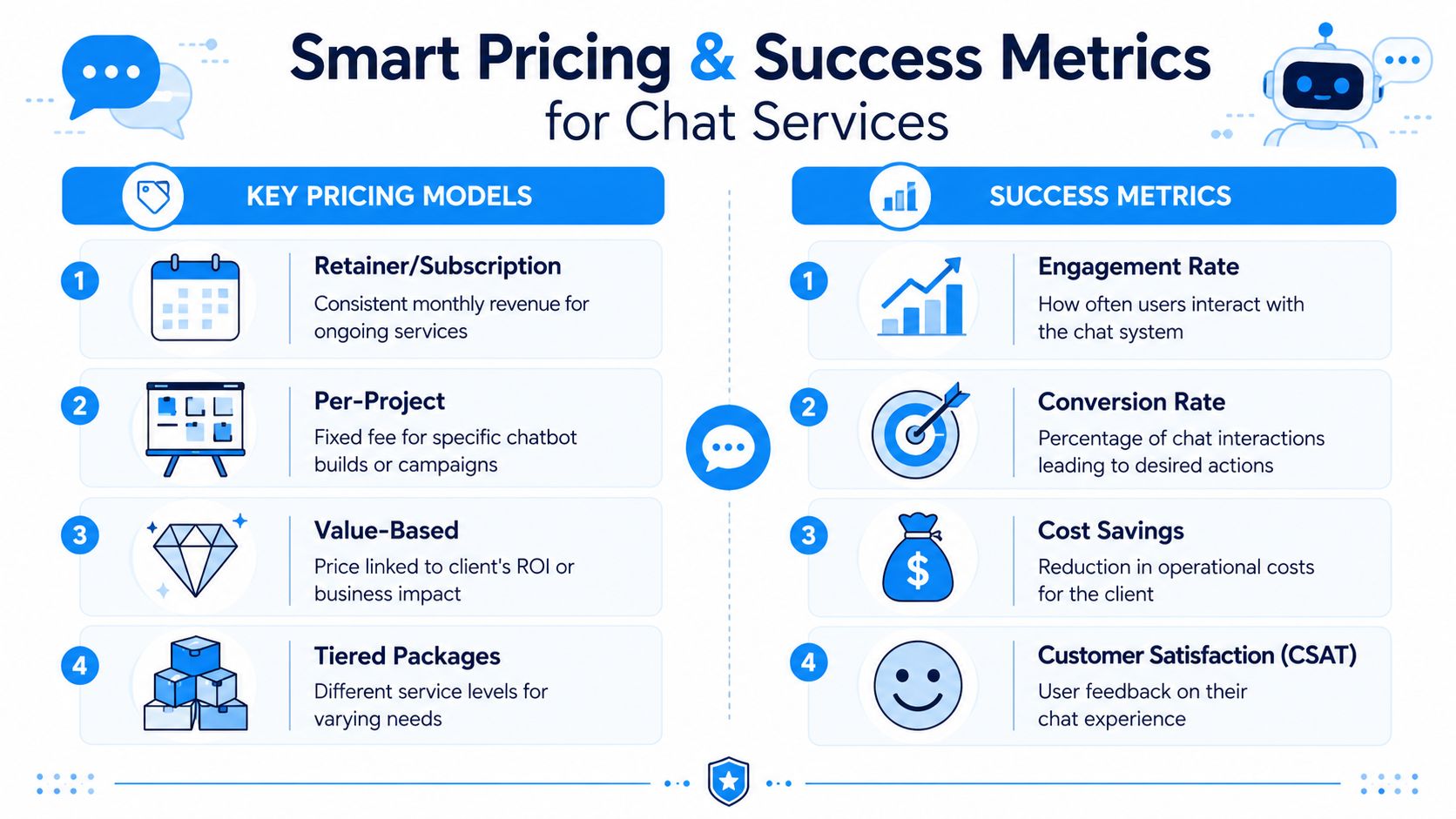
Pick a pricing model that matches the work
Use this framework:
| Model | Best when | Watch out for |
|---|---|---|
| Per-project | Initial builds, setup-heavy work, defined scope | Clients may expect support forever unless boundaries are clear |
| Monthly retainer | Ongoing optimization, maintenance, reporting, prompt updates | You need a clear list of what is and isn't included |
| Tiered packages | You serve similar clients with repeatable needs | Tiers fail when every deal turns custom anyway |
| Value-based pricing | The chat system affects lead flow, sales ops, or support load in a meaningful way | Harder to sell without trust or proof from prior work |
If you're early, keep it simple. Sell one setup package and one monthly support package. Complexity usually hurts conversion more than it helps margin.
Measure the business, not just the chat
A lot of people track vanity metrics because they're easy to see. That's not enough.
The metrics that matter depend on the role chat plays:
- For lead generation: qualified inquiries, booked calls, completed applications
- For sales support: offer page visits after chat, quote requests, checkout progression
- For customer support: issue resolution speed, escalation quality, repeat question reduction
- For service delivery: onboarding completion, client response time, renewal conversations started
Measurement rule: A chat system is working when it improves a downstream business action, not when it simply produces more messages.
What to review every month
A monthly review doesn't need to be complicated. Look at the transcript patterns, breakdown points, and handoff quality.
Review these questions:
- Where are users dropping off?
- Which questions create confusion or hesitation?
- Which traffic sources produce the best conversations?
- Which offers are being routed most often?
- Where does human intervention still outperform automation?
Those answers tell you what to rewrite, what to simplify, and where to add human follow-up. Good chat monetization isn't static. It improves as you learn which conversations create revenue and which ones waste time.
If you want to turn short-form content into a real acquisition system, Aicut can help with the top of the funnel. It's built for creating and automating faceless videos for YouTube, TikTok, and Instagram, which makes it useful when you need a steady stream of niche content feeding into a chat-driven lead or sales flow.