
Struggling to find a short film prompt that works on TikTok or Reels? Most creators don't have an idea problem. They have a format problem. A prompt that sounds cinematic in a notebook often collapses on mobile because it's too broad, too slow, or too dependent on feature-film storytelling.
A good short film prompt isn't just a premise. It's a production brief for a very small runtime window. Many film organizations classify anything under 40 minutes as a short film, but practical short-form storytelling usually works best when the concept is far tighter, often closer to 15 minutes or less, which is why strong shorts lean on compressed setups, minimal locations, and fast payoff structure, as discussed in Noam Kroll's breakdown of short film fundamentals. On TikTok, Reels, and Shorts, that compression gets even more extreme.
That's the gap most “film school” advice misses. It teaches scenes. Platforms reward hooks, visual clarity, and payoff density. If you're building with AI tools, your short film prompt also has to tell the model what to show, how to move, and what feeling to preserve from first frame to last.
So let's skip generic writing prompts. Below are eight practical formats that map cleanly to AI video generation, short-form feeds, and faceless workflows. If your real goal is achieving viral content success, these are the structures worth testing first.
1. The Plot Twist Reveal
The strongest twist videos don't hide information. They steer attention. That's the difference between a satisfying reveal and a cheap trick.
A solid short film prompt for this format starts with one readable assumption. A person waits outside a hospital. A delivery box rattles. A couple argues in a kitchen. Then the last beat reframes what the viewer thought they were watching. The hospital scene becomes a surprise pet reunion. The scary box contains a birthday gift. The relationship drama turns out to be siblings rehearsing a play.
Write the misdirection into the shot plan
Generic prompts fail here because they only describe the ending. The better move is to script visual bias into the opening frames. Use framing, props, and pacing to push the audience toward the wrong conclusion without lying.
Try a structure like this:
- Setup frame: Introduce tension in one location with one strong visual cue.
- Escalation beat: Add a detail that deepens the wrong assumption.
- Reveal beat: Reframe the scene with one clear image, not a speech.
- Aftershock beat: Hold for a reaction shot or one line of voiceover.
Practical rule: If the twist needs explanation, the prompt is too complicated.
This format works well for AI Skeleton Stories, short horror with a humor flip, product reveals where the “twist” is the actual use case, and relationship clips that end in comedy instead of heartbreak.
Prompt template
Use director language, not just story language. AI video guidance is clear that prompts become stronger when they specify subject, action, camera movement, lighting, pacing, and style, as outlined in this AI video prompting guide from LTX Studio.
Prompt example:
Vertical short film prompt, night interior, medium close-up of a woman standing by a front door holding a packed suitcase, soft hallway light, slow push-in, tense expression, she checks her phone and whispers “I can't do this anymore,” cut to footsteps approaching, pause, door opens, reveal a surprise birthday banner and three laughing friends inside, handheld finish, natural reaction, pacing quick, grounded social-video style.
What works:
- A twist visible in one frame
- One location
- One emotional pivot
What doesn't:
- Three fake-outs in one clip
- Backstory-heavy dialogue
- Endings that depend on text screens to make sense
If you're using Aicut, clone a twist-based short you admire, then rewrite only the final beat and the emotional tone. That keeps the proven rhythm while giving you a fresh reveal.
2. The Before and After Transformation
This format wins because the audience understands it instantly. Disorder becomes order. Plain becomes polished. Weak becomes strong. Confusing becomes simple.
That clarity matters in short-form. You don't need the viewer to decode the premise. You need them to stay long enough to feel the contrast.
Here's a visual reference that captures the format fast:
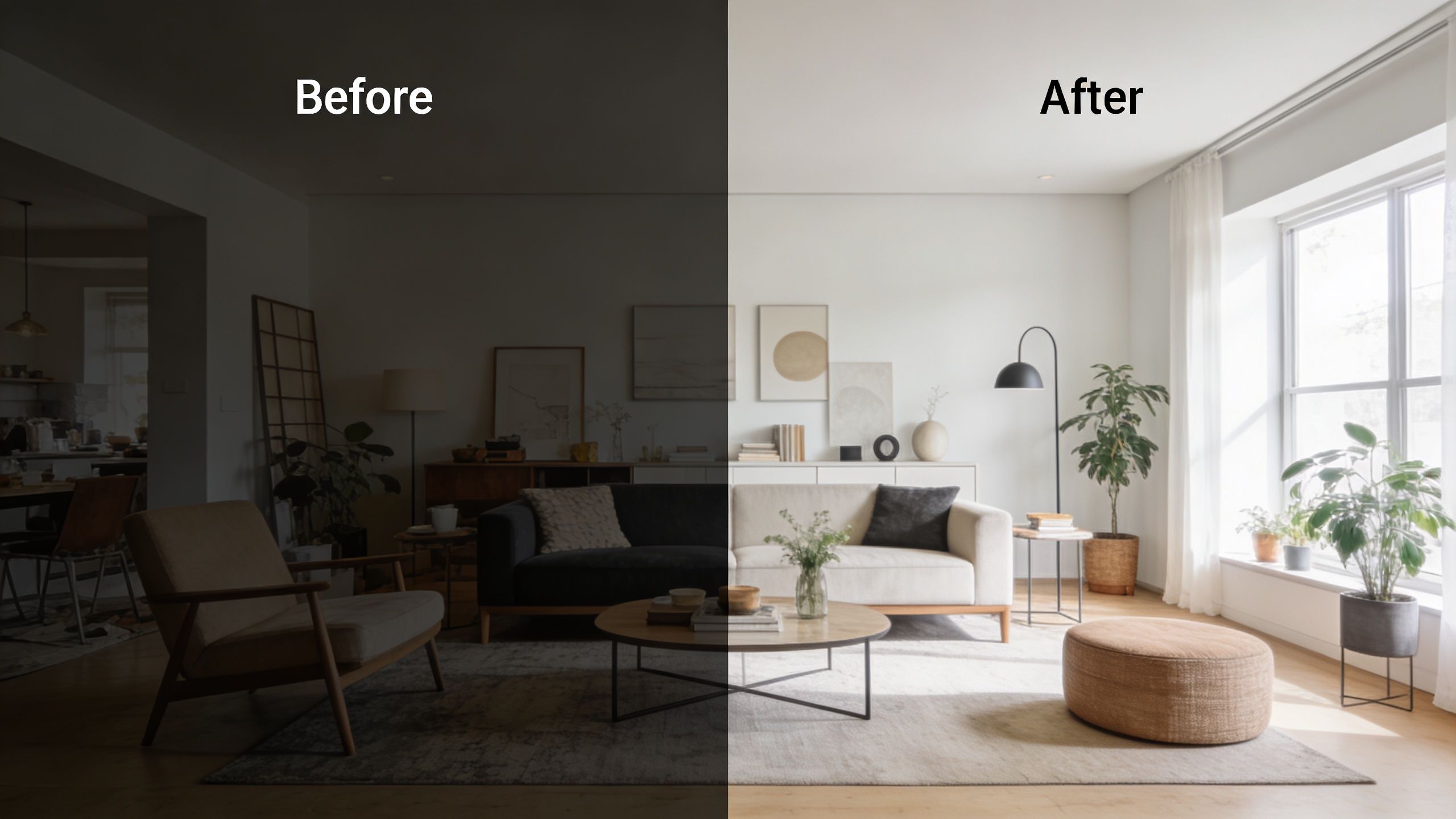
A before-and-after short film prompt works especially well for room makeovers, e-commerce demos, skincare-style narratives, workspace upgrades, and product-led UGC. Even when the “after” is aspirational, the story remains easy to read.
Keep the transformation legible
Most creators make the “before” too attractive. That weakens the payoff. You want contrast, but you also want continuity so the audience believes both states belong to the same story world.
Use Aicut's character swap and background replacement carefully. Keep the camera angle similar between states. Change lighting, texture, color, and posture more than lens logic. If you're polishing generated clips before posting, Aicut's guide on upscaling AI video for cleaner results is useful when the “after” needs a sharper finish.
A practical prompt pattern:
- State one: Cluttered, dim, friction-filled
- Transition cue: Gesture, snap, camera whip, door open, object drop
- State two: Brighter, cleaner, more confident, same core framing
Prompt template
Vertical short film prompt, split narrative of a small apartment desk setup, first scene messy cables, cold lighting, cramped frame, person frustrated while trying to work, fast cuts, then smooth transition with hand swipe across lens, second scene same angle transformed into clean modern workspace, warm daylight, organized accessories, calm posture, slight camera push-in, polished lifestyle ad feel.
Don't overload this format with claims you can't support. Let the visual do the selling. If the product or result is fictional, keep it clearly in concept territory instead of dressing it up as proof.
Later in the edit, a clip like this can help you study pacing and visual contrast:
What works best:
- A dramatic but believable contrast
- Matching composition across both states
- Minimal narration
What usually flops:
- Too many intermediate stages
- Tiny changes that don't read on mobile
- Heavy captions trying to force importance onto a weak visual difference
3. The Day in the Life Cinematic Journey
This is one of the most reusable short film prompt formats because it gives you mood, continuity, and easy serialization. One character. One routine. Several moments that imply a bigger world.
That's why it's strong for AI Influencer workflows, faceless creator channels, lifestyle brand storytelling, and fictional character vlogs. You're not asking the viewer to follow plot complexity. You're inviting them into a pattern.

Think in routines, not scenes
A weak “day in the life” prompt turns into random aesthetic shots. A strong one tracks emotional progression through repeated behavior. Morning rush. Work focus. Midday slump. Evening reset. That gives even a faceless short a quiet story arc.
The 2024 Short Film Dataset is useful context here because it assembled 1,078 publicly accessible amateur short films from YouTube, ranging from 5 to 37 minutes and averaging 13 minutes each, with 4,885 questions across the set. For creators, the important takeaway isn't the benchmark itself. It's the proof that short-form narrative can be broken into recurring promptable units. Daily routines are exactly that kind of repeatable unit.
Prompt template
Vertical cinematic day-in-the-life short film prompt, follow a faceless remote worker through one rainy weekday, close-up of kettle steaming, laptop booting, shoes in hallway, crowded train window reflection, midday coffee refill, late-night desk lamp, muted natural color palette, soft handheld movement, reflective pacing, quiet ambient sound feel, realistic lifestyle vlog style.
Use modular scene blocks so you can remix them across platforms. A morning sequence can become a standalone TikTok. The full routine can run as a Reel. A reordered cut can turn into a YouTube Short with a different voiceover.
Keep one anchor object in every version. A mug, backpack, watch, or notebook helps separate “cohesive journey” from “random montage.”
What works:
- Repeated motifs
- Consistent wardrobe or object continuity
- Voiceover used sparingly
What doesn't:
- Too many locations with no emotional thread
- Every shot trying to be beautiful
- No progression between beginning and end
4. The Cheating Fruits Comedy Reveal
Absurdity travels well on short-form platforms. That's the whole appeal here. You take a basic domestic setup, give fruit human motives, then let the dialogue do the damage.
This format works because the audience understands the joke almost immediately. The humor doesn't come from a complex premise. It comes from mismatch. A banana acts smug. A strawberry gets jealous. An avocado delivers lines like it's in a breakup drama.
Lean into character contrast
The best versions don't rely on random chaos. They give each object a simple role. One fruit is defensive. One is suspicious. One is obviously guilty from frame one.
That's why Aicut's Cheating Fruits video workflow is practical for creators who want a repeatable format. The template already fits a style of short-form humor that's easy to batch and easy to recognize in-feed.
Try these pairings:
- Confident vs anxious: Mango and blueberry
- Serious vs unserious: Apple and grape
- Naive vs manipulative: Orange and cherry
Prompt template
Vertical comedy short film prompt, kitchen counter scene with two animated fruits at eye level, one banana acting overly casual while a strawberry confronts him about texting another fruit, bright natural kitchen light, fast dialogue rhythm, reaction close-ups, slight handheld wobble, mock relationship-drama tone, final reveal that the “other fruit” is a smoothie blender waiting off frame.
This format is ideal for batch production. Swap fruit types, swap the accusation, keep the skeleton. That's how you build recurring characters without rebuilding the whole creative system every time.
What works:
- Distinct voices
- One clear accusation
- A reveal that escalates the absurdity
What doesn't:
- Long setup
- Too many characters talking at once
- Visuals that look polished but not funny
The biggest mistake is writing dialogue like a sitcom script. Mobile comedy lands better when each line is short, direct, and easy to perform through voiceover.
5. The Question Hook to Answer Educational Format
This format is less cinematic on paper, but it performs because it turns curiosity into structure. A strong opening question creates an information gap. The answer becomes the payoff.
The key is asking a question that feels specific enough to matter. “How do creators plan a month of shorts?” is better than “How do you grow online?” A short film prompt built around a broad question usually turns into mush.
Build the answer in beats
Use a visual sequence that moves the viewer from question to explanation without making the whole video feel like a slideshow. If your clip opens on a question card, follow it immediately with a visual example. Then deliver the answer in two or three chunks.
A strong prompt often looks like this:
- Hook line on screen
- Immediate supporting visual
- Answer part one
- Answer part two
- Closing takeaway or demonstration
Educational shorts don't need a lecture voice. They need a clean sequence of thought.
If you're making faceless videos, this format pairs well with Aicut voiceovers because the rhythm matters as much as the wording. Pause too long and the video dies. Explain too early and the viewer has no reason to stay.
Prompt template
Vertical educational short film prompt, open with bold on-screen question “Why do some creators look more consistent even with simple videos?”, close-up of editing timeline and repeated visual style elements, clean studio lighting, quick cuts, confident voiceover pacing, answer delivered through three visual examples, end with a concise takeaway, modern creator-education aesthetic.
What works:
- A real question people already ask
- Fast movement between beats
- Simple examples over abstract explanation
What doesn't:
- Trivia-style bait with a weak answer
- Dense caption blocks
- Generic stock visuals that don't match the question
For trust, keep unsupported claims out of the video itself. If context or references matter, place them in the description rather than cluttering the short.
6. The Emotional Story Arc Personal Narrative
This format doesn't need high spectacle. It needs emotional precision. One struggle. One turning point. One reason to care.
That's why personal narrative works even in AI-assisted workflows. If the feeling is clear, viewers forgive simple production. If the feeling is vague, no amount of cinematic styling saves it.

Use details that imply a life
Avoid generic “I started with nothing” storytelling. Give the person one concrete habit, one visible frustration, and one believable shift. A creator deleting drafts at midnight. A student rehearsing voiceovers and stopping every few seconds. A founder packing orders alone in a dim room.
If you need help generating a narrative skeleton before turning it into shots, Aicut's article on using a story generator for creative video ideas can help you move from vague emotion to a usable scene progression.
Prompt template
Vertical emotional short film prompt, follow a young creator alone in a small bedroom studio late at night, laptop glow, unfinished notes, multiple failed takes, quiet pauses between attempts, then morning light entering the same room as she records again with calm confidence, soft handheld camera, intimate close-ups, natural color, reflective voiceover, hopeful ending without melodrama.
For documentary-style emotional prompts, realism usually improves when you avoid glossy cinematic language and ask for observational cues instead. Guidance on AI film prompting notes that documentary realism often comes from available light, handheld presence, real-time pace, and ungraded color, and that Seedance 2.0 is presented as a better fit for documentary prompts in this genre-specific prompt guide.
Don't score every beat as tragedy. Quiet resilience usually lands better than forced intensity.
What works:
- One emotional shift
- Repeated location for continuity
- Voiceover that sounds spoken, not written
What doesn't:
- Overwritten monologues
- Instant “success” endings
- Hyper-stylized visuals that fight the story
7. The Trend Hijack Trending Audio Plus Fresh Angle
This is the speed format. You're not inventing from scratch. You're taking existing momentum and redirecting it through your own visual concept.
That means timing matters more than polish. If the trend is moving, ship the variation while the audio still feels live. A polished version posted late often loses to a rougher version posted early.
Pair the trend with a stable format
The easiest mistake is chasing the sound without a repeatable structure. A trending audio clip by itself isn't a short film prompt. It's just a layer. It needs a story container.
Good pairings include:
- Trend plus twist reveal
- Trend plus before-and-after
- Trend plus comparison verdict
- Trend plus absurd object dialogue
Aicut's cloning and posting flow can help operationally in this context. Pull the structure from a format that already fits your channel, then adapt the timing to the current sound. The trend gives you reach potential. The structure gives you consistency.
Prompt template
Vertical short film prompt built for trending audio, open with fast visual contradiction to the sound's expected meaning, close-up reaction, jump cuts, exaggerated prop reveal, text overlays timed to beat changes, social-first framing, punchline lands on the audio's most recognizable moment, creator-comedy style.
There's also a broader gap in the prompt advice most creators get. Camera-angle guides explain cinematic terms, but they rarely explain how to adapt those choices for vertical feeds, mobile-first pacing, or platform-specific framing. That gap is described well in this discussion of platform-specific camera angle guidance for AI creators.
What works:
- Immediate adaptation of a trend into your niche
- A familiar content format beneath the audio
- Posting while the trend is still rising
What doesn't:
- Recreating the exact same clip everyone already saw
- Using audio that clashes with your visual payoff
- Overediting and missing the cultural moment
8. The Comparison Debate Format This vs That
Comparison is native to short-form attention. Put two options in conflict and people instinctively pick a side before the clip ends.
That's why this format works for products, lifestyles, workflows, aesthetics, and creator tactics. Expensive vs budget. Morning routine vs night routine. Old method vs AI method. City life vs remote life. The comparison gives you built-in tension without needing a heavy narrative setup.
Make the verdict visual
Most comparison videos fail because the “winner” exists only in the voiceover. Show the difference in frame design, posture, energy, or environment. If the left side is rigid and dim, the right side should feel open and readable. If you're comparing two workflows, make one visibly smoother.
Prompt example:
Vertical comparison short film prompt, split-screen same character living two versions of the same workday, left side cluttered desk, constant interruptions, harsh overhead light, rushed gestures, right side clean desk, focused workflow, soft daylight, composed movement, punchy edits, final verdict delivered by voiceover with clear visual winner, creator productivity style.
The prompt variable problem is real here. Creators need to test angle, lighting, tone, and pacing quickly, but most resources stop at one polished example instead of giving an iteration system. That lack of practical A/B prompt guidance is highlighted in this write-up on short film prompting and testing gaps for creators.
A simple testing frame
- Change one variable: Hook, lighting style, verdict tone, or camera angle
- Keep one constant: Same comparison premise
- Review manually: Which version feels clearer on mute
What works:
- Strong visual contrast
- A verdict that feels earned
- Repeatable series logic
What doesn't:
- Fake neutrality when the edit clearly favors one side
- Too many scoring categories
- Comparing ideas that don't belong in the same frame
8 Short-Film Prompt Formats Compared
| Format | Implementation Complexity 🔄 | Resource Requirements ⚡ | Expected Outcomes 📊⭐ | Ideal Use Cases 💡 | Key Advantages ⭐ |
|---|---|---|---|---|---|
| The Plot Twist Reveal | High 🔄, precise timing and strong writing | Moderate ⚡, short shoot, tight edits, templatable | Very high engagement and shares; strong virality potential ⭐⭐⭐ | Viral UGC, faceless ads, scroll-stopping content | High rewatchability; natural algorithm hook |
| The "Before & After" Transformation | Moderate 🔄, needs consistent presentation | Moderate ⚡, product access, lighting, simple edits | High conversion and trust; excellent for sales ⭐⭐⭐ | E‑commerce demos, product launches, service proof | Clear value demonstration; easy to template |
| The "Day in the Life" Cinematic Journey | High 🔄, multi-scene continuity and visual direction | High ⚡, longer production, assets, editing time | Strong brand storytelling and positioning; moderate virality ⭐⭐ | Brand campaigns, AI Influencer, lifestyle showcases | Builds aspirational connection; showcases products in context |
| The "Cheating Fruits" Comedy Reveal | Low 🔄, template-driven but needs comedic writing | Low ⚡, minimal assets, fast batch production | High novelty engagement for niche audiences ⭐⭐ | Faceless comedy channels, brand personality building | Fast to produce; unique and memorable format |
| The "Question Hook to Answer" Educational Format | Low–Moderate 🔄, structure + accurate content | Low ⚡, text overlays, voiceover, simple graphics | Very high watch-through and trust; repeatable growth ⭐⭐⭐ | Educational channels, thought leadership, explainers | High retention; broadly applicable across niches |
| The "Emotional Story Arc" (Personal Narrative) | High 🔄, nuanced writing and believable performance | Moderate ⚡, consistent character, voiceover, pacing | Deep engagement and community building; long-term value ⭐⭐⭐ | Community building, brand loyalty, AI Influencer narratives | Strong emotional resonance; drives comments and loyalty |
| The "Trend Hijack" (Trending Audio + Fresh Angle) | High 🔄, rapid trend monitoring and quick turnaround | Low–Moderate ⚡, adaptable assets, scheduling tools | High viral probability if timely; short window for success ⭐⭐ | High-volume creators, rapid growth strategies | Immediate algorithm boost; fast iteration possible |
| The "Comparison/Debate" Format (This vs. That) | Moderate 🔄, research + balanced presentation | Low–Moderate ⚡, visuals, metrics, voiceover | High engagement and shareability; good monetization routes ⭐⭐ | Product reviews, educational entertainment, affiliate content | Templatable across topics; naturally engaging tension |
From Prompt to Published Your AI Content Engine
A short film prompt becomes useful when it's built for production, not just inspiration. That's the shift that matters most. Instead of asking, “What's a cool video idea?” ask, “What format can I repeat, vary, and publish quickly without losing clarity?”
That's why these eight prompt types matter. Each one gives you a structure that survives contact with real short-form workflows. The twist reveal gives you retention and shareability. The transformation format gives you immediate readability. The day-in-the-life journey gives you a repeatable lifestyle story. Comedy object prompts like Cheating Fruits give you batchable character content. Educational question hooks create completion pressure. Emotional narratives build connection. Trend hijacks add speed. Comparison formats create comments because viewers naturally want to disagree.
A significant advantage comes when you stop treating each video like a standalone project. Build one format until you understand its rhythm. Then clone it, swap the subject, change the tone, and test a new hook. A prompt library grows much faster when each new version inherits a proven structure instead of starting from zero.
If you're using AI video tools, think like a director and an operator at the same time. Director mindset means defining subject, action, camera behavior, and emotional payoff. Operator mindset means keeping your system practical. Minimal locations. Readable visuals. Consistent characters. Prompts that can be reused without a full rewrite.
That matters even more on short-form platforms because there's still a major gap between cinematic prompt advice and mobile-first execution. Most creators don't need prettier prompts. They need prompts that survive vertical framing, quick cuts, faceless workflows, and constant iteration. That's where process beats inspiration.
Aicut can fit into that process if you want a workflow built around faceless templates, prompt cloning, voiceovers, scheduling, and faster variation. It's one option for turning a raw short film prompt into a publishable asset stream instead of a one-off experiment. Pair that with a habit of saving your best-performing structures, and you start building an engine instead of chasing random ideas.
Pick one format from this list and stay with it long enough to learn what breaks. Maybe your reveals are too delayed. Maybe your before-and-after clips need stronger visual contrast. Maybe your educational hooks are too broad. Those are useful problems. They lead to better prompts.
Once your structure is working, you can branch into adjacent content. You can even expand beyond spoken shorts into hybrid creative formats that generate original songs and videos when music becomes part of the concept.
Blank pages aren't the primary obstacle. Lack of a repeatable format is. Fix that, and your short film prompt stops being an idea on a screen. It becomes a publishing system.
If you want to turn these short film prompt ideas into actual faceless videos faster, try Aicut. It's built for short-form creators who want reusable templates, prompt cloning, AI voiceovers, and a simpler path from concept to published TikTok, Reels, or Shorts content.