We've all been there—staring at a blank content calendar, the cursor blinking, with absolutely no idea what to post. It's a paralyzing feeling. A solid social media content strategy template is the tool that gets you out of that rut. It's what separates creators who post randomly from those who build a repeatable system for actual growth.
This isn't just about avoiding the "what do I post today?" panic. It's about moving from guessing what might work to knowing what to create next.
Why Most Social Media Strategies Fail

So many creators and brands fall into the same traps. They post here and there, the content is pretty generic, and the engagement is just… sad. They're stuck in a "post and pray" cycle, just hoping something goes viral by sheer luck. That's a surefire way to burn out, especially when the algorithms are constantly changing to reward consistency and real value.
The problem isn't usually a lack of effort; it's the lack of a documented system. When you don't have a clear plan, making content feels like a daily chore instead of a strategic move. This guide is all about giving you a practical, customizable template that actually works for real-world growth.
The Downfall of Random Acts of Content
When you post without a strategy, every single day is a blank slate. It’s a reactive way to work, and it leads to a few predictable problems that can completely kill your momentum.
- Inconsistent Messaging: Your audience has no idea what you're about. One day you're sharing memes, the next it’s a super serious tutorial. That lack of focus makes it impossible to build a memorable brand or attract a loyal community that knows what they're getting from you.
- Algorithm Penalties: Let’s be real, platforms like TikTok and Instagram reward consistency. If your posting schedule is all over the place, your content simply gets shown to fewer people. It's a vicious cycle of low reach that makes you feel like you're shouting into the void.
- Content Burnout: The brainpower it takes to come up with fresh ideas and create content every single day without a plan is just massive. It’s a fast track to creative exhaustion, which leads to lower-quality posts and, eventually, giving up altogether.
The goal of a content strategy isn't just to post more; it's to post with purpose. Every single piece of content should have a job, whether it's to educate, entertain, build trust, or drive an action.
This guide will walk you through building that repeatable system. Using a structured template turns content creation from a chaotic mess into a growth engine you can actually scale. We'll even dig into how smart tools like Aicut can help automate the heavy lifting, letting you consistently churn out high-quality videos—perfect for faceless channels and busy brands. It’s all about working smarter, not harder, to get results you can count on.
Defining Your Content Pillars and Audience
Before you even think about filling out a content calendar, you need to lay the groundwork. It all starts with your core content pillars—the 3 to 5 central themes you’ll return to again and again. Think of them like the main categories on a blog or the signature shows on a TV network. Your audience knows exactly what they're tuning in for.
Having this foundation is like having a strategic compass. It ensures every single post has a clear purpose, preventing your feed from becoming a random jumble of ideas that confuses followers. When your pillars are locked in, creating content gets so much easier because you’re never staring at a blank page wondering what to post.
Choosing Your Core Content Pillars
So, how do you pick them? Your content pillars should live at the sweet spot where your expertise meets your audience's curiosity. These are the topics you genuinely know and love, the ones you could talk about endlessly.
Let's imagine you're running a faceless finance channel. Your pillars might look something like this:
- Budgeting Hacks: Simple, actionable tips for saving money day-to-day.
- Investing Basics: Breaking down stocks, ETFs, and retirement accounts without the jargon.
- Side Hustle Ideas: Creative ways to generate extra income.
This structure lets you cycle through your core topics, keeping your feed fresh but always on-brand. Each pillar solves a specific problem for your audience, quickly establishing you as their go-to resource.
Your content pillars aren't just topics; they are promises to your audience about the value you'll consistently deliver. Get these right, and you'll attract followers who stick around for the long haul.
Creating a Detailed Audience Persona
Once your pillars are set, it’s time to get crystal clear on who you’re talking to. A good audience persona is way more than just basic demographics like age or location. Before you can nail down your pillars, you have to understand how to identify your target audience and what truly matters to them.
You need to dig deep. What are their biggest frustrations and pain points in your niche? What kind of content actually makes them stop their endless scroll? The real goal here is to tap into their emotional triggers and motivations.
Let’s flesh out that persona for our faceless finance channel:
- Name: Alex, the "Ambitious Beginner"
- Pain Points: Feels totally overwhelmed by confusing financial jargon. Alex is terrified of making a costly investment mistake and struggles to save anything on a tight budget.
- Goals: Desperately wants to build an emergency fund, start investing (even with a small amount), and find a side hustle that fits a packed schedule.
- Scrolling Stoppers: Quick, visually punchy videos that explain one concept simply (e.g., "What is a Roth IRA in 30 seconds?"). Alex will immediately scroll past dry, text-heavy posts.
See the difference? This level of detail changes everything. You’re no longer just making a generic video about "investing." You’re creating a video specifically for Alex that directly addresses the fear of getting started. This is how you drive real engagement and build a truly dedicated community.
Aligning Pillars with Audience and Platform Trends
The final piece of the puzzle is connecting your pillars and persona to what’s actually working on social media right now. Short-form video is king. In fact, 60% of marketers are using it—more than any other format out there. It also delivers the highest ROI alongside paid social, so for platforms like TikTok and Instagram, it’s non-negotiable.
So what kind of content performs best? Recent data shows that marketers are seeing the most success with funny content (66%), relatable content (63%), and trendy content (59%). This is where tools like Aicut can be a huge help, giving you viral-style templates to create engaging clips without needing a big production.
And while 94% of marketers are planning to use AI, remember that authenticity still wins. That human touch is what will make you stand out from all the noise. By combining a solid strategy with formats that are proven to perform, you’ll be set up for success. You can check out more of these insights and read the full research on current marketing statistics from HubSpot.
To help you get started, here are a few ideas for popular faceless niches. Use this table as a jumping-off point to brainstorm what your own pillars could be.
Content Pillar Examples For Faceless Niches
| Niche | Pillar 1 (Educational) | Pillar 2 (Inspirational/Aspirational) | Pillar 3 (Entertaining/Relatable) | Pillar 4 (Behind-the-Scenes/Process) |
|---|---|---|---|---|
| Finance/Investing | "How to start a Roth IRA" | "Aesthetic shots of a debt-free life" | "POV: Checking your bank account after payday" | "Screen recording of setting up an automated investment" |
| Cozy Gaming | "Top 5 cozy games for Nintendo Switch" | "Dream gaming setup inspo" | "Gaming memes only cozy gamers will get" | "Time-lapse of decorating a room in Animal Crossing" |
| Book Recommendations | "If you liked this book, read this next" | "Aesthetic bookshelf tours & reading nooks" | "Relatable struggles of a book lover" | "My process for annotating a fantasy novel" |
| Recipe/Cooking | "3-ingredient dinner recipe" | "Lush food shots of the final dish" | "Funny cooking fails and kitchen mishaps" | "ASMR of chopping vegetables and preparing a meal" |
Remember, these are just templates. The best content pillars will always be the ones that feel authentic to you and provide genuine value to the specific audience you want to reach.
The Complete Social Media Content Strategy Template
Alright, let's get into the good stuff. This is the complete, multi-part social media content strategy template you can snatch, tweak, and put into action right away. Think of this less as a single document and more as a complete system. Its job is to bring some much-needed order to your creative chaos and make sure every single post has a purpose.
This system is your new command center. It gets rid of the guesswork and turns that fuzzy strategy floating around in your head into a concrete, day-by-day plan.
Let's break down exactly what goes into it.
This whole process really starts with getting your foundation right. You need to know your niche and audience inside and out before you can even think about what to post.
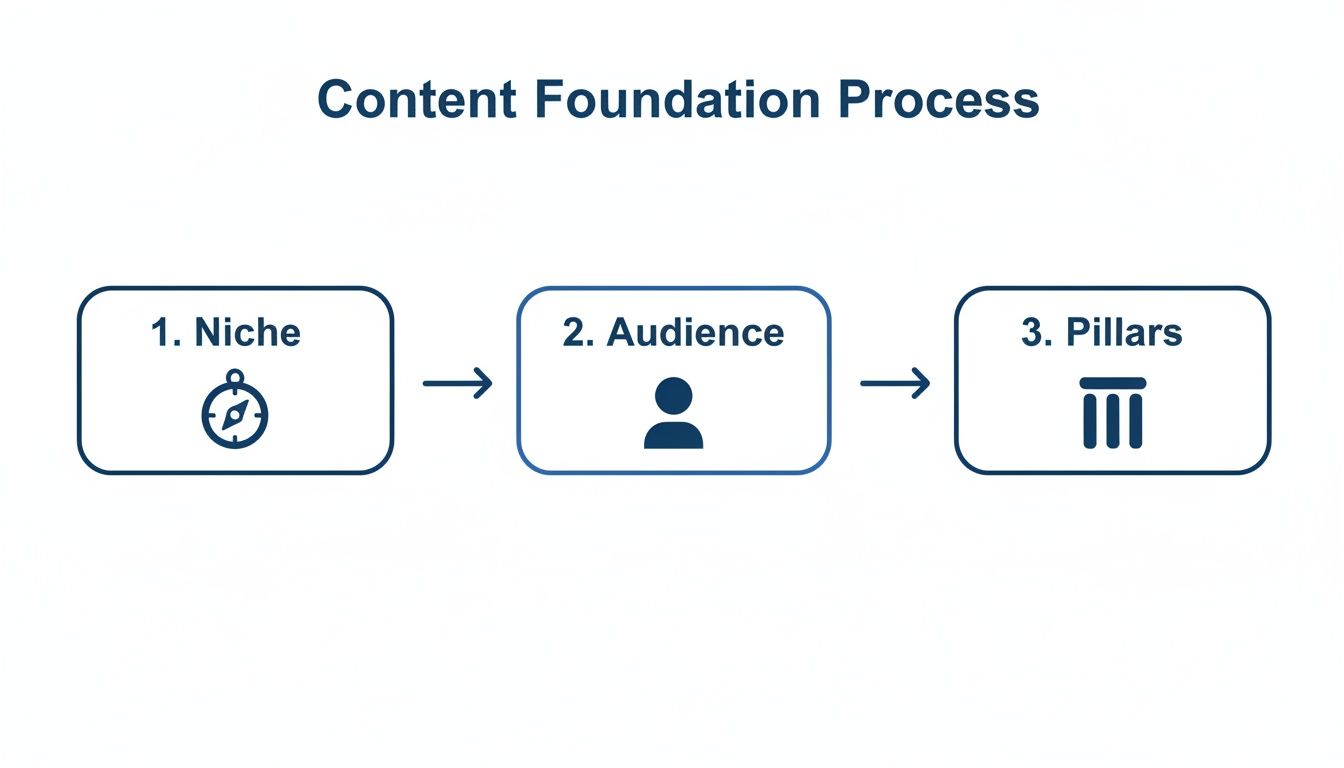
The image above really drives this home. A great template isn't just about scheduling—it's the final piece of the puzzle that comes after you've figured out who you are and who you're talking to.
Component 1: Your Content Calendar
First up is the content calendar. This is your schedule, pure and simple. It's where you map out what’s being posted, on what platform, and at what time. A solid calendar is your best defense against that last-minute "oh no, I have to post something!" panic. Plus, it keeps you consistent, which the algorithms absolutely love.
For each post on your calendar, you'll want to track a few key things:
- Post Date & Time: When it's scheduled to go live.
- Platform: Where it’s going (e.g., TikTok, Instagram Reels, YouTube Shorts).
- Content Pillar: Which of your main topics this post falls under.
- Content Format: Is it a video, a carousel, a single image, or maybe a Story?
- Status: A simple way to see what's done (e.g., Idea, In Progress, Ready to Post, Published).
Using a tool for this is a total game-changer. A simple Google Sheet works, or you can get fancier with something like Notion. For a deeper dive, we have a whole guide on how to create a content calendar that you'll actually stick with.
Component 2: The Content Matrix
The calendar tells you when, but the content matrix tells you what. This is where you really start brainstorming by mapping your content pillars against different formats. The whole point is to make sure your feed doesn't become a monotonous stream of the same old thing.
A simple matrix helps you add variety and cater to how different people like to consume content. Some followers will binge your quick videos, while others would rather swipe through a detailed carousel at their own pace.
Here’s how it might look for a faceless finance channel:
| Content Pillar | Short-Form Video (Reel/TikTok) | Carousel Post | Static Image/Quote |
|---|---|---|---|
| Budgeting Hacks | "3 grocery hacks that saved me $100" | "5-step guide to creating a zero-based budget" | "Quote: A budget is telling your money where to go" |
| Investing Basics | "What's an ETF? Explained in 30 seconds" | "Anatomy of a stock: What new investors need to know" | "Chart showing the power of compound interest" |
| Side Hustle Ideas | "POV: Starting a profitable side hustle from your couch" | "10 side hustles you can start with zero investment" | "Success story from a follower who started a side gig" |
Using this method ensures you get a healthy mix of formats for each of your core topics. It keeps things fresh for your audience and makes your content strategy way more resilient.
Component 3: Your Caption and Prompt Library
Let's be honest, creative burnout is a real threat. That's where a caption and prompt library becomes your secret weapon. This is basically a living document where you save all the good stuff—caption formulas that work, hooks that grab attention, and calls to action (CTAs) that actually get a response.
Every time you see a brilliant hook or a clever caption structure online, toss it into your library. Before you know it, you'll have an incredible resource that makes writing compelling copy feel almost effortless.
Pro Tip: Don't stop at captions. This library is the perfect spot for video ideas and prompts, too. Tools like Aicut are goldmines for this, with built-in templates and prompt libraries for specific niches that can give you a nearly endless supply of proven content ideas.
Get your library started with these categories:
- Hooks: "You're making this mistake with...", "Here's the unpopular truth about...", "3 signs you need to..."
- CTAs: "Save this for later," "Share this with someone who needs it," "Comment your biggest takeaway below."
- Caption Formulas: Problem-Agitate-Solve (PAS), Before-After-Bridge (BAB), Storytelling.
Component 4: The KPI Tracker
Your social media strategy is flying blind if you aren't measuring what's working. A Key Performance Indicator (KPI) tracker is where the magic happens. It can be a simple spreadsheet where you log how each post performs. This data-driven feedback is what separates a good strategy from a truly great one.
Set aside time each week or month to jot down these key metrics:
- Views/Reach: How many eyeballs saw your content.
- Engagement Rate: (Likes + Comments + Shares + Saves) / Followers.
- Saves: A huge clue that your content is valuable and helpful.
- Shares: Shows your content is relatable enough for people to pass it on.
- Website Clicks: Crucial if you're trying to drive traffic off-platform.
Looking at this data will reveal powerful patterns. You might find out your "Budgeting Hacks" carousels get double the saves of your videos, or that your "Investing Basics" TikToks are share-magnets. That’s pure gold. It tells you exactly what your audience craves so you can give them more of it.
Tracking performance is more critical than ever, especially with how much engagement can vary. For example, recent data shows TikTok leads the pack with a 3.70% engagement rate, which is a massive 49% jump from last year. This stat alone shows why any modern content strategy has to put short-form video front and center. Meanwhile, Instagram is at 0.48% and Facebook is down at 0.15%. It's a clear sign that a one-size-fits-all approach just doesn't work anymore. The data also suggests that posting around 5 times per week on TikTok and Instagram hits the sweet spot, as the algorithms favor that kind of consistency.
By weaving these four components together—the Calendar, Matrix, Library, and Tracker—you're not just posting content. You're building a powerful, self-improving system. This is the professional approach that helps creators thrive instead of just guessing.
Let AI Do the Heavy Lifting in Your Content Creation
Having a solid social media strategy is a great start, but the real test is keeping up with it. The daily grind of creating and posting can quickly lead to burnout, and that's where consistency breaks down. This is exactly where AI automation can step in and completely change your workflow. It takes your carefully planned content pillars and turns them into a reliable stream of posts without you having to manually build every single one.
Modern AI tools are built to handle the tedious parts of content creation. Forget spending hours editing one video. Now you can generate several ready-to-post clips in just a few minutes, giving you back the time to think about the bigger picture—your strategy.

Look at the interface above. Tools like Aicut bring everything into one place, letting you go from a simple idea to a finished, scheduled video without jumping between a dozen different apps. This kind of integration is what makes it possible to post at the frequency social media algorithms love.
From a Simple Prompt to a Published Post
The whole process is surprisingly straightforward: you give the AI a prompt, and it creates the content for you. With a tool like Aicut, you can browse a huge library of prompts that are already designed to fit different content pillars and have a history of performing well.
This completely bypasses that "blank screen" paralysis. You're not just throwing ideas at the wall; you're starting with a proven format that’s already resonating with audiences in your niche.
The real magic of AI here isn't just about speed. It's about consistently making content that looks and feels native to each platform. It helps you create videos that seem like they were always meant to be on someone's For You Page.
If you're looking to automate parts of your process, checking out the best content creation tools for social media is a smart move. Many of them use AI to offer features that can seriously simplify your workflow.
Smart Workflows for Faceless Creators
Let's get practical. Here are a few real-world examples of how you can use this, especially if you're running a faceless account. These are repeatable workflows you can set up in a tool like Aicut to fill your content calendar fast.
- Faceless Reddit Narrations: Find a compelling story on a subreddit that fits your niche. Use an AI voice to narrate the post, and let the AI generate interesting background footage or animations that match the story's vibe.
- Animated Text Stories for TikTok: This format is huge for storytelling right now. You just paste your script, and the AI creates a video that looks like a text message exchange, complete with typing effects and sounds.
- UGC-Style Product Ads: Selling products online? You can create authentic-looking "user-generated" videos without hiring a single person. Just use an AI avatar to read a product review script while showing footage of your product.
These aren't just ideas; they're massive time-savers. A single Reddit story can become a finished video in less than ten minutes. Manually, that same video could easily take a few hours of editing and clip sourcing.
Schedule Your Posts to Win with the Algorithm
Making the content is one thing, but posting it is another. To really see the benefits of automation, you need a system that can handle publishing for you. Algorithms on platforms like TikTok and Instagram reward creators who post consistently—often, that means daily.
This is why built-in schedulers are so important. After you generate a batch of videos in Aicut, you can schedule them to post automatically to all your connected accounts. You can literally create an entire week's worth of content in one afternoon and have it go live on its own. If you want a deeper dive, our guide on https://www.aicut.pro/blog/how-to-automate-social-media-posts breaks down exactly how to set this up.
This isn't just for convenience; it's a strategic move that helps you build and maintain the momentum you need to grow. And the industry is catching on—a huge 94% of marketers are planning to use AI in their content creation. Meanwhile, 63% of video marketers are already using AI tools for creating or editing. For the 66.5% of marketers who say lack of resources is their biggest challenge, AI automation is the clear solution to do more with less. By bringing these tools into your strategy, you’re putting yourself right at the front of this shift.
How to Measure and Optimize Your Strategy
Your social media strategy shouldn't be a "set it and forget it" document. Think of it as a dynamic roadmap. You've launched the content, which is a great start, but the real magic happens when you start paying attention to the data and adjusting your course.
This is where the KPI tracker in your template really shines. By consistently tracking your performance, you stop guessing what your audience wants and start knowing what they actually respond to. This feedback loop is the key to real, sustainable growth.
Identifying the Metrics That Truly Matter
It's easy to get caught up in vanity metrics like follower counts, but they often don't tell the whole story. The trick is to focus on the KPIs that directly connect to your goals for each specific platform.
For a faceless YouTube channel trying to get monetized, watch time and audience retention are everything. These are the numbers that tell YouTube's algorithm your videos are worth recommending, and they are critical for getting into the Partner Program.
On the other hand, if you're running a TikTok account aiming for viral reach, shares and saves are your goldmine. These actions are powerful signals to the algorithm that your content is valuable, which helps push it onto more "For You" pages.
Your KPI tracker is more than just a spreadsheet of numbers; it's a story about your audience. A sudden spike in saves on a post is a direct message from them saying, "Yes, please make more of this!"
Conducting a Monthly Content Audit
To make sense of the data, you need a simple, repeatable system. A monthly content audit is the perfect way to spot patterns without getting overwhelmed. All you need is your KPI tracker and about an hour.
Here’s a straightforward way to break it down each month:
- Spot Your Winners: Sort your posts by your main KPI (saves, shares, watch time, etc.). Pull out your top three performers. What content pillar did they fall under? What was the format? The hook?
- Analyze the Duds: Now, look at the bottom three. What do they have in common? Maybe the topic was off, the format didn't land, or the hook was weak.
- Check Pillar Health: Tally up the average engagement for each of your content pillars. You might find your "Budgeting Hacks" pillar is crushing it while "Side Hustle Ideas" is just okay. That's a clear sign of where to focus your energy next.
This simple audit gives you concrete insights to plan the upcoming month’s content. It’s how you refine your strategy with real data, making sure you’re creating more of what works and less of what doesn't. For a deeper dive, check out our guide on how to increase social media engagement for more tips.
Using AI to Test and Iterate Faster
Optimization is really just a series of tests. The good news is that AI tools can help you run these tests much, much faster. Instead of taking all day to create two versions of a video just to test a different hook, you can now do it in minutes.
With a tool like Aicut, you can quickly A/B test different creative ideas to see what your audience prefers. For instance, you could generate two versions of the same video—one starting with a question and the other with a bold, declarative statement. Post both and let the data decide the winner.
This lets you base your creative choices on performance, not just gut feelings. You can test visual styles, music, captions, or calls to action with very little extra effort. By building this kind of rapid testing into your monthly review, you'll speed up your growth and make your social media content strategy template an even more effective tool.
Got Questions? I’ve Got Answers.
Putting a new content strategy into play always sparks a few questions. It’s one thing to have a great plan on paper, but it’s another to make it work in the real world. Let’s tackle some of the most common hurdles you might run into.
How Often Should I Refresh My Content Strategy?
Think of your content template as a living, breathing document, not something you set in stone and forget. I've found that a quarterly review is the sweet spot.
This gives your strategy enough time to collect real performance data, but it’s frequent enough that you don't fall behind. You can react to algorithm changes, what your audience is responding to, and new trends. The idea isn't to scrap everything every three months, but to make smart adjustments—like leaning into a content pillar that’s taking off or shifting your posting schedule based on your analytics.
Can I Use This Template If I’m Not a Faceless Creator?
Of course! The core of a solid content strategy is the same for everyone, whether you’re on camera or not. Things like establishing clear content pillars, knowing your audience inside and out, and sticking to a posting schedule are non-negotiable for any creator serious about growth.
And even if you are the face of your brand, automation is still your best friend. Tools like Aicut can handle the grunt work. Imagine using it to generate slick B-roll for your videos, create animated explainers, or produce extra content to keep your calendar full. It frees you up to do what only you can do: connect with your audience.
No matter your style, the template provides the structure. How you fill it is what makes it unique. The system works for everyone; the content is what you customize.
What’s the Best Way to Find Trending Topics for My Pillars?
The secret is to listen. The best ideas are already out there, happening in the conversations your audience is having every day. When your content taps into what’s current, it instantly becomes more relevant and shareable.
Make a "listening tour" a regular part of your workflow:
- Go to the Source: Spend some time in TikTok's Creative Center. It’s a direct look at which sounds, effects, and hashtags are blowing up right now.
- Hang Out in Niche Communities: Dive into subreddits and Facebook groups where your ideal audience lives. You’ll find unfiltered questions and problems—pure gold for content ideas.
- Check AI Prompt Libraries: Don't overlook the prompt libraries in tools like Aicut. They are constantly updated with viral-style video ideas and trending formats that you can adapt for your niche.
This approach ensures you’re not just chasing trends blindly. You're strategically finding relevant topics that fit perfectly within your content pillars.
Ready to stop guessing and start growing? Aicut gives you the AI-powered tools to fill your content calendar with high-quality videos in a fraction of the time. Start creating with Aicut today and automate your path to social media success.